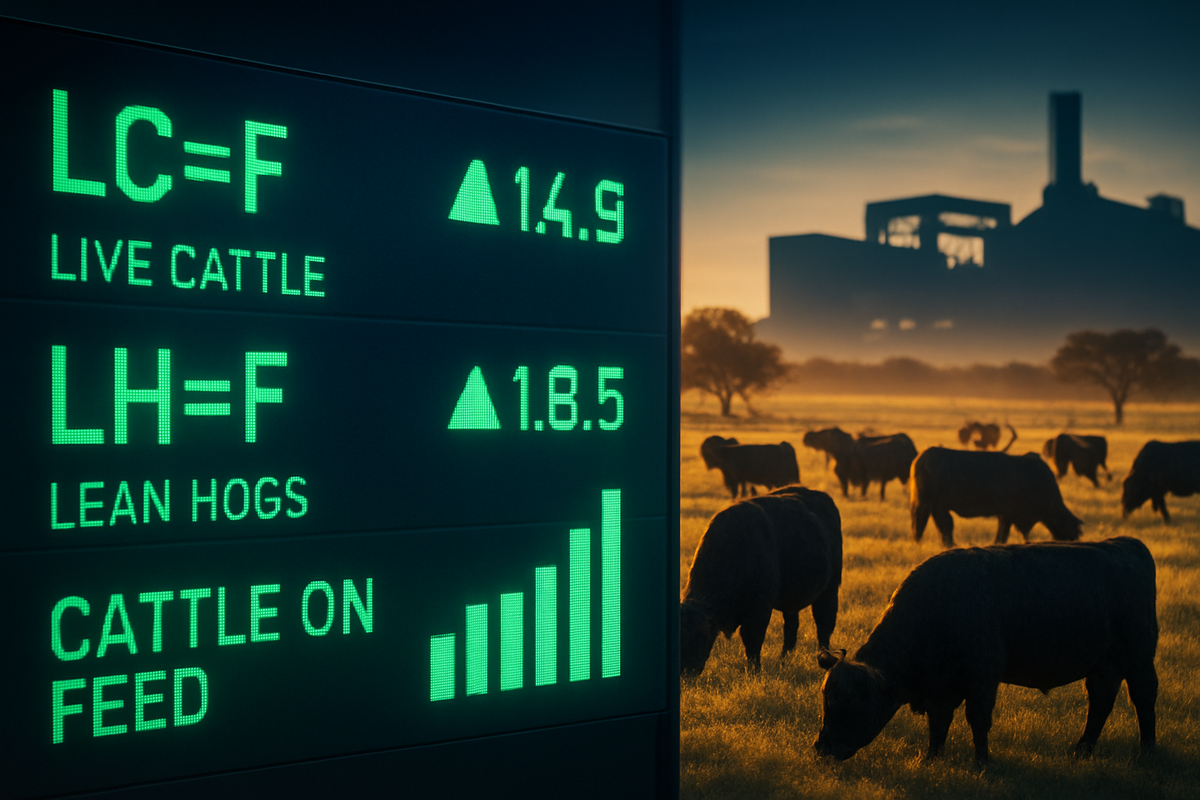
CHICAGO — The domestic livestock market entered a new phase of volatility and bullish sentiment this morning, February 23, 2026, as traders and meatpackers digested the implications of a tighter-than-expected "Cattle on Feed" report. Following the Friday release from the U.S. Department of Agriculture (USDA), Live Cattle futures are opening higher today, continuing a multi-month rally driven by a shrinking national herd and unexpected disruptions in international supply chains.
The latest data confirms that the structural contraction of the U.S. beef industry is accelerating, with placement numbers falling well below trade estimates. While the cattle sector celebrates record-high cash trades, the broader protein market is undergoing a massive price adjustment. Consumers are increasingly "trading down" to pork and poultry, creating a divergence in the fortunes of major meat processors who are now racing to balance high procurement costs against shifting retail demand.
Tight Supplies and the Mexican Standoff: Inside the USDA Numbers
The USDA’s February 2026 "Cattle on Feed" report, released late Friday, provided the fundamental spark for this morning’s market activity. According to the data, the total inventory of cattle on feed as of February 1 stood at 11.5 million head, a 2% decline compared to February 2025. More significantly, January placements—the number of new cattle entering feedlots—fell by 5% year-over-year to 1.74 million head. This figure was nearly 2% lower than the most optimistic trade estimates, signaling that the supply of market-ready beef will remain restricted throughout the second and third quarters of 2026.
The supply crunch has been exacerbated by a sudden geopolitical hurdle: the total closure of the U.S.-Mexico border to live cattle imports. Following a localized outbreak of New World screwworm in southern Mexico earlier this year, the USDA suspended all imports to protect the domestic herd. This move effectively removed hundreds of thousands of feeder cattle from the 2026 supply pipeline, pushing the CME Feeder Cattle Index to a staggering $377.37 per hundredweight.
In the cash market, the disconnect between physical supply and futures contracts has reached a boiling point. Northern dressed cattle were trading as high as $388 per hundredweight last week, while Southern live sales topped $250. These premiums are forcing a consolidation in the market, as smaller feedlot operations struggle with the financing costs of replacing their inventory at such elevated price points.
A Tale of Two Proteins: Winners and Losers in the Processing Sector
The current livestock environment is creating a polarized landscape for the "Big Four" meatpackers and diversified protein companies. Tyson Foods (NYSE: TSN) is perhaps the most visible example of this struggle. While Tyson’s poultry and prepared foods segments have flourished due to lower corn and soybean feed costs in early 2026, its beef segment is under immense pressure. The company is currently projecting operating losses between $250 million and $500 million for the 2026 fiscal year, driven almost entirely by the record-high costs of live cattle. In a strategic move to preserve margins, Tyson recently announced the closure of a major slaughter facility in Lexington, Nebraska, signaling a retreat from high-cost capacity.
Conversely, Hormel Foods (NYSE: HRL) has managed to find a defensive foothold. By divesting its lower-margin whole-bird turkey business (Jennie-O assets) in February 2026, Hormel has focused its capital on value-added, branded products that are less sensitive to raw commodity swings. The company’s stock saw a 4% jump this month as investors sought refuge in its consistent organic growth and 5% dividend yield.
JBS S.A. (NYSE: JBS) is taking a different path, pivoting toward global expansion to offset domestic U.S. headwinds. While JBS closed its Riverside, California, beef facility this month citing cattle supply shortages, it simultaneously announced a $150 million investment in Middle Eastern food processing. This diversification strategy has allowed JBS to maintain a 12% year-to-date stock gain, even as its U.S. beef margins thin. Meanwhile, Pilgrim’s Pride (NASDAQ: PPC) continues to dominate the "trade-down" market. Although the company missed earnings targets in early February due to high automation spending, its "Just Bare" chicken line has become a $1 billion brand, benefiting directly from consumers who find Choice beef cuts—now priced at $366.70 per hundredweight—prohibitively expensive.
The 10% Tariff Shadow and Broader Industry Trends
The rally in cattle prices is occurring against a backdrop of significant regulatory and trade uncertainty. A recent Supreme Court ruling regarding executive authority has paved the way for a proposed 10% across-the-board tariff on all imported goods, including meat and livestock equipment. Analysts warn that these tariffs could create a "trade quagmire," increasing the cost of imported processing machinery and further insulating the high domestic beef prices from international competition.
Historically, the livestock market has seen cycles of contraction, but the 2026 environment is unique due to the speed of the "protein pivot." In previous decades, a spike in beef prices would eventually be met with a surge in production. However, high interest rates and the rising cost of land and labor are preventing many ranchers from expanding their herds. This has led to a "perpetual bull market" for cattle, where supply cannot keep up with a population that—despite higher prices—has shown a surprising resilience in its appetite for premium protein.
Lean Hog markets are also feeling the ripple effects. April 2026 Lean Hog futures settled at $93.67, supported by the massive price gap between pork and beef. As the "price floor" for beef moves higher, pork has become the de facto staple meat for middle-income households, leading the USDA to forecast a 2% rise in hog slaughter for the remainder of the year to meet this shifting demand.
The Road Ahead: Automation and the Demand Wall
Looking toward the summer of 2026, the livestock market faces two primary scenarios. The first is a continuation of the "bull run," where tight supplies and limited imports push beef prices to levels that eventually trigger a "demand wall"—a point where consumers finally stop buying, forcing a rapid and painful market correction. The second scenario involves a managed transition, where processors like Tyson Foods (NYSE: TSN) and Pilgrim’s Pride (NASDAQ: PPC) successfully use automation to lower processing costs, offsetting the high price of the raw animals.
Short-term opportunities exist for investors in the poultry and pork sectors, which are currently enjoying a "sweet spot" of low feed costs and high demand. However, the cattle sector remains a high-risk, high-reward environment. The strategic pivot toward branded, fully cooked, and "case-ready" meats will likely be the defining survival tactic for the major players in the second half of 2026.
Market Wrap-Up and Investor Outlook
The February 2026 "Cattle on Feed" report has confirmed what many feared: the U.S. beef supply is in a period of deep, structural scarcity. With placements down 5% and a border closure with Mexico further tightening the market, the upward pressure on Live Cattle futures is unlikely to abate in the near term. This environment is rewarding companies like Hormel Foods (NYSE: HRL) that prioritize branded stability and penalizing those heavily exposed to unhedged beef procurement.
As we move into the spring grilling season, investors should keep a close eye on retail scanner data to see if the "demand wall" begins to form. Furthermore, the progression of the 10% tariff proposal could introduce a new layer of volatility into an already strained international trade landscape. For now, the "protein shift" remains the dominant theme of 2026, as the industry grapples with the reality of $250 cattle and the quest for more affordable alternatives.
This content is intended for informational purposes only and is not financial advice.