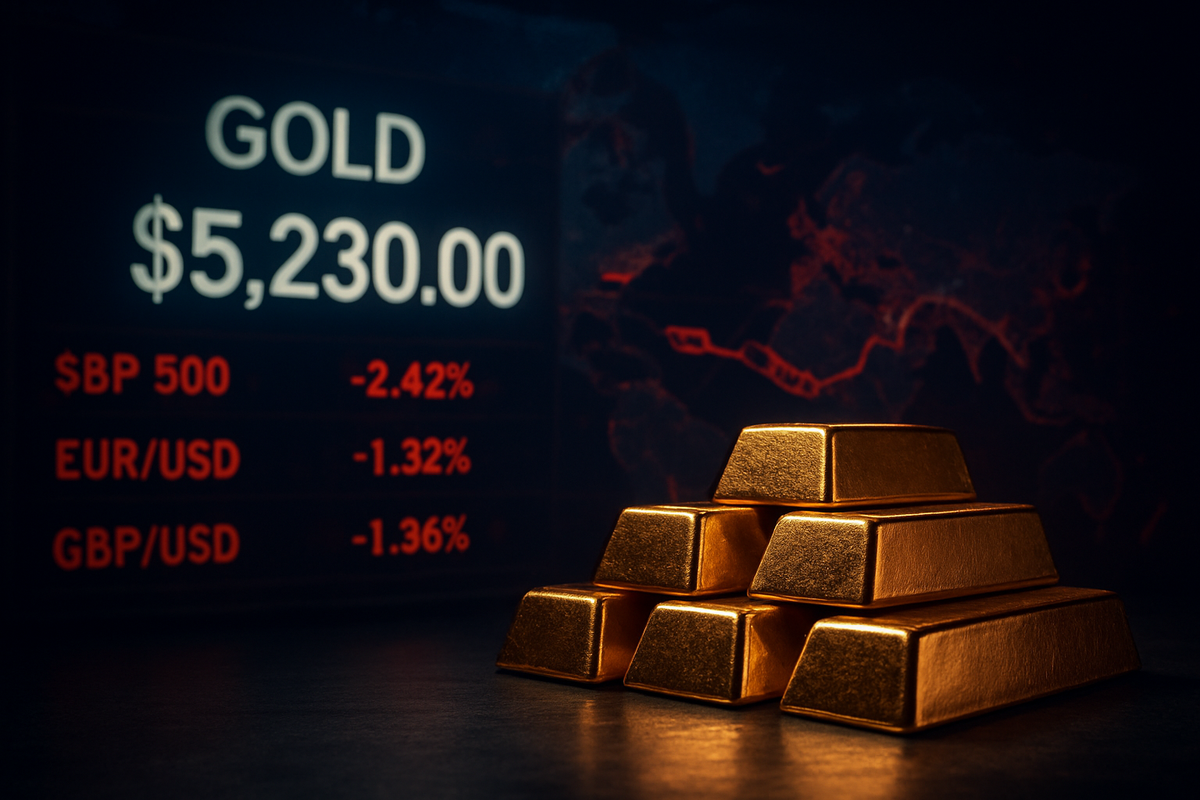
In a historic shift that has redefined the global financial landscape, gold prices surged past the psychological $5,000 barrier this weekend, touching a record high of $5,230 per ounce on February 23, 2026. This meteoric rise—representing a near-doubling of value since late 2024—comes as investors react with alarm to the sudden escalation of a global trade war, punctuated by the U.S. administration's imposition of a universal 15% flat-rate tariff on all imported goods. The move has triggered a violent "flight to safety," decoupling the traditional relationship between the U.S. Dollar and precious metals as market participants seek a hedge against what many are calling the most significant disruption to international commerce in nearly a century.
The immediate implications are stark: equity markets are reeling from the prospect of massive supply chain cost increases, while the currency markets are witnessing a "Sell America" rotation. Unlike previous cycles where tariffs often bolstered the domestic currency, the 2026 "Tariff Shock" has seen the U.S. Dollar Index (DXY) soften as traders price in long-term stagflationary risks and the potential erosion of the dollar’s status as the world’s primary reserve asset. For the average investor, gold has transformed from a speculative inflation hedge into an essential anchor of stability in an increasingly fractured global economy.
The 15% Tariff Shock: A Weekend That Reshaped Global Trade
The catalyst for this weekend’s price action was a series of executive orders signed by President Trump on February 21, 2026, invoking Section 122 of the Trade Act of 1974. This legal maneuver allowed for the immediate implementation of a 15% global tariff for an initial 150-day period, a move described by the administration as a "corrective measure" for persistent trade imbalances. The decision followed a period of intense legal maneuvering after the U.S. Supreme Court previously struck down narrower "reciprocal" tariffs, forcing the administration to pivot toward a more aggressive, universal approach.
The timeline leading to this moment has been one of mounting tension. Throughout 2025, trade relations between the U.S., the European Union, and China deteriorated as digital services taxes and automotive subsidies became flashpoints for "tit-for-tat" retaliations. By the time markets opened this Monday, February 23, the reality of a 15% levy on everything from French wine to Chinese semiconductors had fully sunk in. Initial market reactions were swift; the VIX (CBOE Volatility Index) spiked above 35, and the S&P 500 futures plummeted as much as 4% in pre-market trading before settling into a volatile intraday range.
Key stakeholders, including the World Gold Council and major central banks, have noted that this price surge is also being driven by "structural" rather than "cyclical" demand. While retail investors are piling into ETFs, central banks—particularly in the "Global South"—are reportedly accelerating their diversification away from U.S. Treasuries and into physical bullion. This institutional backing has provided a floor for gold prices, ensuring that the jump to $5,230 was supported by high-volume buying rather than a mere speculative "flash."
Winners and Losers: Miners Surge While Tech and Auto Face Margin Meltdown
The divide between the winners and losers of the 2026 Trade War is becoming increasingly apparent. On the winning side, gold mining majors have seen their valuations reach multi-year highs. Newmont Corporation (NYSE: NEM) and Barrick Gold (NYSE: GOLD) both saw their stock prices climb by over 8% in early trading, as their unhedged exposure to spot gold prices makes them primary beneficiaries of the rally. Other notable gainers include Agnico Eagle Mines (NYSE: AEM) and the royalty-specialist Franco-Nevada (NYSE: FNV), which investors favor for its lower operational risk profile in a high-cost environment.
Conversely, the technology and automotive sectors are bearing the brunt of the tariff burden. Apple Inc. (NASDAQ: AAPL) faces an estimated $3.3 billion in new annual duties, with its stock dropping 4.2% as analysts debate whether the company can pass these costs to consumers without dampening demand. Tesla (NASDAQ: TSLA) has also seen a significant pullback, as its reliance on imported lithium-ion battery components and Mexican-made parts leaves it vulnerable to the new 15% levy. Even the retail giant Walmart (NYSE: WMT), which recently became the first retailer to hit a $1 trillion market cap, issued a cautious outlook, warning that general merchandise inflation is tracking at levels not seen in decades.
Other sectors feeling the heat include software and cloud infrastructure. Companies like Microsoft (NASDAQ: MSFT) and Adobe (NASDAQ: ADBE) have seen their shares pressured by the rising cost of the hardware required to power their data centers. Furthermore, export-heavy manufacturers like Boeing (NYSE: BA) are now facing the looming threat of retaliatory tariffs from the European Union, which could put billions of dollars in 737 Max and 787 Dreamliner orders at risk.
The New "Nixon Shock": Why the 2026 Gold Rally Is Different
Financial historians are already drawing parallels between the current crisis and the 1971 "Nixon Shock," when the U.S. unilaterally suspended the gold standard and imposed a 10% import surcharge. Much like that era, the 2026 scenario represents a fundamental reordering of the global financial system. However, the current situation is arguably more complex due to the deep integration of modern supply chains. While the 1930 Smoot-Hawley Tariff Act exacerbated the Great Depression by stifling a manufacturing-heavy economy, today’s service-dominated world is struggling to adapt to the "tax on global growth" that a 15% flat rate represents.
The wider significance of this event lies in the "decoupling" of the U.S. Dollar from its safe-haven status. Typically, high tariffs and trade uncertainty lead to a stronger dollar; yet in 2026, the Euro (EUR) has actually gained ground, rising to the 1.16–1.18 range against the USD. This shift suggests that international investors are increasingly wary of U.S. policy unpredictability and are seeking alternatives. Even the Chinese Yuan (CNY) has shown surprising resilience, staying below the 7.00 threshold as Beijing strategically reduces import duties on high-tech components to secure its own supply chains, further challenging the dollar's dominance.
This trend is forcing a "consensus migration" among major financial institutions. J.P. Morgan (NYSE: JPM) and Goldman Sachs (NYSE: GS) have both revised their year-end gold targets upward, with J.P. Morgan now projecting $6,300 per ounce by the end of 2026. The prevailing sentiment is that gold is no longer just a "doomsday insurance" policy; it has become the premier "debasement hedge" against a backdrop of mounting sovereign debt and fiscal instability.
Looking Ahead: Stagflation Fears and the "Consensus Migration"
In the short term, market participants should prepare for continued volatility as the "tit-for-tat" retaliatory measures from America's trading partners come into focus. The European Union has already signaled its intent to levy digital taxes on U.S. tech firms, a move that could further depress valuations in the Nasdaq. For companies, the immediate strategic pivot will involve "near-shoring" or "friend-shoring" production to bypass tariff zones, though these transitions are costly and take years to implement.
Long-term, the specter of "stagflation"—the combination of stagnant economic growth and high inflation—is the primary concern. With the Services PMI (Purchasing Managers' Index) slipping below 50 in February 2026 for the first time in two years, the risk of a recession triggered by trade barriers is very real. If the trade war persists, we may see a "doom loop" scenario where declining growth leads to further protectionism, which in turn fuels higher gold prices as the only reliable store of value.
However, opportunities may emerge for companies that provide supply chain logistics and automation. As manufacturers look to move production back to domestic soil to avoid tariffs, those specializing in industrial robotics and domestic logistics could see a surge in demand. Investors will need to be nimble, moving away from high-multiple growth stocks and toward companies with strong pricing power and "hard asset" backing.
A New Era for Global Markets
The surge of gold to $5,230 on February 23, 2026, marks the end of the post-Cold War era of hyper-globalization. The key takeaway for investors is that the "old rules" of the market—where the dollar serves as the ultimate safe haven—are being rewritten. As the 15% global tariff takes hold, the focus has shifted from growth at all costs to capital preservation and the mitigation of geopolitical risk.
Moving forward, the market is likely to remain in a state of high tension until a clear resolution or a "new normal" in trade relations is established. For now, gold stands as the ultimate arbiter of value in a fractured world. Investors should watch closely for the next round of central bank gold purchase data and any signs of cooling in the rhetoric between Washington, Brussels, and Beijing. In this environment, the "chaos insurance" offered by precious metals is no longer an optional luxury, but a fundamental necessity for any balanced portfolio.
This content is intended for informational purposes only and is not financial advice.