NEW YORK — On February 23, 2026, the global commodities markets are witnessing a dramatic flight to safety. Gold and silver prices have surged to multi-week highs as investors grapple with a volatile cocktail of stalled diplomatic efforts in the Middle East and a cooling economy paired with unexpectedly hot inflation data. The convergence of these factors has fundamentally shifted the market narrative, forcing a "rebuilding of the geopolitical risk premium" that many analysts believe could support elevated prices for the remainder of the year.
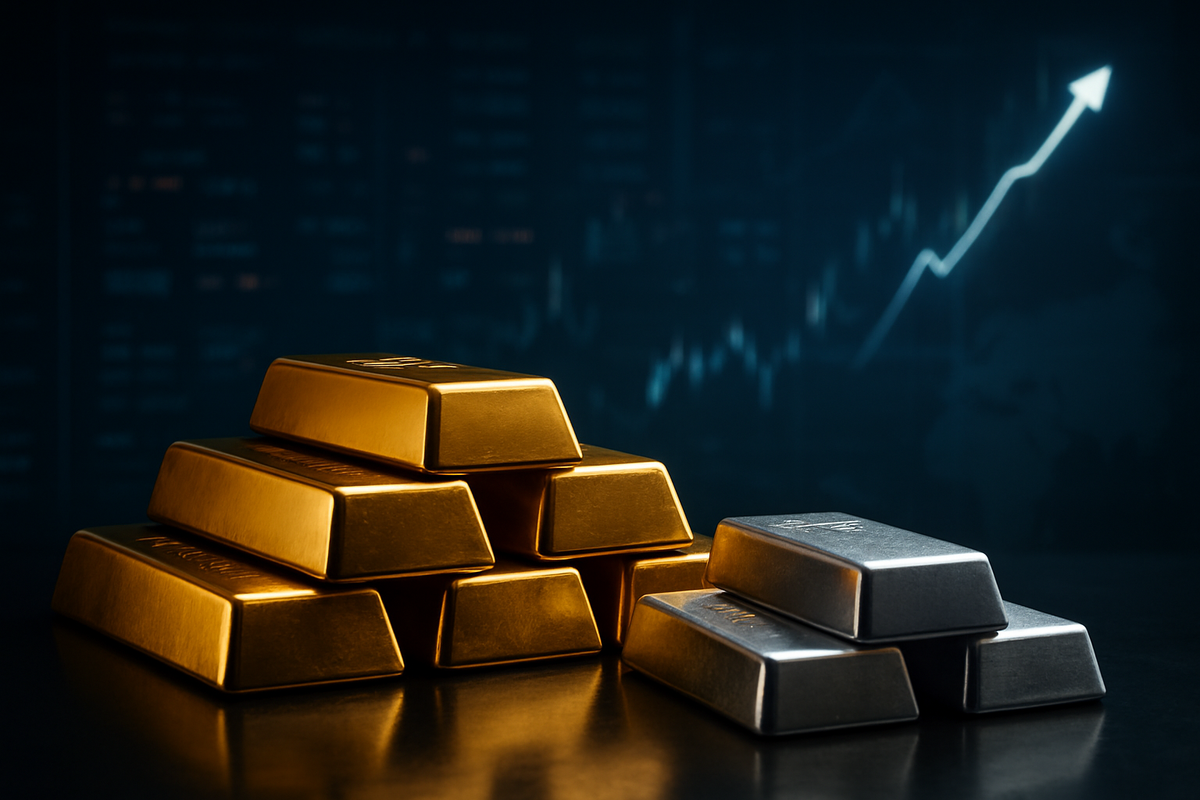
Spot gold (XAU/USD) climbed 1.1% in early Monday trading to reach $5,158.29 per ounce, firmly establishing a foothold above the psychological $5,000 threshold. Silver followed suit with even more aggressive momentum, jumping over 3% to trade near $86.61 per ounce. These moves come as market participants pivot away from riskier assets, seeking the traditional protection of hard assets against a backdrop of deteriorating international relations and persistent domestic price pressures.
The Perfect Storm: Stalled Diplomacy and Sticky Inflation
The immediate catalyst for today’s rally is the deteriorating state of U.S.-Iran relations. Despite a scheduled diplomatic summit in Geneva later this week, talks are widely characterized as "stalled" due to a significant U.S. military buildup in the Middle East and increasingly bellicose rhetoric from both Washington and Tehran. This tension has reintroduced a massive uncertainty premium into the bullion market, as the threat of regional escalation hangs over global energy and trade routes. Market participants are no longer pricing in a "diplomatic dividend," but are instead hedging against the possibility of a complete breakdown in communication.
Compounding the geopolitical anxiety is the latest macroeconomic data from the Department of Commerce. The Personal Consumption Expenditures (PCE) price index, the Federal Reserve's preferred inflation gauge, rose by 0.4% in the most recent monthly report—surpassing consensus expectations. This data confirms that inflation remains stubbornly persistent, even as broader GDP growth begins to show signs of a cyclical slowdown. This "stagflationary" environment—high inflation coupled with stagnant growth—historically favors precious metals, which act as a store of value when the purchasing power of fiat currency is eroded.
Adding a layer of complexity to the market is the "Trump Tariff" shock. Following a U.S. Supreme Court ruling that struck down previous emergency-power tariffs, the administration reacted by invoking Section 122 of the Trade Act of 1974 to impose a 15% global flat tariff, effective February 24. This move has reignited fears of a global trade war, further weakening the U.S. dollar's dominance and driving capital into the SPDR Gold Shares (NYSE Arca:GLD) and the iShares Silver Trust (NYSE Arca:SLV).
Mining Giants and Market Beneficiaries
The primary winners in this environment are the large-cap mining corporations, which are currently enjoying what analysts are calling an "era of super-margins." Newmont Corporation (NYSE: NEM), the world’s largest gold miner, has seen its stock price hover near $150, a staggering ascent from levels seen just two years ago. Newmont recently reported a record annual net income of over $7 billion, driven by the decoupling of operating costs from the soaring spot price of gold. Despite guiding for slightly lower production in 2026 due to increased capital expenditure, the company’s massive cash flow has allowed it to raise dividends and aggressively pay down debt.
Similarly, Barrick Gold (NYSE: GOLD) has reported gross profit margins approaching 70% at its Tier One assets. Barrick’s "dual-commodity" strategy, which emphasizes both gold and copper, has protected it from the volatility of single-metal markets while providing exposure to the green energy transition. By utilizing advanced automation and autonomous hauling at its flagship sites, Barrick has managed to keep its All-In Sustaining Costs (AISC) between $1,400 and $1,600 per ounce, ensuring that nearly $3,500 of every ounce of gold sold at current prices falls straight to the bottom line.
However, the sector is not without its risks. The ongoing operational dispute regarding the Nevada Gold Mines joint venture—a critical asset for both Newmont and Barrick—remains a point of contention for investors. Any disruption in production at this massive complex could dampen the earnings potential of these industry titans. On the losing side of this shift are high-growth technology and consumer discretionary stocks, which are being hammered by the dual pressures of rising input costs and the potential for a prolonged "higher-for-longer" interest rate environment.
A Fundamental Shift in the Risk Landscape
The significance of today’s market action lies in the "rebuilding of the geopolitical risk premium." For several years, markets had become somewhat desensitized to regional conflicts, treating them as localized events with minimal impact on global liquidity. The stalled Iran talks and the threat of new global tariffs have shattered that complacency. We are seeing a return to a 1970s-style investment philosophy where geopolitical stability is no longer taken for granted, and "hard money" is viewed as the only reliable hedge against policy error.
Furthermore, this event highlights the growing disconnect between traditional economic models and current market reality. Typically, a hot PCE print and the resulting rise in Treasury yields would put downward pressure on gold. Instead, the 0.4% rise in PCE has acted as a "floor" for prices, as investors focus more on the systemic risk of inflation than on the opportunity cost of holding non-yielding assets. This suggests a fundamental shift in central bank and institutional behavior, with gold transitioning from a speculative asset back to a core reserve currency.
Historically, periods of stagflation have led to multi-year bull runs in precious metals. The current situation mirrors the late 1970s, where an energy crisis and geopolitical instability in the Middle East collided with entrenched inflation. The modern difference, however, is the sheer scale of global debt, which limits the Federal Reserve's ability to combat inflation with aggressively high interest rates without risking a systemic financial collapse.
The Path Forward: Geneva and the Fed
The short-term trajectory of the market will depend heavily on the outcome of the Geneva talks this Thursday. If a diplomatic breakthrough is achieved, we could see a sharp "mean-reversion" trade as the geopolitical risk premium evaporates, potentially sending gold back toward the $4,800 level. Conversely, a total collapse of the talks or a military provocation would likely clear the path for gold to challenge $5,400 and silver to breach the $90 mark.
In the long term, the Federal Reserve faces an impossible choice. The 0.4% PCE print suggests that the central bank cannot pivot to rate cuts without risking a hyperinflationary spiral. However, the slowing GDP growth and the impact of the new 15% flat tariff on global trade threaten a deep recession. This "Catch-22" for policymakers is a fertile environment for precious metals, as it undermines confidence in the ability of central banks to manage a "soft landing."
Investors should also watch for strategic pivots within the mining industry. As prices remain high, expect to see an uptick in Mergers and Acquisitions (M&A) as mid-tier producers become attractive targets for giants like Newmont and Barrick seeking to replenish their reserves. Additionally, any sign of supply chain disruptions in silver—essential for both high-end electronics and the burgeoning solar industry—could lead to a "squeeze" scenario that pushes silver to outperform gold on a percentage basis.
Conclusion: A New Macro Reality
The events of February 23, 2026, serve as a stark reminder that the era of low inflation and geopolitical stability has effectively ended. The surge in gold and silver is not merely a technical breakout but a reflection of a world where risk is being repriced in real-time. The combination of stalled Iranian diplomacy and persistent stagflationary data has created a robust foundation for a sustained rally in safe-haven assets.
As the market moves forward, the "rebuilding of the risk premium" will likely remain the dominant theme. Investors should maintain a close eye on the Thursday diplomatic session and the subsequent implementation of the U.S. flat tariffs. While volatility will undoubtedly remain high, the underlying fundamentals—characterized by sticky inflation and geopolitical fragmentation—suggest that the bull market for precious metals is still in its middle innings.
For the months ahead, the key metric will be the Federal Reserve's response to the PCE data. If the Fed remains paralyzed by the fear of a recession, the "inflation hedge" narrative will continue to drive institutional capital into the gold and silver markets, solidifying their status as the ultimate assets of last resort in an increasingly uncertain world.
This content is intended for informational purposes only and is not financial advice.