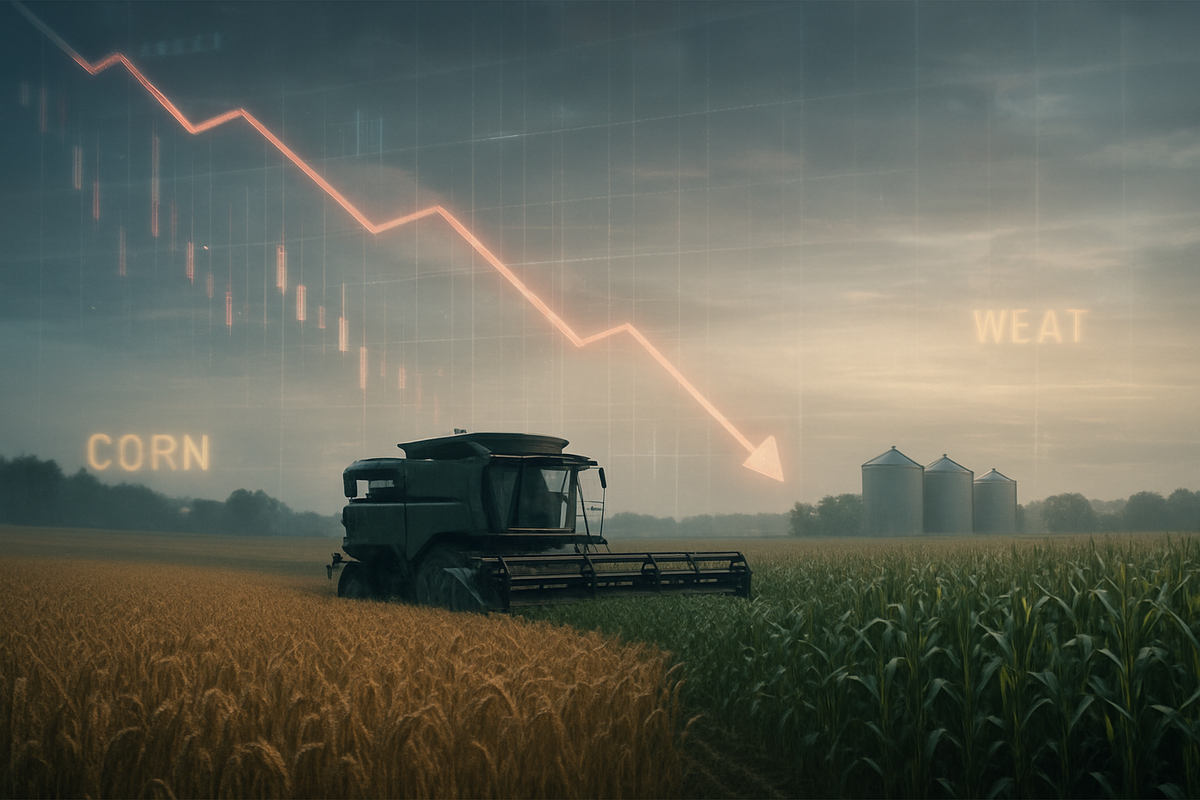
The global grain markets are facing a sobering start to February 2026, as a relentless wave of supply from the Americas continues to crush commodity prices and dampen the outlook for the agricultural sector. On Monday, February 2, 2026, grain futures extended their recent slide: Wheat led the retreat with a 1.16% drop, while Soybeans and Corn followed suit, falling 0.73% and 0.70%, respectively. This downward trajectory reflects a fundamental shift in the market from the scarcity-driven spikes of the early 2020s to a persistent surplus that is testing the resilience of even the most established farming operations.
For U.S. producers, the immediate implications are stark. The combination of record-breaking yields and a strengthening U.S. dollar—fueled by a hawkish Federal Reserve transition—has created a "perfect storm" that makes domestic exports less competitive on the global stage. As prices hover near multi-year lows, the psychological and financial toll on the American heartland is mounting. With balance sheets for the 2026 planting season appearing increasingly precarious, many farmers are now facing the grim reality of operating below breakeven costs for the first time in years.
The Anatomy of a Slump: Record Yields and Market Saturation
The current downturn is not an overnight phenomenon but the culmination of a year-long trend characterized by "monster crops" in both the Northern and Southern Hemispheres. The downward pressure intensified following the January 2026 World Agricultural Supply and Demand Estimates (WASDE) report, which caught traders off guard. The USDA revised U.S. corn production upward to a staggering 17.02 billion bushels, with average yields reaching a record 186.5 bushels per acre. This surplus was compounded by an equally aggressive output from South America, where Brazil is currently on track to harvest between 176 and 184 million metric tons of soybeans.
As of early February, the market is also grappling with a geopolitical landscape that has fundamentally altered trade routes. The re-imposition of universal tariffs under the current Trump administration has prompted China—the world’s largest grain importer—to pivot even more aggressively toward Brazilian and Russian supplies. This shift has left U.S. silos bulging with unsold inventory. Furthermore, the strengthening of the U.S. dollar has acted as a persistent headwind, making U.S.-grown wheat and corn significantly more expensive for international buyers compared to the devalued currencies of major competitors in the Black Sea region.
The timeline leading to this moment was marked by a series of false rallies in late 2025. Brief periods of "short covering" occurred in December as cold snaps threatened winter wheat in the U.S. Plains, but these were quickly eclipsed by the realization that global ending stocks were more than sufficient to absorb minor localized shocks. By the time the February 2026 trading sessions opened, the sentiment had shifted from cautious optimism to a definitive bearish stance, as institutional investors accelerated their exits from agricultural long positions.
Corporate Tensions in a Low-Price Environment
The impact of this grain glut is felt unevenly across the corporate landscape, creating a clear divide between those who profit from cheap inputs and those who rely on high-volume machinery sales. For livestock giants like Tyson Foods (NYSE: TSN), the decline in grain prices is a significant tailwind. In its February 2 earnings report, Tyson noted that its chicken segment has seen a major margin expansion as feed costs—primarily corn and soymeal—plummeted. While the company still faces challenges in its beef segment due to high cattle procurement costs, the abundance of cheap grain provides a much-needed buffer for its poultry and pork operations.
Conversely, the "losers" in this environment are prominent. John Deere (NYSE: DE) recently revised its 2026 net income guidance downward, citing a significant contraction in demand for large agricultural equipment. Management described 2026 as the "bottom of the cycle," as struggling farmers defer capital expenditures on tractors and combines to preserve liquidity. Similarly, the world’s leading fertilizer producer, Nutrien Ltd. (NYSE: NTR), is feeling the pinch as lower crop prices discourage farmers from investing in high-end nutrients, leading to a "wait-and-see" approach for spring applications.
The investment vehicles tracking these commodities are also bearing the brunt of the bearish trend. The Teucrium Corn Fund (NYSE Arca: CORN) has faced a 12.5% decline over the past year, currently trading near its 52-week low of $17.40 as the market digests the record-breaking U.S. harvest. The Teucrium Wheat Fund (NYSE Arca: WEAT) has shown slightly more resilience due to geopolitical volatility in Europe, but still struggles to maintain any upward momentum against a backdrop of massive Russian exports. Meanwhile, global logistics players like Bunge Global SA (NYSE: BG) have managed to outperform the sector, reaching a 52-week high of $106.05 by leveraging their diverse global footprint to capture margins regardless of whether the grain originates in Iowa or Mato Grosso.
Structural Shifts and the "New Normal" for Global Trade
This event marks a significant chapter in the broader commodity super-cycle. The transition from the supply-chain disruptions and "scarcity mindset" of 2022-2024 to the current state of oversupply suggests that global agriculture has successfully adapted to post-pandemic realities, albeit at the cost of producer profitability. This "new normal" is characterized by a high-efficiency production model where technological advancements in seed genetics and precision farming have pushed yields to levels that demand can no longer easily absorb.
The policy implications are also becoming more apparent. The aggressive tariff stance of the current administration has created a "Fortress America" effect for grain, where domestic stocks are high but international access is restricted. This has forced major trading houses like ADM (NYSE: ADM) to pivot their strategies. ADM has recently announced a $750 million cost-cutting initiative and is shifting its focus toward the growing biofuels market, specifically Sustainable Aviation Fuel (SAF). The hope among industry analysts is that SAF and renewable diesel will eventually create a new floor for corn and soybean demand, decoupling grain prices from traditional food and feed markets.
Historically, this period draws comparisons to the late 1980s and the mid-2010s, where periods of high net farm income were followed by "corrections" that flushed out less efficient operators. However, the 2026 slump is unique because it occurs during a period of relatively high interest rates compared to the previous decade. This means that while grain prices are falling, the cost of financing the debt on land and equipment remains elevated, placing a double-bind on the American farmer that was not as prevalent in previous cycles.
The Road Ahead: Potential Pivots and Scenarios
As we look toward the remainder of 2026 and into 2027, several scenarios could alter the current bearish trajectory. In the short term, the market remains hyper-focused on the final stages of the South American harvest. Any unexpected weather disruptions—such as a late-season La Niña event—could provide a "weather premium" and allow prices to recover some lost ground. However, barring a major climate catastrophe, the path of least resistance for grain futures appear to be lower or sideways.
Strategic adaptations will be required for survival. We expect to see a surge in consolidation within the farming sector, as smaller family-owned operations are absorbed by larger entities with better economies of scale. From a market perspective, the "SAF revolution" remains the primary long-term hope for corn and soybean bulls. If government incentives for green energy continue to align with agricultural production, the surplus grain currently weighing on the market could be redirected into jet fuel tanks by the end of the decade, creating a structural shift in demand that could end the current cycle of oversupply.
Wrap-Up and Investor Outlook
The current slide in wheat, corn, and soybean futures is more than just a seasonal dip; it is a reflection of a global agricultural system that has overproduced into a cooling economy. For investors, the key takeaways are the diverging fortunes within the sector: look for strength in food processors and livestock producers who benefit from lower input costs, while remaining cautious on equipment manufacturers and input providers until the "cycle bottom" is clearly established.
Moving forward, the market will be watching the March 2026 planting intentions report with intense scrutiny. This will be the first definitive signal of whether U.S. farmers will proactively reduce acreage in response to current prices. For now, the sentiment remains heavy, and the "Harvest of Plenty" continues to be a mixed blessing—providing food security for the globe while creating a period of deep financial austerity for the producers who provide it.
This content is intended for informational purposes only and is not financial advice.