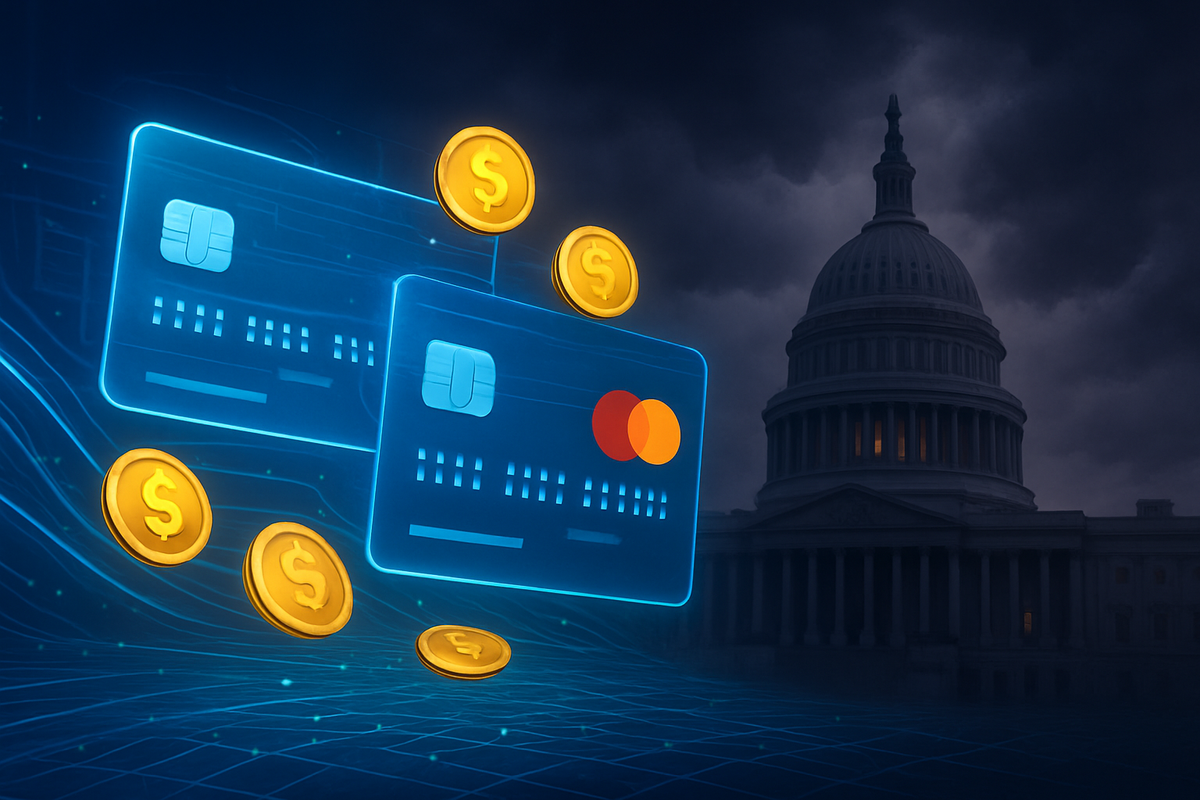
NEW YORK — In a tale of two realities, the world’s leading payment giants, Visa Inc. (NYSE: V) and Mastercard Inc. (NYSE: MA), reported robust earnings for the final quarter of 2025, revealing a U.S. consumer that remains resilient despite mounting economic and political headwinds. However, the financial triumph of these transaction titans is being overshadowed by a "perfect storm" in Washington D.C., where a rare bipartisan coalition and an emboldened administration are taking aim at the very fees that have long fueled the industry’s record profits.
As of February 2, 2026, the contrast between the companies' balance sheets and their stock market performance has never been more stark. While both firms managed to beat Wall Street expectations in their late January reports, their share prices have been battered by the looming threat of the Credit Card Competition Act and a proposed 10% cap on interest rates. This divergence highlights a pivotal moment for the transaction processing industry: a transition from a post-pandemic growth era to a defensive stance against a populist regulatory wave that seeks to dismantle the "swipe fee" status quo.
Resilience Amidst the Regulatory Crosshairs
The earnings reports released on January 29, 2026, painted a picture of sustained dominance. Visa (NYSE: V) reported a net revenue of $10.9 billion for its fiscal first quarter, a 15% increase year-over-year, while Mastercard (NYSE: MA) posted $8.81 billion in revenue, up 18%. Both companies saw a healthy surge in processed transactions—69.4 billion for Visa and 46.5 billion for Mastercard—driven by a surprisingly strong 2025 holiday season that saw consumer spending rise by 4.1%. Management from both firms characterized the U.S. consumer as "healthy," though they acknowledged a widening "K-shaped" divide where high-income earners continue to splurge on luxury travel while lower-income bands are increasingly sensitive to price hikes linked to recent "tariff pass-through effects."
The timeline leading to this earnings season was marked by significant political turbulence. On January 13, 2026, the regulatory climate shifted dramatically when President Trump officially endorsed the Credit Card Competition Act (CCCA), labeling the current interchange fee structure an "out-of-control ripoff." This endorsement galvanized a legislative push led by a bipartisan group of senators including Dick Durbin (D-IL) and Roger Marshall (R-KS). Following the earnings beat, rather than a celebration, the market saw Visa shares drop 3.00% to $321.83 on January 30, as investors focused on management's cautious guidance regarding "Washington noise" and the potential for moderating growth in the face of new legislation.
Winners and Losers in a Shifting Payments Landscape
The primary "losers" in the current environment appear to be the payment networks themselves, specifically the Visa and Mastercard duopoly. If the CCCA passes, it would require banks with over $100 billion in assets to offer at least two routing networks for credit transactions, effectively forcing the giants to compete on price with smaller networks like Discover or private label options. For Mastercard, the blow was partially softened by the successful renewal of its partnership with Capital One Financial Corp. (NYSE: COF), which mitigated fears that the latter’s acquisition of Discover Financial Services (NYSE: DFS) would lead to an immediate exodus of cardholders from the Mastercard network.
On the winning side of this regulatory battle are major retailers and merchant groups. The Merchants Payments Coalition (MPC) and the National Association of Convenience Stores (NACS) have been the primary beneficiaries of the political shift, as lower swipe fees would directly improve the razor-thin margins of grocery stores and gas stations. Furthermore, smaller fintech challengers and alternative payment methods could see increased adoption if routing mandates become law. However, analysts warn that "middle-class winners" might be hard to find; the Bank Policy Institute (BPI) and the American Bankers Association (ABA) have argued that a forced reduction in fees will inevitably lead to the gutting of popular credit card reward programs, a staple of the American middle-class financial experience.
The Populist Pivot and Historical Precedents
The current scrutiny of the transaction processing industry fits into a broader global trend of "financial populism." The proposal for a 10% interest rate cap, championed by an unlikely alliance of lawmakers like Bernie Sanders (I-VT) and Josh Hawley (R-MO), echoes historical movements to limit usury during times of high consumer debt. For Visa and Mastercard, who do not lend money directly but rely on the health of the banks that do, these caps represent a systemic risk. If issuers like JPMorgan Chase & Co. (NYSE: JPM) or Citigroup Inc. (NYSE: C) are forced to slash APRs, they may tighten credit availability, leading to a contraction in the total volume of transactions processed—the lifeblood of the network giants.
Historically, the industry has weathered similar storms, such as the 2010 Durbin Amendment which capped debit card swipe fees. While that regulation did lower costs for some merchants, it also led to the disappearance of free checking accounts at many banks. Today’s situation is more complex because it targets credit—a much larger and more profitable segment of the market. The ripple effects are already being felt; some banks have begun experimenting with "low-interest, low-reward" cards, dubbed "Trump Cards" in some circles, to align with the political climate before mandates are even signed into law.
Strategic Pivots and the Road Ahead
Looking forward, both Visa and Mastercard are rapidly pivoting toward "Value-Added Services" (VAS) to insulate themselves from fee regulation. In their latest reports, Visa’s VAS revenue—which includes cybersecurity, fraud prevention, and data analytics—surged 28% to $3.2 billion. Mastercard followed suit with a 26% increase in its similar segments. This strategic shift suggests that the companies are preparing for a future where they are no longer just "toll booths" for money, but essential software and security layers for global commerce. In the short term, the market will likely remain volatile as the CCCA moves through committee hearings in the spring of 2026.
Potential scenarios range from a "soft landing" where a watered-down version of the bill passes, to a more drastic restructuring of the payments industry. If the 10% rate cap becomes a reality, we may see a massive consolidation in the banking sector as smaller players, unable to sustain the costs of credit with lower returns, are swallowed by larger entities. Conversely, this could open a massive market opportunity for non-bank lenders and "Buy Now, Pay Later" (BNPL) providers like Affirm Holdings Inc. (NASDAQ: AFRM), who may find ways to navigate the new rules more nimbly than traditional institutions.
Final Assessment: A High-Stakes Balancing Act
The latest earnings from Visa and Mastercard confirm that the business of moving money remains incredibly lucrative and that the U.S. consumer is surprisingly durable. However, the fundamental stability of the transaction processing industry is facing its most significant challenge in decades. The "moat" that has protected these companies—a lack of network competition and a steady stream of interchange revenue—is being breached by a bipartisan political movement that prioritizes "merchant relief" and "consumer affordability" over corporate margins.
For investors, the coming months will require a careful watch on Washington rather than just Wall Street. The primary indicator of health will not just be transaction volume, but the progress of the Credit Card Competition Act and any executive actions regarding interest rate caps. While the long-term outlook for Visa and Mastercard remains strong due to their expansion into data and security services, the era of effortless duopoly growth may be drawing to a close. The market is now pricing in a world where "swipe fees" are no longer a guaranteed windfall, but a contested commodity.
This content is intended for informational purposes only and is not financial advice.