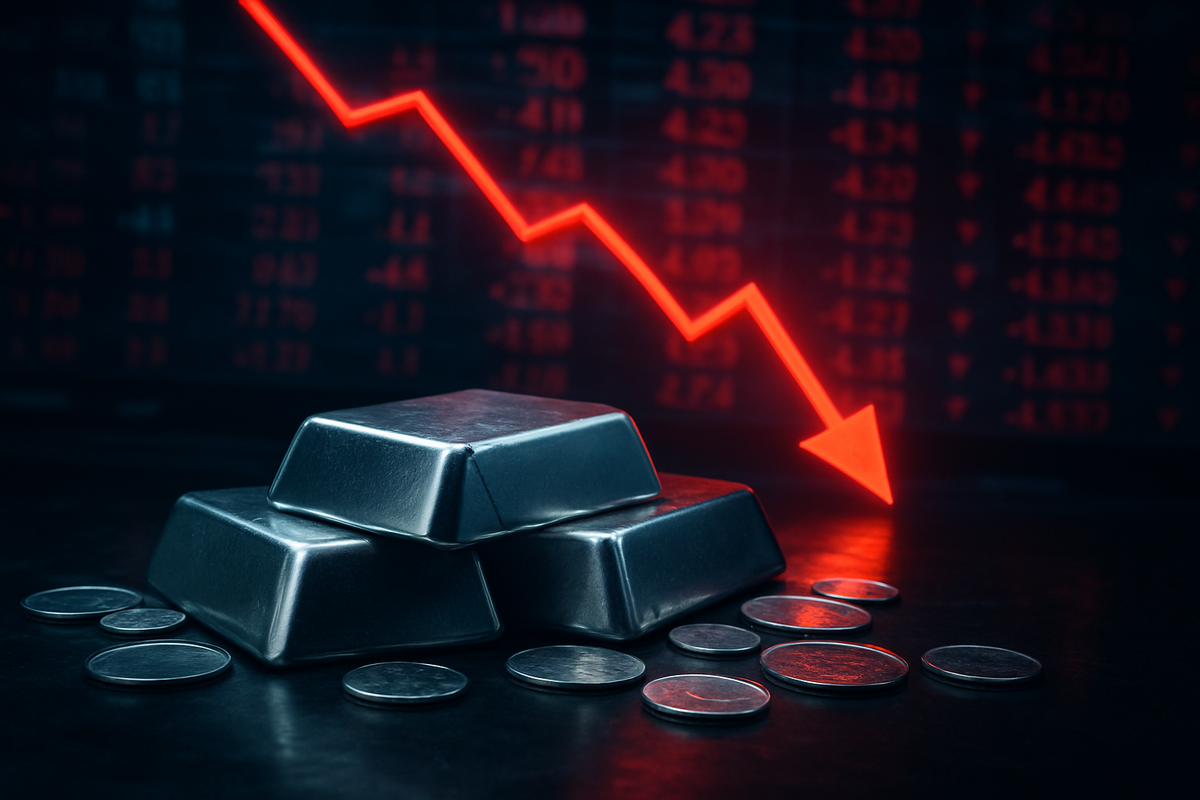
The silver market was rocked on Thursday, January 8, 2026, by a sudden and severe price correction that saw the precious metal lose more than 5% of its value in a single trading session. This "flash crash" comes on the heels of a historic rally that pushed silver to all-time highs, leaving investors scrambling as profit-taking intensified across global exchanges. On India’s Multi Commodity Exchange (MCX), the impact was particularly pronounced, with prices cratering by over ₹13,000 per kilogram as the speculative fever that defined late 2025 met a harsh reality check.
The immediate implications of this downturn are widespread, affecting everything from exchange-traded funds to the balance sheets of major mining corporations. While silver has long been celebrated for its dual role as both a safe-haven asset and a critical industrial component, the velocity of this decline highlights the inherent volatility of the white metal. As margin calls trigger and institutional rebalancing takes hold, the market is now forced to reconcile whether this is a healthy correction in a long-term bull market or the beginning of a more sustained bearish trend.
Market Turbulence: The Mechanics of the Crash
The dramatic sell-off reached its peak during the intraday session on January 8, 2026, following a period of unprecedented euphoria. Just 24 hours earlier, on January 7, silver had hit a lifetime high on the MCX of ₹2,59,692 per kilogram. The subsequent crash saw March 2026 futures contracts plunge by as much as ₹14,000, hitting an intraday low near ₹240,605. In the international spot market (XAG/USD), prices retreated from a late-December peak of approximately $84 per ounce to trade in the $75.50 to $76.00 range, representing a sharp rejection of the $80 psychological ceiling.
A "perfect storm" of technical triggers accelerated the decline. Most notably, the CME Group (NASDAQ: CME) implemented a massive 47% increase in maintenance margins for silver futures, raising the requirement from $22,000 to $32,500 per contract. This move, designed to curb speculative excess, forced many highly leveraged traders to liquidate their positions immediately. Simultaneously, the first week of January coincided with the annual rebalancing of the Bloomberg Commodity Index and other major benchmarks, leading to an estimated $7 billion in passive mechanical selling of precious metals.
The timeline leading to this moment was defined by a parabolic 160% gain throughout 2025, driven by a global silver deficit and surging demand in the green energy sector. However, as the US Dollar showed renewed strength ahead of key employment data, the narrative shifted. The combination of a stronger greenback and the rejection of record-high price levels provided the necessary catalyst for institutional "whale" investors to lock in profits, creating a vacuum of liquidity that exacerbated the downward move.
Winners and Losers: Impact on Mining and Investment Vehicles
The sharp correction has sent shockwaves through silver-focused investment vehicles, most notably the iShares Silver Trust (NYSE Arca: SLV). On January 7 and 8, the SLV recorded its largest single-day outflows of the year as retail sentiment soured. While the ETF had been a primary beneficiary of the 2025 rally, the recent volatility has prompted a notable rotation toward physical-backed alternatives like the Sprott Physical Silver Trust (NYSE Arca: PSLV), as investors seek assets with less exposure to the paper-market fluctuations that characterized this week's crash.
Major silver producers have also felt the sting of the price retreat. First Majestic Silver (NYSE: AG), often regarded as a high-leverage play on silver prices due to its pure-play status, saw its shares fall over 4% to approximately $17.94, retreating from a 52-week high of $18.72 reached only days prior. Other industry heavyweights, such as Pan American Silver (NYSE: PAAS) and Wheaton Precious Metals (NYSE: WPM), also faced selling pressure as the lower spot prices threatened to compress profit margins that had expanded significantly during the 2025 surge.
Conversely, some industrial consumers of silver may find a silver lining in the correction. Companies in the solar photovoltaic and electronics sectors have been struggling with "thrifting"—the process of reducing silver content in products to manage costs—due to the metal's extreme price appreciation. A sustained correction could offer these manufacturers a reprieve, allowing them to stabilize production costs. However, for the mining sector, the sudden drop serves as a reminder of the risks associated with high operational leverage in a volatile commodity environment.
Wider Significance: Industrial Thrifting and Geopolitical Shifts
This event fits into a broader industry trend where silver's industrial utility is increasingly at odds with its investment premium. A recent report from HSBC (NYSE: HSBC) warned that while a fundamental supply deficit persists, industrial demand has begun to weaken as manufacturers seek cheaper substitutes. The "thrifting" of silver in solar cell production is no longer a theoretical risk but a strategic necessity for firms facing $80/oz silver. This week’s price action suggests that the market may have reached a "demand destruction" threshold where high prices finally began to weigh on physical consumption.
Geopolitically, the crash was further complicated by new restrictive licensing regimes in China. As of January 1, 2026, China reclassified silver as a "strategic dual-use" metal, initially causing a price spike due to supply chain uncertainty. However, the resulting market instability contributed to the frantic selling seen this week as traders realized that supply bottlenecks could cut both ways, impacting global liquidity. This move by China echoes historical precedents where major exporters of industrial metals have tightened grips on supply, often leading to increased market volatility rather than sustained price floors.
The current situation bears a striking resemblance to the silver "hunt" of the early 1980s and the 2011 peak, where rapid price appreciation was followed by a sharp, margin-induced correction. In each case, the intervention of exchanges through margin hikes played a pivotal role in cooling the market. The 2026 crash reinforces the lesson that when an asset's price moves parabolically, the technical infrastructure of the market—such as margin requirements and index rebalancing—can become a more dominant force than the underlying supply-and-demand fundamentals.
The Road Ahead: Strategic Pivots and Market Scenarios
In the short term, the silver market is likely to remain in a period of consolidation as it digests the recent losses. Technical analysts are closely watching the $72 to $74 per ounce range in the international market to see if it provides a stable floor. If these levels hold, the correction may be viewed as a necessary "reset" that removes excess speculation from the market. However, a breach below these levels could signal a deeper retracement toward the $65 mark, which would force many mining companies to re-evaluate their capital expenditure plans for the coming fiscal year.
Looking further ahead, the long-term outlook for silver remains tied to the energy transition. Despite the current "thrifting" trend, the sheer volume of silver required for global electrification and 6G telecommunications infrastructure suggests that the structural deficit is unlikely to disappear. Investors should watch for a potential strategic pivot by silver miners toward more diversified metal portfolios or increased hedging activities to protect against future "flash crashes." The market may also see an increase in M&A activity as larger diversified miners look to acquire silver-pure plays at a discount following the share price pullbacks.
Final Assessment: A Wake-Up Call for the Precious Metals Sector
The sharp correction of January 2026 serves as a stark reminder that even the most robust bull markets are susceptible to sudden reversals. The loss of over ₹13,000 per kg on the MCX is a significant blow to retail sentiment in India, one of the world's largest consumers of physical silver. Moving forward, the market will likely be characterized by a "wait-and-see" approach as participants gauge the impact of the CME's margin hikes and the potential for further industrial demand softening.
For investors, the key takeaway is the importance of distinguishing between silver's long-term industrial story and its short-term speculative volatility. While the fundamental case for silver remains supported by its role in green technology, the technical factors—including exchange regulations and currency fluctuations—can override those fundamentals in the blink of an eye. In the coming months, market participants should keep a close eye on US Federal Reserve policy shifts and Chinese export data, as these will likely be the primary drivers of silver's next major move.
This content is intended for informational purposes only and is not financial advice.