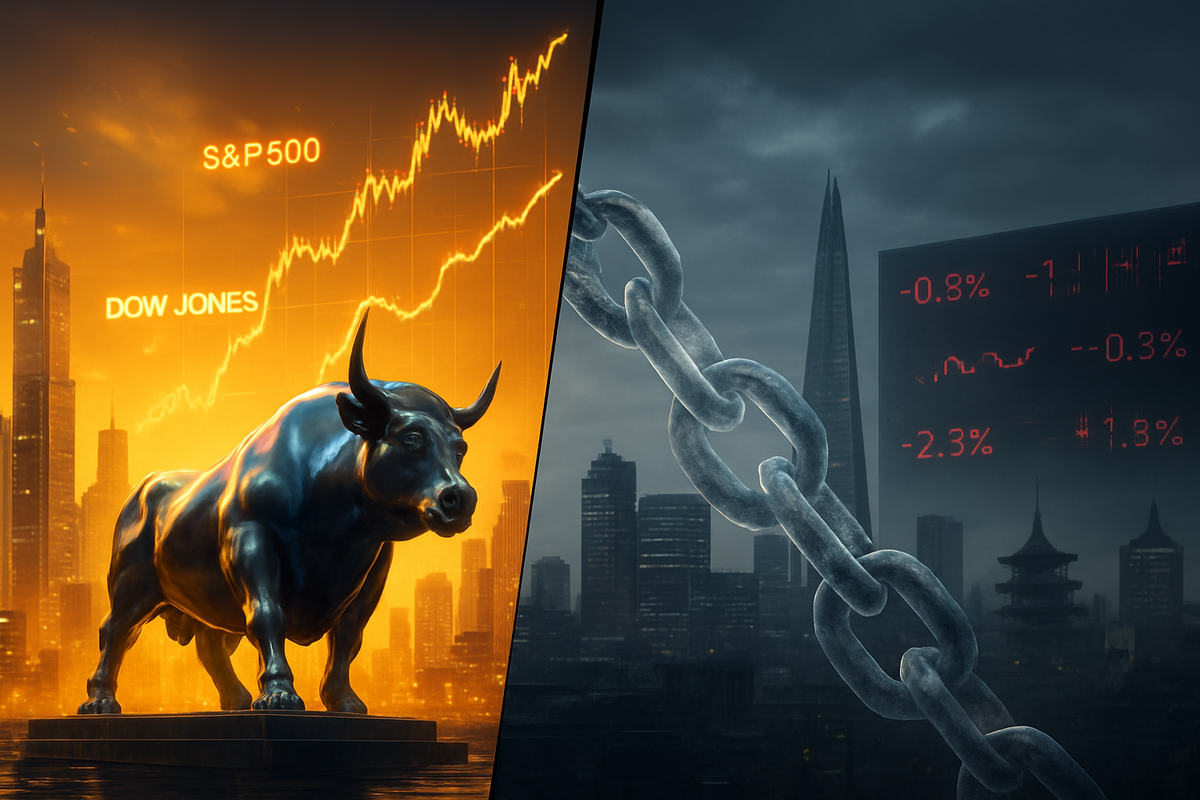
As of January 7, 2026, a profound divergence has emerged in the global financial landscape, marking what many analysts are calling "The Great Decoupling." While the S&P 500 (INDEXSP:.INX) has shattered records to hit the 7,200 mark and the Dow Jones Industrial Average (INDEXDJI:.DJI) hovers on the precipice of the historic 50,000-point milestone, international markets are beginning the year with a sense of exhaustion. This trend represents a sharp reversal from 2025, a year characterized by a "catch-up" rally in Europe and Asia, as the U.S. market now asserts a dominant lead fueled by aggressive fiscal policy and a maturing artificial intelligence cycle.
The immediate implications are stark: capital is fleeing international equities in favor of the perceived "safe haven" of the American domestic industrial base. This rotation is not merely a flight to quality but a strategic response to a new era of "Security-First" economics. As the U.S. implements sweeping tax reforms and protective trade barriers, the global "synchronized growth" narrative of the past decade has effectively collapsed, leaving international indices like the Euro Stoxx 50 and the Nikkei 225 to grapple with structural stagnation and the mounting costs of a fragmented global trade system.
A Policy-Driven Surge: The OBBBA and the 2026 Market Pivot
The primary catalyst for this decoupling is the full implementation of the One Big Beautiful Bill Act (OBBBA), a massive fiscal package signed into law in late 2025. The act has effectively "supercharged" the U.S. corporate landscape by making the 2017 tax cuts permanent and reinstating 100% bonus depreciation for research and development. In the first week of January 2026, these provisions have already begun to manifest in corporate balance sheets, with analysts estimating the bill will add a staggering 1.2% to U.S. GDP over the coming year. This domestic "fiscal floor" has provided a cushion that international markets simply do not possess.
The timeline leading to this moment was accelerated by a series of geopolitical shifts in late 2025. The capture of Venezuelan leader Nicolás Maduro by U.S.-backed forces in early January 2026 sent shockwaves through the energy sector, sparking a massive rotation into U.S. energy giants. Simultaneously, the Federal Reserve successfully navigated a "soft landing," maintaining higher interest rates that reflect economic strength rather than inflationary panic. This stands in sharp contrast to the European Central Bank, which is under increasing pressure to cut rates to stave off a recession in Germany, the continent's former industrial engine.
Key stakeholders, from institutional hedge funds to retail investors, have reacted with a "Security Supercycle" mindset. This shift prioritizes national security, energy independence, and domestic manufacturing over the globalized efficiency models of the 2010s. The initial reaction in early 2026 has been a "vertical" capital rotation, where money is moving out of speculative international growth and into U.S.-based infrastructure, defense, and energy sectors.
Winners and Losers: The Corporate Divide of 2026
The decoupling has created a clear hierarchy of corporate winners, led by the titans of the U.S. tech and energy sectors. NVIDIA (NASDAQ: NVDA), now challenging a $5 trillion market cap, has emerged as a "macro-independent" winner. Benefiting from specific OBBBA tariff exemptions for its high-end Blackwell chips, NVIDIA has transitioned from hardware speculation to the "physical AI" implementation phase. Similarly, Microsoft (NASDAQ: MSFT) has leveraged OBBBA subsidies for domestic data center infrastructure, demonstrating "AI-led margin expansion" that has captivated Wall Street.
In the energy sector, Chevron (NYSE: CVX) and ExxonMobil (NYSE: XOM) have reached all-time highs. Chevron, in particular, has seen its stock surge as it takes the lead in reconstructing Venezuela’s oil infrastructure under a new, U.S.-friendly regime. These companies are benefiting from a regulatory environment that has lowered federal royalty rates and streamlined permitting, creating a "home run" for domestic production that international competitors cannot replicate.
Conversely, the implementation of "reciprocal tariffs"—ranging from 10% to 50% on imports—has hammered international giants. LVMH (OTC:LVMUY) has seen a significant sales slump as it attempts to pass tariff costs onto American consumers, with executives now "seriously considering" moving production of Louis Vuitton and Tiffany goods to the U.S. to bypass levies. Volkswagen (OTC:VWAGY) has been forced to slash its operating margin guidance as its prestige brands, Audi and Porsche, face a 25% tariff on non-USMCA compliant vehicles. Perhaps most significantly, ASML (NASDAQ: ASML) has struggled as the price of its lithography machines nears €325 million due to new trade barriers, leading to a miss in consensus bookings for early 2026.
The Security Supercycle: Wider Significance and Historical Parallels
The current decoupling fits into a broader industry trend known as the "Security Supercycle," where "Security"—National, Energy, and Cyber—replaces "Growth" as the primary driver of price-to-earnings multiples. This is a structural shift away from the "efficiency-at-all-costs" model of globalization. We are seeing a "nuclear renaissance" in the U.S., where companies like Palantir (NYSE: PLTR) are being valued as essential national security assets, integrating software directly into the domestic defense agenda.
Historical precedents for this era can be found in the "Reaganomics" of the 1980s and the trade wars of 2018-2019. Like the 1980s, 2026 is defined by supply-side tax cuts and a massive increase in defense spending. However, unlike the 2018-2019 period, which was characterized by market-wide volatility and "policy by tweet," the 2026 decoupling is built on a foundation of legislative permanence. The OBBBA has created a "fiscal floor" that makes the U.S. market more resilient to the very volatility its own trade policies are exporting to the rest of the world.
The regulatory implications are profound. The U.S. has moved toward "Domestic-Only" mandates, such as the 45Z Clean Fuel Production Credit, which effectively bans imported feedstocks. This has created a "mini-lateralism" where the U.S. and its "Tier 1" partners—including the UK, Australia, and Japan—share a restricted tech ecosystem, leaving the rest of the world, particularly China, on the outside of a new, high-tech "Iron Curtain."
Strategic Pivots: What Comes Next for the Global Market
In the short term, the U.S. market is likely to maintain its "sugar high" from the OBBBA tax refunds and corporate incentives. However, the long-term challenge will be managing the "tariff-induced inflation" that could emerge if domestic production cannot scale fast enough to meet demand. Strategic pivots are already underway; international firms are no longer just "exporting" to the U.S. but are aggressively "onshoring" their own operations. Expect to see a wave of foreign direct investment as European and Asian manufacturers scramble to build factories on American soil to qualify for OBBBA benefits.
Market opportunities will likely emerge in "friend-shored" nations like Vietnam, Mexico, and India, which are positioning themselves as the "certified" alternatives to Chinese manufacturing. However, the true test will be the "S&P 493"—the companies outside the mega-cap tech giants. If the OBBBA successfully revitalizes the broader domestic industrial base, the decoupling could last for the remainder of the decade. If inflation returns with a vengeance, the Fed may be forced to break the "soft landing," creating a potential "hard landing" for 2027.
Final Assessment: A New Era of American Dominance
The key takeaway from the start of 2026 is that the U.S. stock market has successfully "legislated" its way into a position of dominance. The decoupling is not a temporary anomaly but a structural re-weighting of global capital. While international markets face the headwinds of de-industrialization and trade barriers, the U.S. is reaping the rewards of energy independence and a superior technological ecosystem.
Moving forward, the market will be defined by "idiosyncratic U.S. dominance." Investors should watch for the sustainability of the OBBBA-fueled earnings growth and the potential for "retaliatory" trade policies from the EU and China. However, for now, the "American Exceptionalism" narrative is firmly back in the driver's seat. The 2026 market is no longer a tide that lifts all boats; it is a selective surge that favors the domestic, the secure, and the technologically advanced.
This content is intended for informational purposes only and is not financial advice.