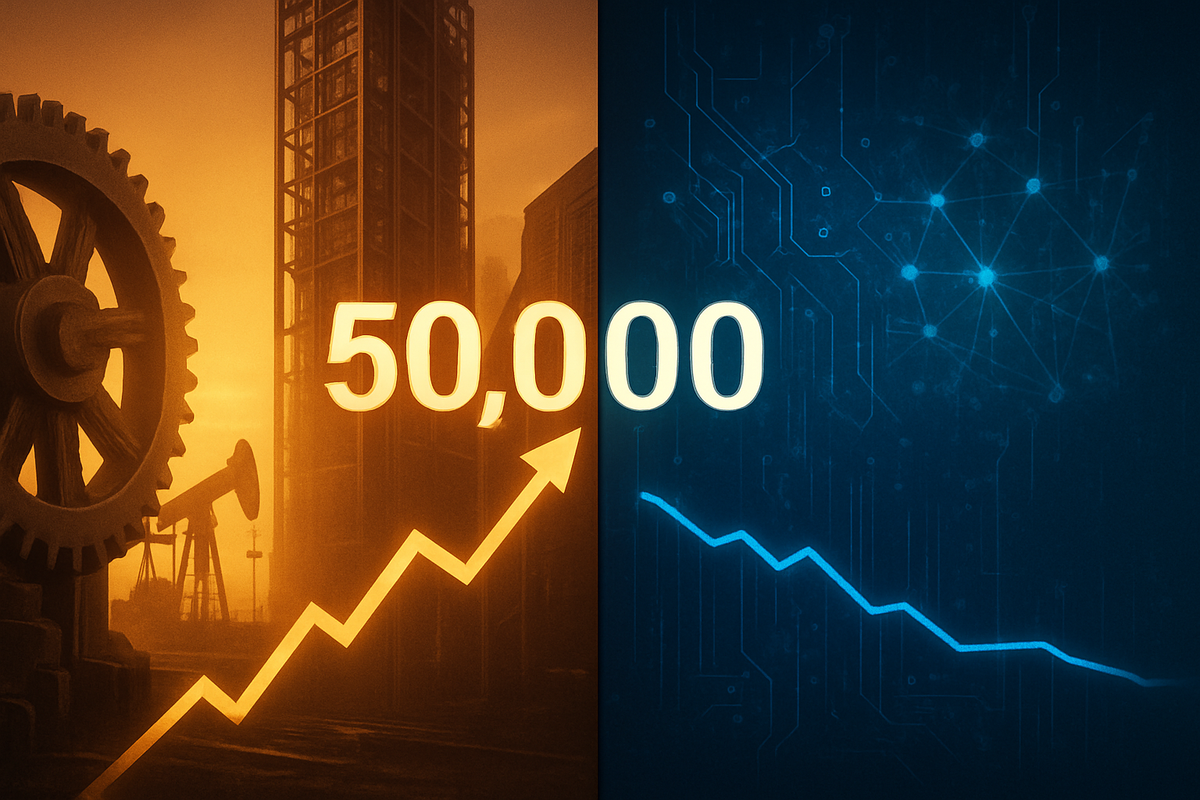
The first week of 2026 has unveiled a stark divide on Wall Street, as the Dow Jones Industrial Average (DJIA) charges toward historic heights while the tech-heavy Nasdaq Composite struggles to maintain momentum. On January 6, 2026, the Dow surged to a record close of 49,462.08, a rally fueled by a resurgence in "Old Economy" sectors like energy, financials, and industrials. Meanwhile, Nasdaq futures have signaled a more cautious tone, underperforming their blue-chip peers as investors grapple with valuation fatigue and a recalibration of expectations for the artificial intelligence (AI) sector.
This divergence represents a significant shift in market leadership, marking what many analysts are calling the "Great Rotation." After years of tech dominance, the capital flow is reversing. While the Dow is benefiting from a series of geopolitical breakthroughs and a domestic industrial renaissance, the Nasdaq is facing the harsh reality of "sticky" inflation and a cooling enthusiasm for high-growth software stocks that have yet to translate AI hype into bottom-line reality.
The Great Rotation: Geopolitics and Industrial Reshoring
The primary catalyst for the Dow’s record-breaking run is a combination of geopolitical stability and a fundamental shift in the American supply chain. In early January 2026, news broke regarding the capture of Venezuelan President Nicolás Maduro by U.S.-led forces, an event that has been dubbed the "Venezuela Shock." This development sparked immediate optimism regarding the stabilization of global oil supplies and the potential reopening of South American markets. For the energy-heavy Dow, this was a massive tailwind, sending shares of energy giants like Chevron (NYSE: CVX) to new heights as the market priced in a more predictable energy landscape.
Beyond geopolitics, the Dow is reaping the rewards of a multi-year trend in industrial reshoring. By the start of 2026, data indicated that over 45% of U.S. manufacturers had successfully relocated significant international operations back to North America. This "U-shaped" recovery has breathed new life into industrial stalwarts like Caterpillar (NYSE: CAT), which has seen increased demand for domestic infrastructure and mining equipment. The Dow’s focus on tangible assets and physical production has made it the primary beneficiary of this "bricks and mortar" revival.
The timeline leading to this divergence began in late 2025, when the Federal Reserve initiated a series of rate cuts, bringing the target range to 3.50%–3.75%. While lower rates typically benefit growth stocks, the Nasdaq’s rally had already reached extreme valuations by October 2025. As we entered 2026, the "catch-up trade" became the dominant theme, with investors hunting for value in sectors that were overlooked during the 2024–2025 tech boom.
Winners of the Value Surge and Losers of the Tech Reset
The winners in this current market environment are clearly concentrated in the value and cyclical sectors. Financial institutions like Goldman Sachs (NYSE: GS) and JPMorgan Chase & Co. (NYSE: JPM) have benefited from a steeper yield curve and a renewed interest in traditional investment banking services as industrial mergers and acquisitions (M&A) pick up pace. Additionally, healthcare giants such as UnitedHealth Group (NYSE: UNH) have provided a defensive backbone for the Dow, offering stable earnings growth in an era of lingering inflationary pressures.
Conversely, the Nasdaq is feeling the weight of its own success. Tech behemoths like Apple (NASDAQ: AAPL) and Microsoft (NASDAQ: MSFT) are facing "valuation fatigue," where even solid earnings are no longer enough to drive stock prices higher against a backdrop of stretched multiples. The most significant drag, however, has come from the software-as-a-service (SaaS) sector. Companies that promised massive revenue gains from AI integration are now under the microscope, as investors demand to see actual ROI rather than just pilot programs.
Even the "picks and shovels" of the AI revolution are not immune to the cooling sentiment. While NVIDIA (NASDAQ: NVDA) remains a dominant force, the hyper-growth phase of AI infrastructure build-out is showing signs of maturation. As the market pivots toward the "Old Economy," these high-flying tech names are seeing capital outflows as portfolio managers rebalance toward the Dow’s more reasonably priced industrial and energy components.
Macroeconomic Headwinds and Historical Precedents
The current divergence fits into a broader industry trend of "normalization." After the post-pandemic tech surge and the subsequent AI frenzy, the market is returning to a state where fundamentals and dividend yields matter. Inflation remains a critical factor; despite the Fed’s rate cuts in 2025, inflation has proven "sticky," hovering between 2.7% and 3.0% in early 2026. This persistent inflation disproportionately affects the Nasdaq, as high-growth companies are more sensitive to the long-term cost of capital and the discounting of future earnings.
Historically, this split mirrors the post-dot-com bubble era of the early 2000s and the value rotation seen in 2022. In both instances, a period of extreme tech outperformance was followed by a multi-year stretch where value stocks and the Dow outperformed as the "hype" was washed out of the system. The 2026 version of this rotation is unique, however, because it is underpinned by a genuine domestic manufacturing boom and a major shift in global energy geopolitics.
The ripple effects are being felt across the globe. Competitors in Europe and Asia are watching the U.S. industrial resurgence with concern, as the reshoring trend threatens to hollow out traditional manufacturing hubs abroad. Regulators are also taking note, with a renewed focus on ensuring that the "AI infrastructure" being built is sustainable and does not lead to a systemic energy crisis, further supporting the Dow’s energy and utility sectors.
The Path Forward: Earnings and the Fed’s Next Move
Looking ahead, the short-term trajectory of this divergence will be determined by the upcoming Q4 2025 earnings season. Investors will be laser-focused on whether the Dow’s industrial and financial components can justify their recent price surges with strong guidance for 2026. For the Nasdaq, the challenge will be proving that AI is more than just a capital expenditure line item. If tech companies can demonstrate tangible margin expansion from AI, the Nasdaq may find its footing; otherwise, the underperformance could persist through the first half of the year.
A potential strategic pivot may be required for tech investors, moving away from broad-index exposure and toward "quality growth"—companies with strong balance sheets and proven cash flows. Meanwhile, the Dow’s components must navigate the challenges of a cooling labor market. Recent ADP and JOLTS data from early January 2026 showed private sector job gains of only 41,000 in December, suggesting that while the "Old Economy" is growing, it is doing so with a focus on automation and efficiency rather than aggressive hiring.
Market opportunities are emerging in small-caps as well, with the Russell 2000 (IWM) showing signs of a "Renaissance" as lower interest rates finally begin to ease the debt burdens of smaller, domestically-focused firms. This suggests that the rally in the Dow is not an isolated event but part of a broader broadening of market participation that excludes the overextended tech giants.
Assessing a Market in Transition
The divergence between the Dow and the Nasdaq in early 2026 is a clear signal that the market is entering a new phase of the economic cycle. The Dow’s march toward 50,000 is a testament to the resilience of the American industrial base and the impact of favorable geopolitical shifts. In contrast, the Nasdaq’s struggle reflects a necessary cooling period after years of breakneck growth and speculative fervor.
For investors, the key takeaway is the importance of diversification and the return of "value" as a primary driver of returns. The "Great Rotation" is not merely a temporary blip but a reflection of changing macroeconomic realities, including sticky inflation, reshoring, and a more cautious Federal Reserve. Moving forward, the market is likely to remain bifurcated until valuations in the tech sector reach a more sustainable level.
In the coming months, investors should watch for the Fed’s "data-dependent" commentary and any further developments in the energy sector. As the Dow flirts with the 50,000 mark, the psychological impact of that milestone could either trigger a fresh wave of buying or a period of profit-taking. Regardless, the 2026 market landscape belongs to the blue chips, the builders, and the energy producers who form the backbone of the Dow.
This content is intended for informational purposes only and is not financial advice.