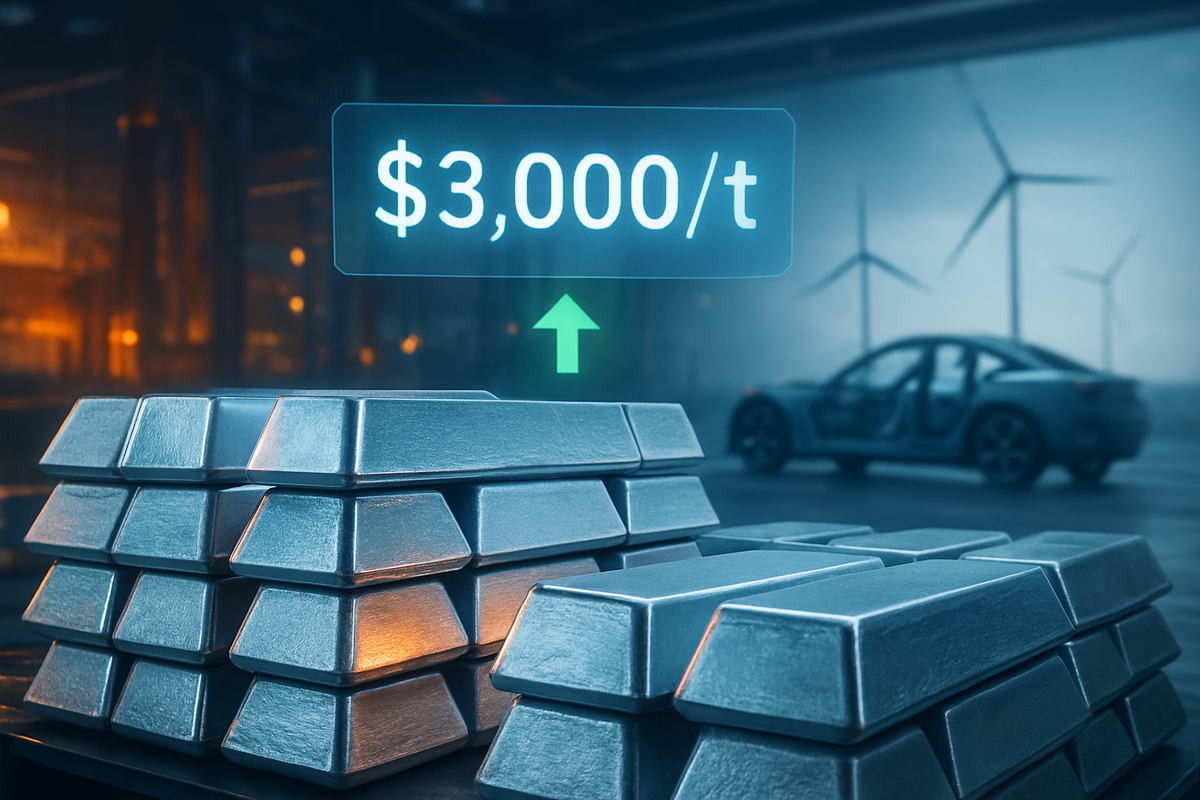
The global commodities market reached a historic milestone this week as aluminum prices decisively breached the $3,000 per tonne mark on the London Metal Exchange (LME). As of January 6, 2026, the three-month aluminum contract is trading between $3,082 and $3,125 per tonne, its highest level in nearly four years. This surge is not an isolated event but rather the vanguard of a broader "super-cycle" in the base metals sector, driven by a perfect storm of structural supply deficits and an insatiable demand for the materials required for the global energy transition.
The immediate implications of this price breakthrough are being felt across global equity markets, particularly in the mining and smelting sectors. Major producers are seeing their valuations skyrocket as investors bet on sustained high margins. The rally in aluminum is being mirrored by record-breaking performances in copper and significant recoveries in nickel, signaling a fundamental shift in how the market values industrial metals in an era of decarbonization and high-tech infrastructure expansion.
The journey to $3,000 per tonne has been building throughout the latter half of 2025, culminating in the breakout seen in the first week of 2026. A primary catalyst for this move is the strict enforcement of China’s 45-million-tonne primary aluminum production cap. As the world’s largest producer, China’s refusal to expand capacity further has effectively removed the "safety valve" for global supply. Simultaneously, European smelters remain hampered by structurally high energy costs, with many facilities that were shuttered during the 2022-2023 energy crisis remaining offline or operating at reduced capacity.
The timeline leading to this moment was also accelerated by the implementation of more aggressive "Green Aluminum" standards. In late 2025, the industry saw a significant shift where low-carbon aluminum began commanding a substantial premium over traditional primary metal. This bifurcation of the market has squeezed the supply of "standard" LME-grade aluminum, pushing prices higher. On the demand side, the massive scale-up of renewable energy infrastructure—specifically solar frames and power grid upgrades—has outpaced even the most bullish analyst projections from a year ago.
Key stakeholders, including global automotive manufacturers and renewable energy developers, have expressed concern over the rising costs. However, the market reaction has remained overwhelmingly bullish. Institutional investors have been aggressively "front-running" expected supply deficits for the 2026–2027 period, viewing the $3,000 level not as a ceiling, but as a new floor for the commodity.
The primary beneficiaries of this price surge are the integrated producers who control their own raw material supply chains. National Aluminium Company Limited (NSE: NALCO) has emerged as a standout performer, with its shares hitting a fresh record high of ₹352 on January 6, 2026. The company’s ability to maintain high production levels of alumina hydrate while benefiting from soaring metal prices led to a 36.7% year-on-year jump in net profit in its most recent quarterly report. Investors are particularly optimistic about NALCO’s expansion of its 5th stream Alumina refinery, which is expected to bolster its export capacity significantly by 2027.
Similarly, Hindalco Industries (NSE: HINDALCO) has seen its stock price surge to an all-time high of ₹963.8. Hindalco is uniquely positioned as a "dual-metal" winner; while its aluminum business is thriving, its massive copper segment is reaping the rewards of copper prices hitting record highs of $13,000 per tonne. Analysts suggest that Hindalco’s subsidiary, Novelis, is also benefiting from the shift toward sustainable packaging and lightweight automotive components, further insulating the company from localized market volatility.
In the United States, Alcoa (NYSE: AA) shares rose over 5% in early January trading. The company’s strategic pivot to close less efficient assets, such as the Kwinana refinery, has streamlined its operations just in time to capture peak pricing. Meanwhile, Rio Tinto (NYSE: RIO) has seen steady gains, supported by its diverse portfolio. While iron ore remains a core component of its business, Rio Tinto's heavy investment in low-carbon smelting technology has made it a favorite for ESG-focused institutional funds that are increasingly wary of carbon-intensive producers.
The strength in aluminum is a symptom of a much larger trend: the "electrification of everything." Copper, often considered the bellwether for the global economy, reached an unprecedented $13,387.50 per tonne today. This is largely due to the massive power requirements of AI data centers and the global push for grid modernization. The synergy between aluminum and copper is becoming more pronounced, as aluminum is increasingly used as a cost-effective substitute for copper in certain wiring and heat-sink applications, further driving up aluminum demand.
Furthermore, the regulatory landscape is shifting. The European Union’s Carbon Border Adjustment Mechanism (CBAM) has begun to fundamentally alter trade flows. Producers with high carbon footprints are finding it increasingly expensive to export to premium markets, creating a supply vacuum that low-carbon producers are struggling to fill. This has led to a "green premium" that is now being baked into the base LME price, a historical precedent that marks the end of the era of "cheap, dirty" industrial metals.
Historical comparisons are being drawn to the commodities boom of the early 2000s, but with a critical difference. While the previous boom was driven by China’s rapid urbanization, the current rally is driven by a global transition to a different kind of economy—one that is more metal-intensive but less carbon-intensive. This structural change suggests that the current price levels may be more sustainable than the speculative peaks of the past.
Looking ahead, the short-term outlook remains tight. Market participants are watching for any signs of China easing its production caps, though most analysts believe Beijing will prioritize its environmental targets over global price relief. In the long term, we may see a strategic pivot among manufacturers toward "circularity." Increased investment in aluminum recycling—which requires only 5% of the energy used to produce primary aluminum—is expected to become a major corporate priority for companies looking to hedge against high primary metal prices.
Market opportunities are also emerging in the mid-stream sector. Companies that specialize in high-precision aluminum extrusions for the EV and aerospace sectors are likely to see increased pricing power. However, challenges remain; if prices stay above $3,000 for an extended period, we may see "demand destruction" in lower-margin sectors like construction or basic consumer packaging, as manufacturers look for alternative materials like plastics or composites, though this is less likely in the high-growth green energy sectors.
The breach of the $3,000/t mark for aluminum is a watershed moment for the commodities market in 2026. It confirms that the base metals sector has entered a new phase of structural growth, where supply constraints are meeting a multi-decade demand surge. For investors, the key takeaways are the resilience of integrated producers like NALCO and Hindalco, and the undeniable influence of the "green" transition on commodity pricing.
Moving forward, the market is likely to remain volatile but biased toward the upside. Investors should keep a close eye on LME inventory levels, which are currently at multi-year lows, and any shifts in Chinese industrial policy. As we move further into 2026, the ability of companies to adapt to a high-cost, low-carbon environment will be the primary differentiator between the winners and losers in this new industrial era.
This content is intended for informational purposes only and is not financial advice.