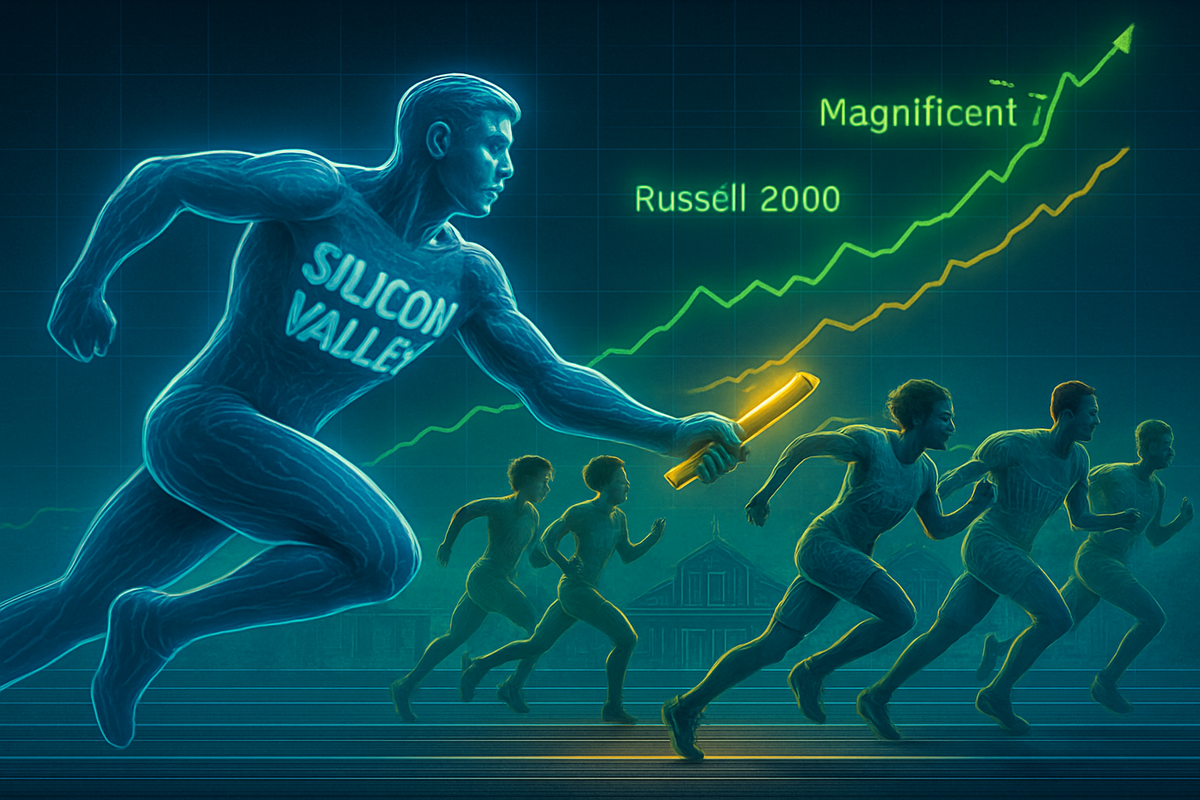
As of January 26, 2026, the financial landscape has undergone a seismic shift, marking the definitive end of the "Magnificent 7" era of uncontested dominance. For the first time in decades, the baton of market leadership has been passed to the small-cap arena in what analysts are calling the "Earnings Handoff." This month, the Russell 2000 Index has not just participated in the rally; it has dictated its terms, staging a historic ten-day winning streak against the tech-heavy Nasdaq that has left institutional investors scrambling to rebalance their portfolios.
The immediate implications are profound: the concentrated "AI-or-bust" trade that fueled the S&P 500 for the better part of two years is giving way to a broader, more democratized market. While the tech giants grapple with the law of large numbers and massive infrastructure costs, smaller domestic firms are beginning to reap the rewards of a lower interest rate environment. This rotation is not merely a sentiment-driven spike but a fundamental realignment based on a widening divergence in earnings growth expectations for the year ahead.
The 10-Day Streak That Shook the Nasdaq
The momentum reached a fever pitch this week as the Russell 2000 officially secured its tenth consecutive session of outperformance relative to the Nasdaq 100. This streak, the most significant of its kind since the mid-1990s, follows a broader trend that began in early January. While the Nasdaq has languished with a year-to-date loss of roughly 1.4%, small caps have surged by nearly 14%, fueled by a massive influx of institutional capital. On January 20 alone, the "Magnificent 7" (including Apple Inc. (NASDAQ: AAPL), Microsoft Corp. (NASDAQ: MSFT), and Alphabet Inc. (NASDAQ: GOOGL)) collective shed an estimated $653 billion in market value as investors harvested profits from the winners of 2024 and 2025.
The timeline leading to this moment was paved by the Federal Reserve’s consistent easing cycle throughout late 2025. With the federal funds rate now sitting in the 3.50% range, the prohibitive "higher for longer" narrative that choked small-cap growth has finally dissolved. Market participants initially reacted with skepticism during the first week of the year, but as domestic economic data remained resilient and small-cap earnings beats began to roll in, the skepticism turned into a "Fear Of Missing Out" (FOMO) for a sector that many had written off as a "zombie graveyard."
Key stakeholders, including major hedge funds and passive index providers, have been the primary drivers of this volatility. The iShares Russell 2000 ETF (NYSE: IWM) saw record-breaking inflows of over $600 million in a single week mid-month, while the Technology Select Sector SPDR Fund (NYSE: XLK) faced its largest monthly outflow in over two years. This "Great Rotation" is being reinforced by the fundamental "Earnings Handoff," where the profit growth lead is projected to shift from 20% for mega-caps to as high as 35% for the Russell 2000 in 2026.
Winners and Losers: From AI Suppliers to AI Beneficiaries
The primary beneficiaries of this shift are companies that were previously punished by high borrowing costs. Sezzle Inc. (NASDAQ: SEZL) has emerged as a standout winner, with its "Buy Now, Pay Later" model thriving as lower rates reduce its internal cost of capital. Similarly, the industrial sector has seen a renaissance, with firms like Limbach Holdings, Inc. (NASDAQ: LMB) benefiting from a domestic reshoring boom and the passage of the "One Big Beautiful Bill Act" (OBBBA) in mid-2025, which incentivized U.S.-based manufacturing and infrastructure projects.
In the technology space, the focus has shifted from the "suppliers" to the "beneficiaries" of artificial intelligence. While NVIDIA Corp. (NASDAQ: NVDA) remains a cornerstone of the market, its parabolic growth has slowed, leading investors to seek value in mid-stream players like Aehr Test Systems (NASDAQ: AEHR) and SoundHound AI, Inc. (NASDAQ: SOUN). These firms are viewed as having more "runway" for growth as AI moves from the data center build-out phase to real-world integration in restaurants, cars, and factories.
Conversely, the "Magnificent 7" are facing a rare period of underperformance. Meta Platforms, Inc. (NASDAQ: META) has seen its shares drop as investors question the long-term ROI of its multi-billion dollar AI capital expenditures. Tesla, Inc. (NASDAQ: TSLA) continues to struggle with global price wars and shifting subsidy landscapes, while even stalwarts like Microsoft and Apple have become "liquidity donors" for the market—sold off not because of poor performance, but because they are the only assets large enough to fund a massive rotation into small-caps.
Macro Fundamentals and the ‘OBBBA’ Catalyst
The wider significance of this event lies in the structural differences between small and large-cap balance sheets. Approximately 40% to 51% of the debt held by Russell 2000 companies is floating-rate, compared to less than 10% for the S&P 500. For years, this was a massive headwind, as rising rates directly drained the cash flows of smaller firms. Now, as rates decline, these same companies are experiencing an immediate "relief valve" effect. This is particularly vital for regional financial institutions like KeyCorp (NYSE: KEY), which are seeing improved net interest margins and a rebound in small-business lending.
Furthermore, the legislative landscape of 2025 played a critical role in setting the stage for 2026. The OBBBA Act fundamentally changed interest deductibility limits, moving the threshold from 30% of EBIT to 30% of EBITDA. For capital-intensive small firms that carry significant depreciation and amortization, this policy shift has allowed them to retain significantly more of their earnings, effectively acting as a massive tax cut for the most vulnerable sectors of the market.
Historically, such rotations have signaled the transition from a late-cycle to a mid-cycle economic expansion. The current trend mirrors the mid-1990s, where after a period of extreme tech concentration, the market broadened out to include industrials, financials, and materials. This ripple effect is already being felt by competitors and partners in the global supply chain, as domestic demand in the U.S. begins to outpace the growth of global digital advertising and cloud services.
The Road Ahead: A New Market Regime
Looking toward the remainder of 2026, the short-term possibility of a minor pullback in small caps exists given the "overbought" nature of the recent ten-day streak. However, the long-term outlook remains bullish as small caps enter the year trading at near 25-year lows relative to the S&P 500. For institutional investors, the strategic pivot is clear: the era of "growth at any price" is over, replaced by a focus on "quality cyclicality." Small-cap firms that can prove sustainable earnings growth will likely continue to attract the lion's share of new capital.
Potential challenges include the risk of a "re-inflation" scare if the Federal Reserve cuts rates too aggressively, which could force a pause in the easing cycle. Additionally, the Russell 2000’s upcoming semi-annual reconstitution in June 2026 will be a critical event, as it will formalize the inclusion of several high-growth biotech and fintech firms that have matured over the last year, such as GeneDx Holdings Corp. (NASDAQ: WGS).
Investors should watch for a "convergence" in valuations. While the S&P 500 continues to trade at over 22 times forward earnings, the S&P SmallCap 600 (INDEX: SML) is still hovering around a 31% discount. As this gap narrows, the volatility seen in January 2026 may become the new normal, as the market finds a new equilibrium between the safety of mega-cap tech and the explosive potential of the domestic economy.
Summary: The New Equilibrium
The "Earnings Handoff" of early 2026 represents more than just a successful month for the Russell 2000; it is a fundamental re-weighting of the American economy's growth engine. By breaking the 10-day winning streak against the Nasdaq, small caps have proven that they are no longer just "interest-rate sensitive" proxies, but viable engines of earnings growth in their own right. The combination of legislative tailwinds from the OBBBA and the natural relief of lower borrowing costs has created a "Goldilocks" environment for firms that were previously on the brink.
Moving forward, the market appears more balanced and resilient than it has been in years. The extreme concentration risk that haunted the 2024-2025 rally has been mitigated by the broadening of market participation. For investors, the takeaway is clear: the "Magnificent 7" may still be great companies, but they are no longer the only game in town. The focus for the coming months will be on whether small-cap firms can meet the lofty 35% growth targets set for them by Wall Street.
As we move deeper into 2026, market participants should keep a close eye on regional bank health and manufacturing data. If the "Great Rotation" holds, we are witnessing the birth of a new market cycle—one defined by domestic production, fiscal incentives, and a return to value. The "Earnings Handoff" is complete; now, it is up to the small caps to run with the ball.
This content is intended for informational purposes only and is not financial advice