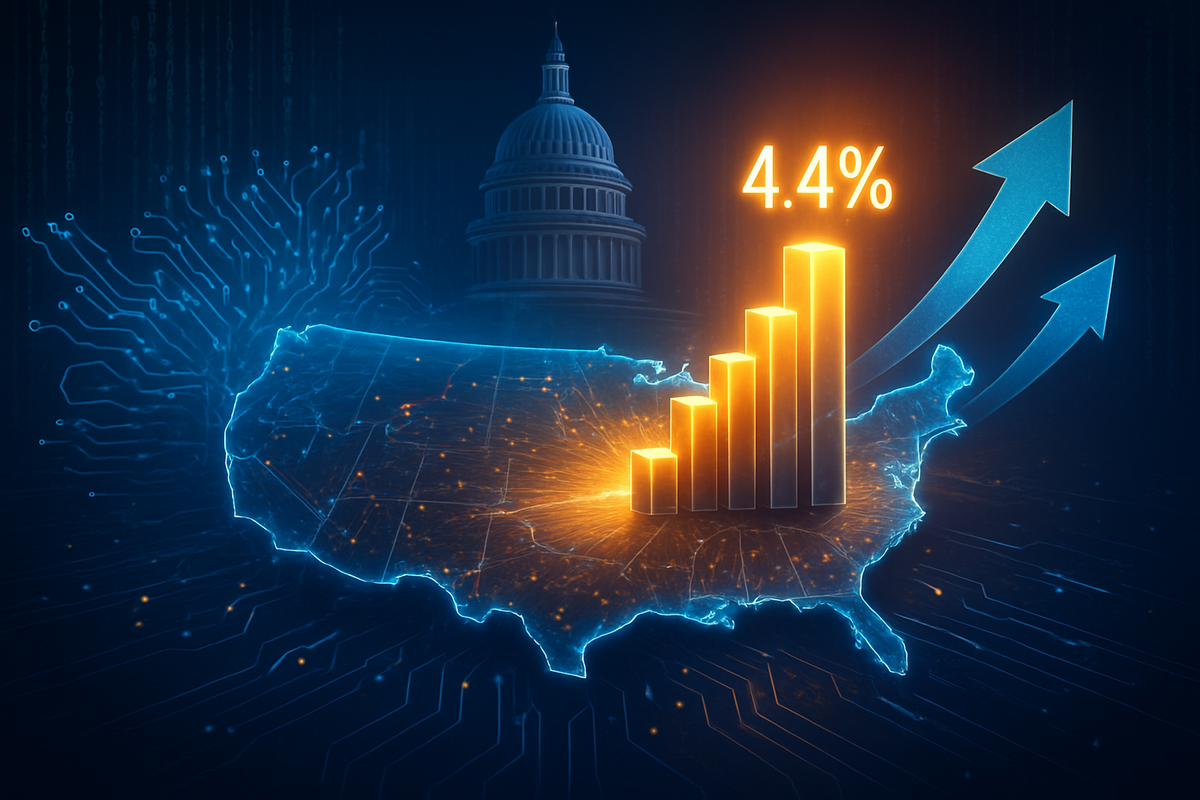
WASHINGTON, D.C. — The United States economy continues to defy gravity, showcasing a resilience that has caught both domestic and international observers by surprise. On Thursday, January 22, 2026, the Bureau of Economic Analysis (BEA) released its final estimate for the third-quarter 2025 Gross Domestic Product (GDP), revealing an annualized expansion rate of 4.4%. This final figure slightly outpaced the consensus economist expectation of 4.3% and confirms that the U.S. remains the primary locomotive of global economic growth amidst a landscape of shifting fiscal policies and technological upheaval.
The robust 4.4% reading marks the strongest quarterly performance in two years, effectively silencing critics who had predicted a mid-decade slowdown. This growth is being driven by a "perfect storm" of high-octane factors: a massive surge in capital expenditure related to Artificial Intelligence (AI), a resilient—albeit polarized—consumer base, and the early stimulative effects of the "One Big Beautiful Bill" Act (OBBBA) signed into law last summer. However, the sheer strength of the report has immediately shifted the focus to the Federal Reserve, as the specter of an "overheating" economy threatens to stall the progress made in cooling inflation.
The journey to this 4.4% final estimate began in late 2025 with an "advance" reading of 4.3%, which already signaled a significant acceleration from previous quarters. The upward revision to 4.4% was primarily attributed to stronger-than-expected exports, which jumped by 9.6%, and a 3.5% surge in personal consumption expenditures. Government spending also played a pivotal role, contributing significantly to the headline figure as the initial tranches of the OBBBA began to permeate infrastructure and manufacturing sectors.
The timeline leading up to this release has been defined by a tense standoff between fiscal stimulus and monetary restraint. Throughout late 2025, while the Federal Reserve maintained a restrictive stance to bring inflation toward its 2% target, the executive and legislative branches moved in the opposite direction, passing a series of tax cuts and business incentives designed to "re-industrialize" America. This policy divergence has created a unique economic environment where growth remains high despite interest rates sitting in the 3.50% to 3.75% range.
Market reaction to the Thursday morning data was swift but complex. Treasury yields ticked higher as traders recalibrated their expectations for the Fed’s January 27-28 meeting. Equity futures initially dipped on the fear of "higher-for-longer" interest rates but recovered as the market focused on the underlying health of corporate earnings. Key stakeholders, including Treasury Secretary Janet Yellen and various industry leaders, have praised the data as a sign of American exceptionalism, though consumer advocacy groups warn that the high headline growth masks a deepening cost-of-living crisis for lower-income households.
The beneficiaries of this high-growth environment are led by the titans of the technology sector, particularly those dominating the AI landscape. NVIDIA (NASDAQ: NVDA) continues to reap the rewards of what analysts call the "AI Capex Supercycle," as cloud service providers and private enterprises accelerate their hardware investments to keep pace with GDP growth. Similarly, Microsoft (NASDAQ: MSFT) and Alphabet Inc. (NASDAQ: GOOGL) are seeing record demand for productivity-enhancing software, which has become a cornerstone of the modern U.S. economy's efficiency gains.
In the banking sector, the environment is a double-edged sword. JPMorgan Chase & Co. (NYSE: JPM) reported a surge in loan demand from mid-sized businesses looking to expand, yet the sector faces a "bumpy" road ahead. While high interest rates have traditionally helped net interest margins, a proposed 10% cap on credit card interest rates and the threat of increased regulatory scrutiny could squeeze profitability. Conversely, the investment banking arms of firms like Goldman Sachs (NYSE: GS) are seeing a revival in merger and acquisition (M&A) activity, fueled by the confidence that a 4.4% growth rate provides to corporate boardrooms.
The retail landscape highlights the "K-shaped" nature of this expansion. Walmart Inc. (NYSE: WMT) has emerged as a clear winner, capturing a larger share of the "value-seeking" middle class who are grappling with sticky inflation. Meanwhile, Amazon (NASDAQ: AMZN) has benefited from the 4.4% holiday retail sales growth recorded in late 2025, leveraging its logistics dominance to capture the lion's share of the export and domestic delivery surge. However, regional retailers and luxury brands have struggled to maintain momentum as high borrowing costs begin to weigh on non-essential high-ticket purchases.
The wider significance of this GDP report lies in its challenge to traditional economic theory. The U.S. is currently managing to sustain a 4%+ growth rate while also attempting to maintain an inflation-targeting regime. This "productivity-driven expansion" suggests that AI may finally be delivering the long-promised efficiency gains that allow for non-inflationary growth. However, this is being tested by the simultaneous imposition of double-digit tariffs in late 2025, which has introduced a "lagged cost shock" into the system.
Historically, periods of growth this strong—when coupled with significant fiscal stimulus—have often led to a "hard landing" as the central bank is forced to hike rates aggressively. The current situation echoes the mid-1990s "Goldilocks" economy, but with the added volatility of modern political interference. The growing concern over the Federal Reserve’s independence, particularly with legal challenges to the current leadership, adds a layer of uncertainty that the GDP figures alone do not capture.
Furthermore, the ripple effects are being felt globally. A strong U.S. economy typically pulls in imports, but with the recent shift toward protectionist trade policies, the U.S. is increasingly acting as a self-contained engine. This "decoupling" from global norms has left traditional partners in Europe and Asia searching for new growth catalysts as the U.S. domestic market becomes more insular and competitive.
Looking ahead, the momentum from the third quarter appears to have accelerated into the end of 2025 and the beginning of 2026. The Atlanta Fed’s GDPNow tool is currently forecasting a staggering 5.4% growth rate for the fourth quarter of 2025. In the short term, this will likely force the Federal Reserve to hold interest rates steady at their next meeting, postponing any pivot toward easier monetary policy until the latter half of 2026.
Strategic pivots will be required for companies that have built their 2026 budgets around the expectation of multiple rate cuts. Firms with high debt loads may find themselves in a liquidity crunch if "higher-for-longer" remains the mantra for the rest of the year. Conversely, companies with strong cash positions and those directly involved in the AI supply chain or government-funded infrastructure projects are likely to see continued outperformance.
The potential for a "melt-up" in the stock market remains a distinct possibility if the Q4 data confirms the 5.4% projection. However, the primary risk remains a resurgence in inflation. If the CPI, which stood at 2.7% in December 2025, begins to tick back toward 4% due to the OBBBA stimulus and tariff pass-through, the market could face a sharp correction as the "Goldilocks" narrative dissolves into one of stagflationary pressure.
The final Q3 GDP reading of 4.4% is a testament to the sheer scale and adaptability of the U.S. economy in 2026. While the headline figure is cause for celebration, the underlying drivers—AI investment and massive fiscal spending—carry their own sets of risks and rewards. Investors have been gifted a robust growth environment, but it comes at the price of persistent inflation and a Federal Reserve that is effectively "boxed in" by strong data.
Moving forward, the market will transition from focusing on whether the economy can grow to whether that growth can be sustained without igniting a new inflationary spiral. The synergy between the "One Big Beautiful Bill" Act and the AI revolution is currently the primary tailwind, but the looming impact of tariffs and political uncertainty regarding the central bank will be the defining themes of the coming months.
Investors should keep a close eye on the Q4 advance estimate due later this month, as well as the Fed’s rhetoric following their January meeting. While the "U.S. exceptionalism" trade is alive and well, the margins for error are narrowing as the economy enters a high-growth, high-stakes phase of the cycle.
This content is intended for informational purposes only and is not financial advice.