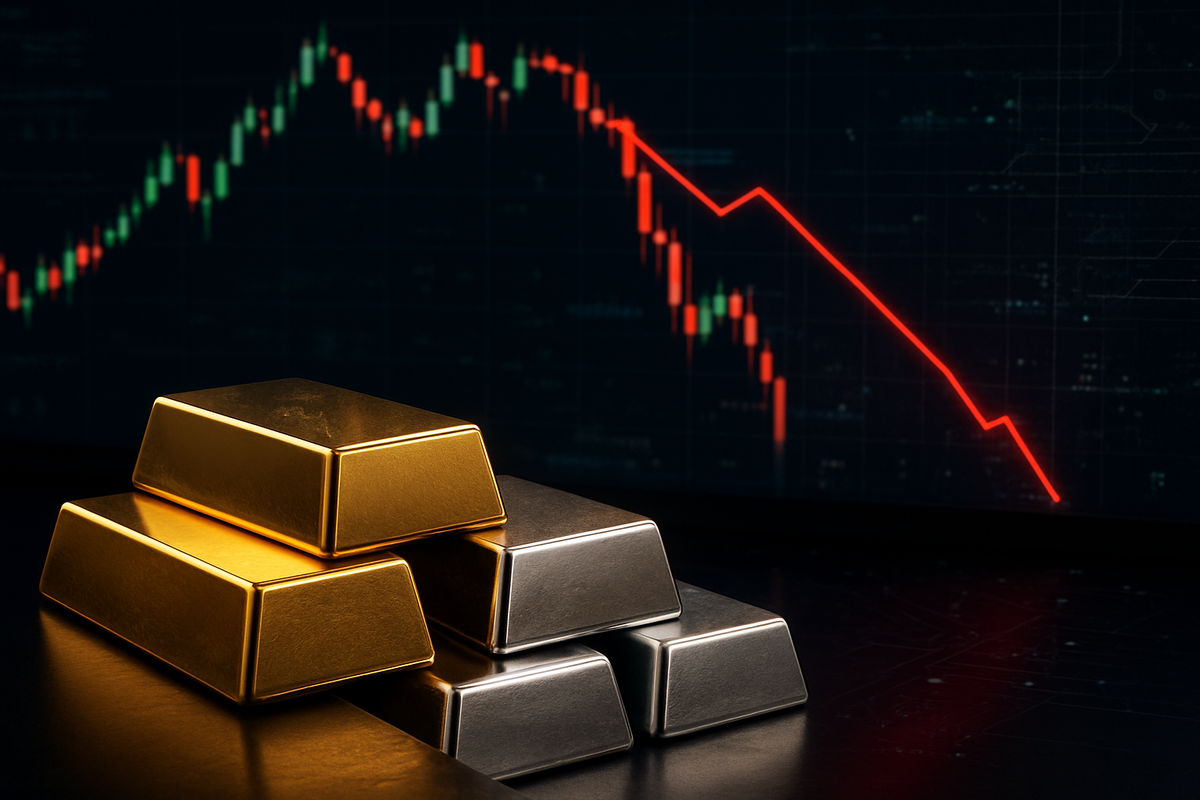
The final week of 2025 closed with a dramatic shift in the precious metals market, as a sharp "Monday correction" on December 29 sent shockwaves through the trading community. After a year defined by a parabolic "Hard Asset Super-Cycle," gold and silver prices experienced their most significant one-day retracement in years, cooling a market that many analysts had begun to describe as overheated.
This sudden dip, which saw silver plunge nearly 11% and gold retreat from its all-time high of over $4,500 per ounce, serves as a stark reminder of the volatility inherent in rapid commodity rallies. While the immediate implications involved heavy liquidations for leveraged traders, the broader market remains focused on whether this is a temporary "healthy digestion" of gains or the beginning of a more sustained bearish trend heading into 2026.
The Perfect Storm: Margin Hikes and Technical Exhaustion
The correction on Monday, December 29, 2025, was not a random occurrence but rather the result of a "perfect storm" of regulatory and technical factors. The primary catalyst was the CME Group’s release of Advisory No. 25-393 on the preceding Friday. This advisory aggressively raised initial margin requirements for silver futures from $22,000 to $25,000 per 5,000-ounce contract. When the markets opened on Monday, this 13.6% hike forced a wave of liquidations among leveraged traders who could no longer meet the increased capital demands, causing a "flash crash" style descent in prices.
Leading up to this moment, the metals had been on a historic multi-week run. Gold reached a record high of $4,549.71 on December 26, while silver touched an intraday peak of $84.03. This rally was fueled by a combination of escalating geopolitical tensions in Eastern Europe and South America, a weakening U.S. Dollar, and a structural "AI Squeeze" in silver demand. However, by the morning of December 29, technical exhaustion had set in. Profit-taking by institutional desks looking to lock in gains before the 2026 tax year added further downward pressure, causing spot gold to fall over 4% to approximately $4,350/oz and silver to settle between $70 and $73/oz.
Initial market reactions were a mix of panic and calculated repositioning. While retail sentiment on social media platforms dipped into fear, institutional analysts at firms like J.P. Morgan and Saxo Bank noted that such a correction was inevitable after silver had gained nearly 181% year-to-date. The liquidity drain during the thin holiday trading window exacerbated the price swings, leading to the largest one-day dollar drop in silver since the early 1980s.
Winners, Losers, and the Equity Disconnect
The fallout from the Monday correction was felt acutely across major exchange-traded funds and mining equities. The iShares Silver Trust (NYSEARCA:SLV) bore the brunt of the volatility, declining between 8.5% and 8.7% in a single session. Trading volume for SLV topped 380 million shares in the final week of December, the highest level since the 2021 silver squeeze. Similarly, the SPDR Gold Shares (NYSEARCA:GLD) dropped 4.5%, marking its first major outflow of the autumn season as investors pivoted toward cash or stabilized assets.
Mining companies, which had already been struggling to keep pace with the meteoric rise in spot prices due to rising capital expenditures, saw significant sell-offs. Newmont (NYSE: NEM) fell roughly 6.9% to close at $99.81, retreating from its record high of $106.34. Barrick Gold (NYSE: GOLD) experienced a similar fate, dropping 4.8% to settle near $33.42. Pan American Silver (NASDAQ: PAAS) closed down 5.69% at $52.24, even as its year-to-date performance remained over 140% higher.
The Global X Silver Miners ETF (NYSEARCA:SIL) declined by 5.29%, highlighting a "glaring disconnect" that has puzzled investors throughout late 2025. Despite silver's triple-digit gains, mining equities in the SIL basket only saw a fraction of those returns. Analysts point to "margin compression" as the culprit; while the value of the metal they mine has skyrocketed, the costs of labor, energy, and exploration have also surged, preventing these companies from fully capturing the upside of the rally. Short-sellers and cash-heavy investors were the primary winners of the day, finding opportunities to enter positions at levels not seen since the mid-November breakout.
A Shift in the Industrial Landscape: The AI Squeeze
The broader significance of this correction lies in the changing identity of silver. By late 2025, the market had largely stopped viewing silver as a mere precious metal, instead reclassifying it as a "strategic critical mineral." This shift is driven by the "AI Squeeze"—a phenomenon where the explosive growth of AI data centers and high-performance computing has created an insatiable demand for high-conductivity silver wiring and connectors. Unlike jewelry or bullion, silver used in these industrial applications is often "consumed" and difficult to recycle, leading to a structural supply deficit of over 200 million ounces.
This event fits into a wider trend of "resource nationalism" and supply chain security. In the months leading up to the correction, major tech conglomerates like Samsung were reportedly bypassing global exchanges to negotiate direct "off-take" agreements with mines in Mexico and Peru. The U.S. government’s decision to add silver to the Critical Minerals list in late 2025 further underscores the metal's importance to national security and the energy transition. The Monday correction, therefore, represents a clash between the "paper" futures market and the "physical" industrial reality.
Historical precedents, such as the Hunt Brothers' silver cornering in 1980 or the 2021 retail-driven squeeze, offer some comparison, but analysts argue that 2025 is fundamentally different. While previous rallies were often driven by speculation, the current environment is underpinned by a severe supply-demand imbalance that regulatory margin hikes can only temporarily mask. The ripple effects are likely to be felt by competitors in the copper and gold sectors, as investors weigh whether other industrial metals are due for similar "strategic" revaluations.
Looking Ahead: 2026 and the Path to Recovery
In the short term, the market is expected to remain volatile as it digests the December 29 shock. However, early signs of "bargain hunting" were already visible by Tuesday, December 30, with silver rebounding nearly 11% to reclaim the $77 level. This suggests that the "buy the dip" mentality remains strong among investors who believe the structural deficit will continue to drive prices higher in the new year. Strategic pivots may be required for mining companies, who must find ways to lower operational costs to better align their stock performance with the underlying commodity.
Long-term possibilities remain bullish for the precious metals sector. With the Federal Reserve expected to continue its rate-cutting cycle into 2026, a weaker dollar will likely provide a persistent tailwind for gold. For silver, the challenge will be the "physical-paper" decoupling. If industrial users continue to secure supply outside of traditional exchanges, the COMEX and London markets may face liquidity challenges, potentially leading to even more explosive price action if another "squeeze" occurs.
Market opportunities may emerge in mid-tier miners and exploration companies that have yet to be acquired by tech giants or major producers. However, investors must watch for potential regulatory changes; if prices continue to rise at a pace that threatens industrial stability, further margin hikes or even government-mandated price caps on "strategic minerals" could become a reality.
Summary of the Market Outlook
The "Monday correction" of late 2025 was a necessary release of pressure for a market that had moved too far, too fast. The key takeaways for investors are the impact of regulatory intervention via margin requirements and the persistent disconnect between spot prices and mining equities. While the 11% drop in silver and 4% drop in gold were jarring, they occurred within the context of a generational bull market driven by the unique demands of the AI era and a shifting global monetary landscape.
Moving forward, the market appears to be in a phase of "healthy consolidation." The long-term significance of the 2025 rally remains intact, supported by central bank accumulation and a critical industrial shortage. Investors should keep a close eye on CME margin announcements, U.S. Dollar Index (DXY) stability, and any further direct-purchase agreements between tech companies and miners. As we enter 2026, the precious metals market is no longer just a haven for inflation-hedgers; it is the frontline of the global race for the materials that power the future.
This content is intended for informational purposes only and is not financial advice.