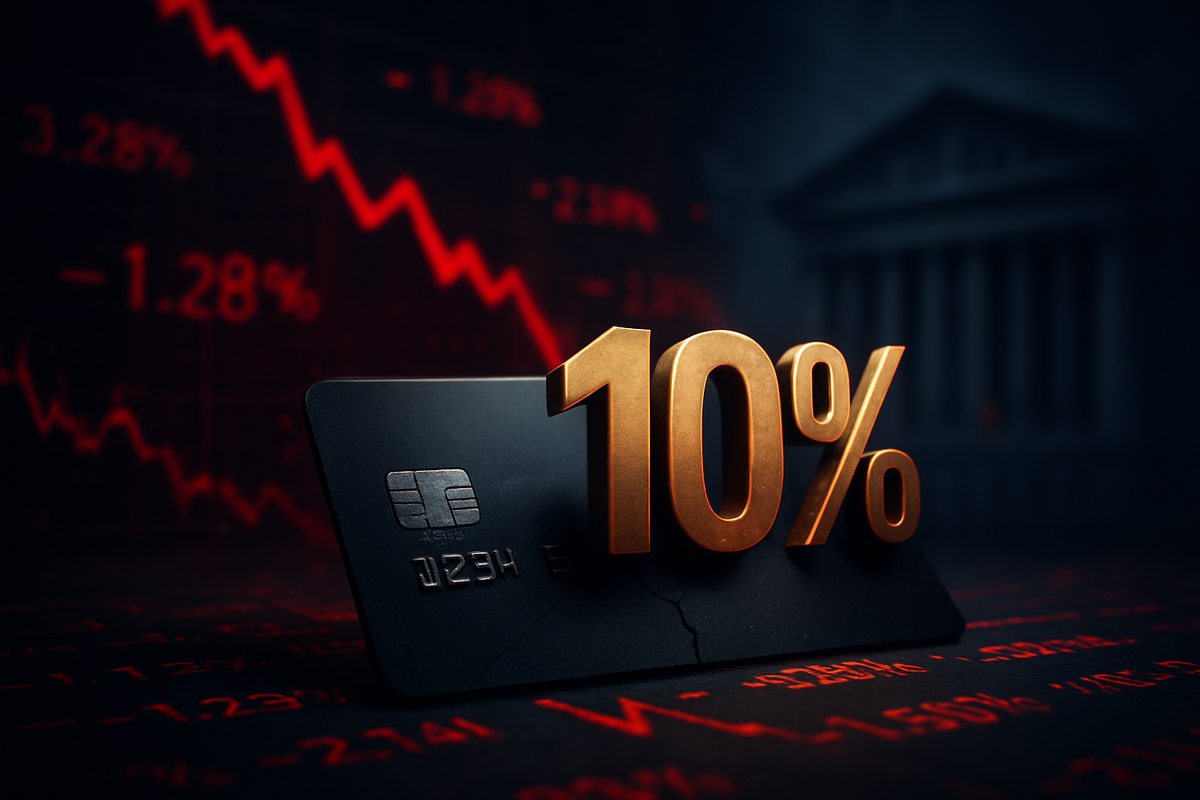
As President Donald Trump approaches the first anniversary of his second term, a revived campaign promise has sent the financial sector into a tailspin. With a self-imposed deadline of January 20, 2026, the administration is moving to implement a nationwide 10% cap on credit card interest rates. This aggressive move, framed as "temporary and immediate relief" for a middle class still grappling with the tail-end of inflationary pressures, has ignited a fierce battle between the White House and the nation’s largest financial institutions.
The immediate reaction in the markets has been nothing short of seismic. Since the President’s renewed call for the cap on January 9, major banking indices have faced their steepest declines in months. Investors are pricing in a reality where the high-margin credit business—a cornerstone of retail banking profitability—could be effectively halved overnight. For the public, it represents a potential windfall in interest savings, but for the financial ecosystem, it threatens to fundamentally rewrite the rules of consumer lending and credit availability.
The Path to the 10% Threshold
The proposal for a 10% cap is not a new iteration of Trump’s economic policy but rather the culmination of a momentum that began in late 2024. During a campaign rally in Savannah, Georgia, in September 2024, Trump first floated the idea, arguing that Americans were being "ripped off" by interest rates that frequently exceed 25% or 30%. While the proposal was initially dismissed by many Wall Street analysts as campaign rhetoric that would never survive the legislative process, the political landscape shifted significantly in 2025.
Throughout 2025, an unusual "horseshoe" coalition formed in Washington. Populist Republicans like Senator Josh Hawley (R-MO) found common ground with progressive stalwarts like Senator Bernie Sanders (I-VT) and Representative Alexandria Ocasio-Cortez (D-NY), all of whom have long advocated for federal usury laws. Although the 10% cap was notably absent from the massive "One Big Beautiful Bill Act" (OBBBA) signed in July 2025, the President’s January 9 social media announcement signaled that he is willing to use the "bully pulpit"—and potentially executive orders—to force the issue by the January 20 anniversary. The administration argues that the Truth in Lending Act and existing emergency powers provide the necessary leverage, though legal scholars remain skeptical.
Winners and Losers: A Sector Under Siege
The financial institutions most deeply embedded in the consumer credit market have felt the sharpest sting. Capital One Financial Corp. (NYSE: COF), a primary lender to subprime and "near-prime" borrowers, saw its shares plummet 6.9% in the days following the announcement. Analysts at KBW noted that Capital One faces a "binary risk": the company must either accept massive earnings compression or begin the painful process of closing millions of accounts for borrowers whose risk profiles are no longer sustainable at a 10% return. Similarly, Synchrony Financial (NYSE: SYF), which manages private-label credit cards for major retailers, saw an 8.4% drop due to its heavy reliance on high-interest retail-brand portfolios.
Even the "too big to fail" giants have not been spared. JPMorgan Chase & Co. (NYSE: JPM) shares fell 4.2%, with CFO Jeremy Barnum warning that such a cap would lead to a "sharp contraction in credit resources," effectively excluding nearly one-third of the American population from the credit market. Citigroup Inc. (NYSE: C), which holds a massive international and domestic card presence, faces an estimated 10% cut to its 2026 earnings per share if the cap is fully implemented. While American Express Co. (NYSE: AXP) has a more affluent, higher-credit-score clientele, its stock fell 5.1% as investors fretted over the potential loss of the high interchange and interest income that funds its lucrative rewards programs.
A Fundamental Shift in Credit Dynamics
This event marks a departure from decades of deregulated interest rates, fitting into a broader global trend of populist economic intervention. Historically, the closest comparison is the Credit Card Accountability Responsibility and Disclosure (CARD) Act of 2009, which restricted certain fee structures but stopped short of a hard interest rate cap. If Trump’s 10% cap holds, the ripple effects will extend far beyond bank balance sheets. The American Bankers Association (ABA) has already warned of a "credit desert" for the estimated 47 million subprime borrowers who rely on cards for liquidity but present too high a default risk for 10% lending.
The regulatory implications are equally profound. If the President attempts to enact this via executive order, it will almost certainly face an immediate stay from federal courts, potentially escalating to the Supreme Court. This creates a period of unprecedented "regulatory whiplash" where banks must decide whether to comply with a looming deadline or wait for a judicial reprieve. Furthermore, competitors in the "Buy Now, Pay Later" (BNPL) space and non-bank fintechs may see a temporary surge in demand, though they too could eventually fall under the same regulatory umbrella as the government seeks to close "usury loopholes."
Looking Ahead: The Battle for January 20
In the short term, the market should prepare for a barrage of litigation. Trade groups representing the financial sector are expected to file lawsuits within days, arguing that the President lacks the unilateral authority to override private contracts. For the banks, the strategic pivot has already begun: many are quietly preparing to increase annual fees, eliminate "no-fee" card options, and scale back rewards programs like cash-back and travel points to offset the lost interest revenue. The "Golden Age of Credit Rewards" may be the first unintended casualty of the 10% cap.
Longer-term, the industry may see a shift toward more "subscription-based" banking models, where consumers pay a flat monthly fee for access to credit rather than fluctuating interest. If the 10% cap becomes permanent law through a bipartisan legislative push, it could lead to a permanent contraction in consumer spending among lower-income groups who lose access to their primary safety nets. Conversely, proponents argue it will force a healthier deleveraging of the American consumer, who currently carries over $1 trillion in credit card debt.
Conclusion: A Market in Transition
The move to cap credit card interest at 10% is perhaps the most significant challenge to the American banking model in the post-2008 era. While the populist appeal of the policy is undeniable—potentially saving consumers over $100 billion in interest payments annually—the structural risks to the banking sector are immense. The next few months will be defined by volatility as the market weighs the likelihood of the cap surviving a legal challenge.
Investors should closely watch the Q1 2026 earnings calls from major issuers like JPMorgan Chase & Co. (NYSE: JPM) and Capital One Financial Corp. (NYSE: COF) for guidance on how they plan to de-risk their portfolios. Additionally, any movement in the Supreme Court regarding presidential authority over financial contracts will be a primary market mover. Whether this is a masterstroke of consumer protection or a disruption that leads to a credit freeze remains to be seen, but the era of 29.99% APR is officially on notice.
This content is intended for informational purposes only and is not financial advice.