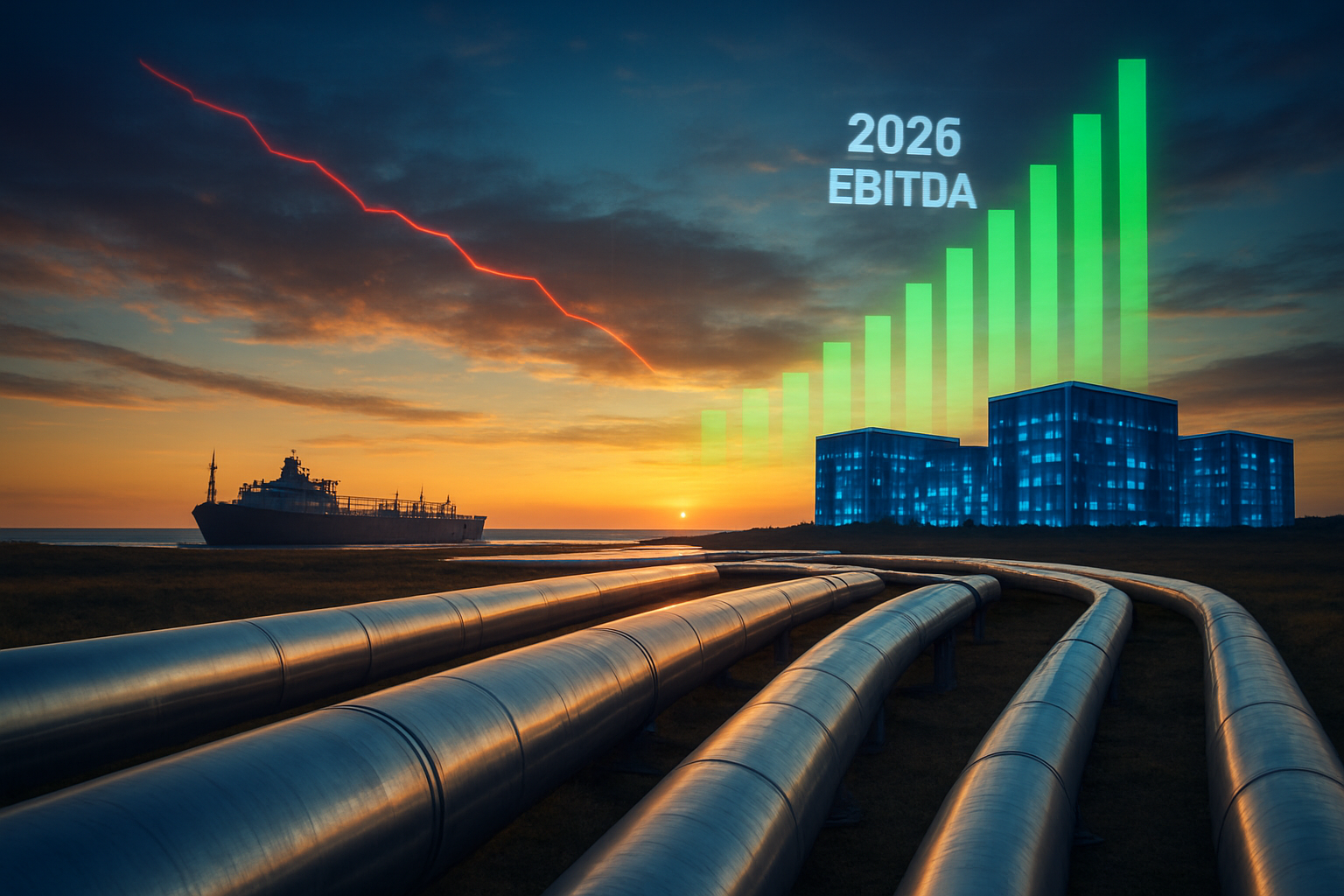
As the global energy market enters the first quarter of 2026, a striking divergence has emerged between the price of raw commodities and the financial health of the companies that transport them. While crude oil prices face significant downward pressure—with West Texas Intermediate (WTI) hovering near the $55 per barrel mark due to a persistent global supply glut—the midstream energy sector is projecting a year of record-breaking stability. Major infrastructure players have released their 2026 EBITDA guidance, signaling mid-to-high single-digit growth and a definitive decoupling from the volatility of the oil patch.
The immediate implication for investors is a reinforced "safe haven" status for energy infrastructure. As exploration and production (E&P) companies tighten their belts in response to lower prices, midstream giants are leveraging long-term, fee-based contracts and a massive structural pivot toward natural gas demand. This shift is being fueled by the dual engines of liquefied natural gas (LNG) export expansion and the burgeoning power needs of AI-driven data centers, ensuring that even if the price of a barrel drops, the volume of energy moving through the pipes remains at an all-time high.
A New Era of Financial Fortitude
In the opening weeks of 2026, the midstream sector has provided a masterclass in defensive positioning. Energy Transfer (NYSE: ET) led the charge, issuing an Adjusted EBITDA guidance range of $17.3 billion to $17.7 billion for the fiscal year. This represents a significant reacceleration of growth, underpinned by the completion of major projects like the Mustang Draw processing plants and the Nederland Flexport expansion. Similarly, Enbridge (NYSE: ENB) reaffirmed its multi-year growth profile, projecting 2026 EBITDA between C$20.2 billion and C$20.8 billion, a steady climb supported by its recent integration of massive U.S. gas utility assets.
The timeline leading to this moment has been defined by a multi-year shift toward "capital discipline." Since the volatility of the early 2020s, the industry has transitioned from a "growth-at-all-costs" model to one focused on balance sheet strength and free cash flow. This strategy is bearing fruit in 2026. Kinder Morgan (NYSE: KMI) has guided for nearly $8.7 billion in Adjusted EBITDA, a 4% increase over 2025, specifically citing a "massive buildout" to serve utility power demand. Market reactions have been tellingly positive; while broad energy indices have dipped alongside oil prices, the Alerian MLP ETF (NYSE: AMLP) has remained resilient, with investors gravitating toward its projected 8.5% yield and the sector's historically low leverage ratios.
Winners and Losers in a Bifurcated Market
The primary winners in this environment are companies with heavy exposure to natural gas and natural gas liquids (NGLs). The Williams Companies (NYSE: WMB) is positioned as a top-tier beneficiary, with its "Wellhead to Water" strategy and the Transco pipeline expansion driving an estimated 2026 EBITDA of approximately $8.4 billion. As coal plants continue to retire and AI data centers demand 24/7 baseload power, WMB’s infrastructure is becoming more essential regardless of where crude oil trades. Targa Resources (NYSE: TRGP) also stands to gain, as its dominant position in Permian Basin gathering and processing allows it to capture high volumes even if producers slow down new drilling.
Conversely, the "losers"—or at least those facing more headwinds—are smaller, oil-leveraged midstream firms and those with higher exposure to spot prices rather than fixed-fee contracts. While Plains All American Pipeline (Nasdaq: PAA) remains a stable player, its heavy reliance on crude oil volumes in the Permian means its growth ceiling may be lower than its gas-focused peers in a $50–$55 oil environment. However, even these firms are protected by "take-or-pay" contracts, which require producers to pay for pipeline capacity whether they use it or not, effectively insulating the midstream sector from the immediate pain being felt by oil field service providers.
The Structural Shift: AI, LNG, and the Fee-Based Fortress
The wider significance of the 2026 guidance lies in the sector's fundamental transformation. Historically, midstream stocks traded in lockstep with crude oil. Today, that correlation is breaking. The industry has built a "fee-based fortress," where 80% to 95% of revenue is derived from fixed fees for moving, storing, or processing energy. This event fits into a broader trend of "energy infrastructure as a utility," where the reliability of the cash flow is valued more than the underlying commodity's upside potential.
The ripple effects are reaching beyond the energy sector. The stability of midstream EBITDA is a critical signal for the broader economy, indicating that the U.S. energy export machine remains fully operational despite lower global prices. Furthermore, the 2026 guidance highlights a regulatory and policy shift; with the completion of several long-delayed pipelines, the industry is entering a "harvest" phase. Unlike the shale bust of 2014-2016, when midstream companies were over-leveraged and forced to cut dividends, the 2026 versions of Enterprise Products Partners (NYSE: EPD) and its peers enter the year with record-low debt and a focus on returning capital to shareholders through buybacks and distribution hikes.
Navigating the 2026 Horizon
Looking ahead, the midstream sector is expected to reach a major "free cash flow inflection point" by the second half of 2026. For a company like Enterprise Products Partners (NYSE: EPD), a projected reduction in capital expenditures from $4.5 billion in 2025 to roughly $2.3 billion in 2026 is expected to trigger a surge in excess cash. This will likely lead to a wave of opportunistic share buybacks and potential M&A activity, as larger players look to consolidate smaller, undervalued assets that are struggling with the low-oil-price macro environment.
In the short term, the market will be watching for the official February earnings calls to see if companies like Williams Companies (NYSE: WMB) increase their long-term growth targets. The primary challenge remains the pace of the energy transition and potential regulatory hurdles for new gas infrastructure. However, the immediate opportunity is clear: as long as the world demands electricity for data centers and heat for homes, the "toll-booth" model of the midstream sector appears increasingly bulletproof.
Strategic Takeaways for the Year Ahead
The 2026 EBITDA guidance for midstream energy marks a definitive milestone in the sector's evolution. The key takeaway for the market is that infrastructure stability is no longer a theory—it is a demonstrated reality. By decoupling from the price of oil and anchoring their growth in natural gas and NGLs, these companies have provided a roadmap for navigating a volatile energy transition. The Global X MLP & Energy Infrastructure ETF (NYSE: MLPX) and similar instruments are likely to see continued inflows as investors seek yield without the typical commodity-price risk.
As we move through 2026, investors should keep a close eye on natural gas storage levels and the progress of major LNG export terminals along the Gulf Coast. Any acceleration in AI data center construction will serve as a further tailwind for the sector. While the broader energy market may be feeling the chill of $50 oil, the midstream industry is proving that in the world of energy, the pipes are often more valuable than the product they carry.
This content is intended for informational purposes only and is not financial advice.