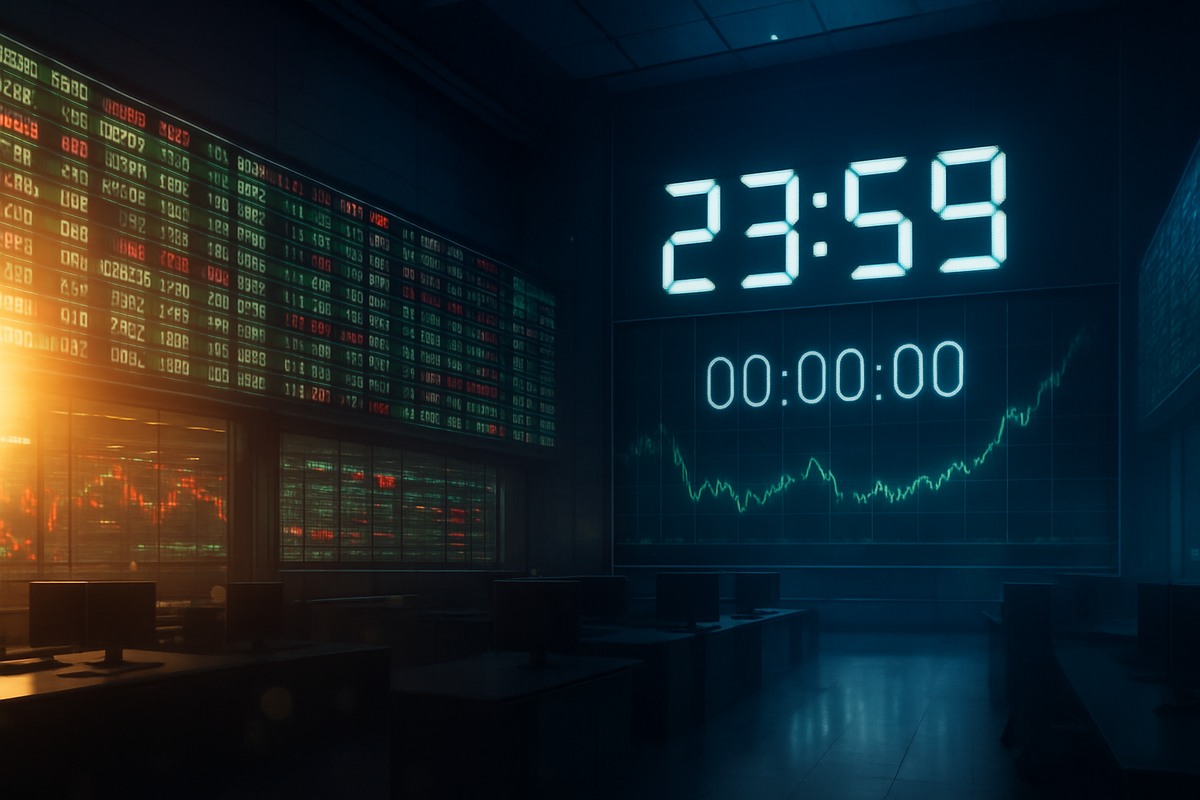
As the final days of 2025 wind down, investors and institutional traders are readying their portfolios for the annual transition. The New York Stock Exchange (NYSE: ICE) and the Nasdaq Stock Market (NASDAQ: NDAQ) have officially confirmed their holiday schedules, providing a clear roadmap for the final trading sessions of the year. With the current date being December 29, 2025, market participants have only two full trading sessions remaining before the 2026 calendar officially begins.
The immediate implication for the market is a typical year-end thinning of liquidity, though the schedule itself contains a few nuances that often surprise casual investors. While New Year’s Day is a universally recognized market holiday, the hours leading up to the ball drop in Times Square remain surprisingly robust, offering a final window for tax-loss harvesting and portfolio rebalancing.
Full Steam Ahead on New Year's Eve
Contrary to popular belief, New Year’s Eve—Wednesday, December 31, 2025—is not an early-close day for the U.S. equity markets. Both the New York Stock Exchange and the Nasdaq will operate during their standard trading hours, from 9:30 AM to 4:00 PM ET. This provides a full eight-and-a-half-hour window for traders to finalize their 2025 positions. However, the fixed-income side of the house will see a different rhythm. The Securities Industry and Financial Markets Association (SIFMA) has recommended an early close for the bond markets at 2:00 PM ET on December 31, a move that typically curtails volatility in interest-rate-sensitive products late in the afternoon.
The transition to the new year will be marked by a total cessation of activity on Thursday, January 1, 2026. All major U.S. exchanges, including the options and commodities pits at the CME Group (NASDAQ: CME), will be closed in observance of New Year’s Day. This closure is a federal holiday and a mandatory break for the financial system, allowing for year-end audits and system resets. Trading is scheduled to resume at the normal opening bell on Friday, January 2, 2026.
Key stakeholders, from high-frequency trading firms to retail brokerages like Charles Schwab (NYSE: SCHW), have already alerted clients to these hours. While the equity markets remain open on the 31st, institutional volume is expected to be significantly lower than average as many fund managers have already "locked in" their performance for the year. This lower volume can sometimes lead to exaggerated price movements if unexpected news hits the wires, a phenomenon often referred to as "thin-market volatility."
Winners and Losers in the Holiday Lull
The primary beneficiaries of the full-day session on December 31 are the exchange operators themselves, such as Intercontinental Exchange and Nasdaq Inc. By maintaining a full trading day, these entities maximize transaction fee opportunities during a period when many global markets might already be winding down. Additionally, retail-focused platforms like Robinhood Markets (NASDAQ: HOOD) often see a surge in "New Year’s Resolution" investing, as individual traders move capital into accounts in anticipation of the new tax year.
On the losing side, the lack of liquidity can be a disadvantage for large institutional players trying to move significant blocks of stock without moving the price. For these "whales," the final hours of 2025 are often a period of forced inactivity or high-cost execution. Furthermore, the early bond market close on December 31 can create a "disconnect" between equity prices and treasury yields, potentially frustrating algorithmic traders who rely on the correlation between the two asset classes for hedging.
Market makers and liquidity providers also face a unique challenge during this window. With fewer participants in the market, the "bid-ask spread"—the difference between the price to buy and the price to sell—tends to widen. This increases the cost of trading for everyone involved, though it can provide a more profitable environment for the few market makers who remain active and are willing to take on the risk of holding inventory over the holiday.
The Broader Market Context and Historical Precedents
The New Year’s schedule fits into a broader seasonal trend known as the "Santa Claus Rally," a historical tendency for the stock market to rise during the last five trading days of December and the first two of January. Since 1950, this period has seen the S&P 500 (NYSEARCA:SPY) post a positive return roughly 75% of the time. The full trading day on December 31, 2025, serves as the penultimate chapter of this seasonal phenomenon, often characterized by "window dressing," where fund managers buy winning stocks to make their portfolios look better in year-end reports.
From a regulatory standpoint, the New Year’s closure is one of the nine standard holidays observed by the NYSE each year. Historical comparisons show that while the market used to occasionally close early on New Year's Eve in the mid-20th century, the modern standard has been a full day of trading unless the holiday falls on a weekend. This consistency is vital for global financial stability, as the U.S. markets serve as the primary liquidity hub for the world.
The ripple effects of the U.S. closure are felt globally. European and Asian markets often see reduced volume on January 1 as well, though some international exchanges operate on different holiday calendars. The synchronization of the U.S. market closure ensures that global clearinghouses and settlement systems can reconcile the massive amounts of data generated throughout the fiscal year without the pressure of live trading.
Looking Ahead to Q1 2026
As the markets reopen on January 2, 2026, the focus will immediately shift to the "January Effect." This is a perceived trend where stocks, particularly small-caps, tend to outperform in the first month of the year as tax-related selling ends and fresh capital flows into the market. Investors will be watching closely to see if the momentum from late 2025 carries over into the first quarter of the new year.
In the short term, the first week of January 2026 will be a litmus test for market sentiment. Economic data releases, including the initial jobless claims and manufacturing surveys, will provide the first fundamental signals of the new year. Strategically, many firms will be looking to adapt to the interest rate environment of 2026, with the Federal Reserve's projected path remaining the dominant narrative for both equity and fixed-income participants.
The transition into 2026 also brings new contribution limits for retirement accounts and fresh corporate budgets. This influx of capital often leads to a "re-risking" phase where investors move out of defensive positions held for year-end safety and back into growth-oriented sectors. The success or failure of this transition in the first few days of January often sets the tone for the entire first quarter.
Summary of the 2025-2026 Transition
The 2025-2026 New Year’s holiday schedule is a study in standard financial procedure. The confirmation that the NYSE and NASDAQ will remain open for full hours on December 31 provides a final opportunity for market activity, while the total closure on January 1 offers a necessary pause for the global financial engine. For investors, the key takeaway is the divergence between equity and bond market hours on New Year’s Eve, which requires careful timing for multi-asset strategies.
Moving forward, the market will be characterized by the "January Effect" and a renewed focus on 2026 earnings projections. While the holiday lull often brings lower volumes, the structural importance of these final sessions cannot be overstated. They represent the closing of one chapter and the immediate preparation for the next.
Investors should keep a close eye on volume levels on January 2, as the return of institutional players will provide the first true indication of where the "smart money" is heading in 2026. As always, while seasonal trends like the Santa Claus Rally provide a historical backdrop, the underlying economic fundamentals will remain the primary driver of market direction in the months to come.
This content is intended for informational purposes only and is not financial advice