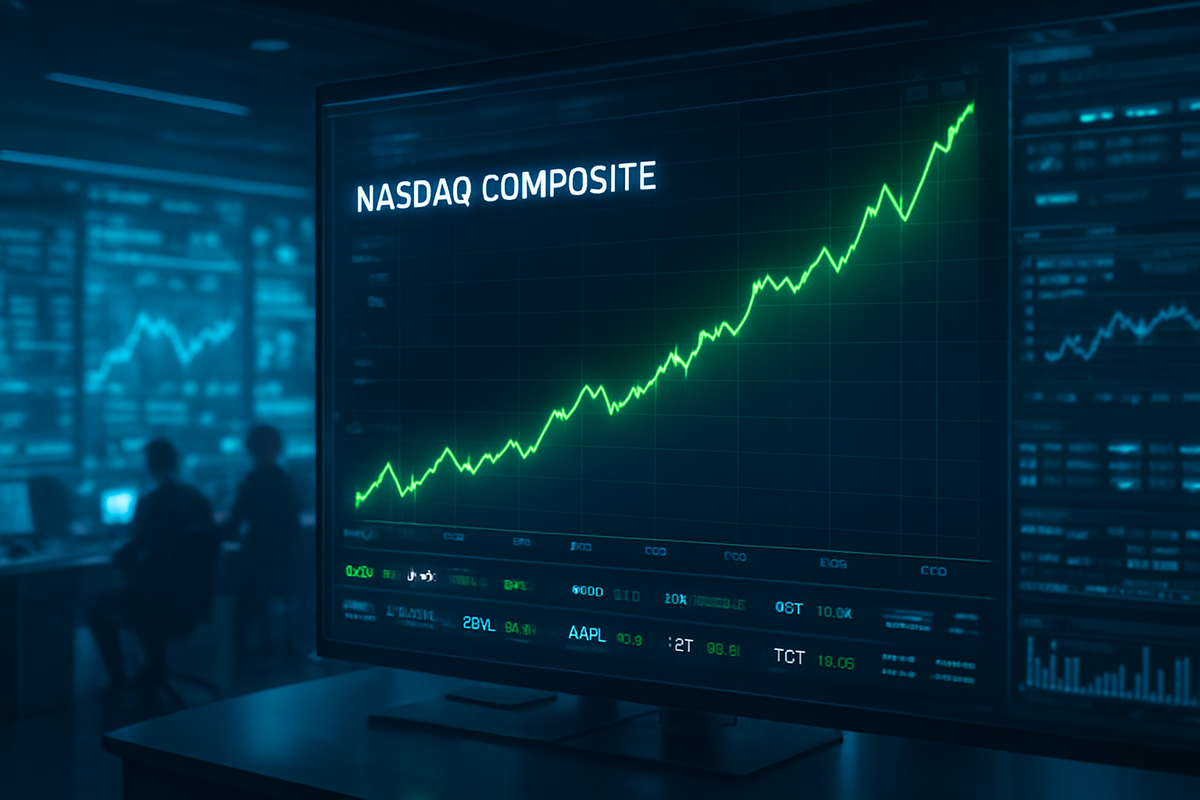
The high-flying tech sector experienced a moment of sobriety on Friday, December 26, 2025, as the Nasdaq Composite (INDEXNASDAQ: .IXIC) saw a modest "wobble" in early trading. This slight retreat follows a powerful five-day winning streak that propelled the index to record levels just before the Christmas holiday. The dip marks a pause in what has been a resilient year-end "Santa Claus rally," as investors begin to recalibrate their portfolios for the final trading days of the year and the transition into 2026.
The immediate implications of this wobble suggest a market that is searching for a floor after a period of rapid appreciation. While the decline is statistically minor—hovering around a 0.4% drop in the opening hours—it signals a shift from the unbridled optimism seen earlier in the week. Market participants are now grappling with the tension between robust economic growth and the "higher-for-longer" interest rate environment that appears increasingly likely as the calendar turns.
A Tale of Two Decembers: From Volatility to Momentum
The path to this week's five-day winning streak was far from linear. December 2025 began with significant turbulence, characterized by a sharp mid-month slump that threatened to derail the year’s gains. On December 12, the Nasdaq suffered its worst single-day performance in three weeks, falling 1.7%. This "wobble" was largely precipitated by disappointing guidance from enterprise tech giants. Oracle (NYSE: ORCL) saw its shares plummet 10.8% following reports of slowing cloud momentum, while Broadcom (NASDAQ: AVGO) fell 11.4% as investors reacted poorly to future margin forecasts, despite the company beating profit estimates.
However, the narrative shifted dramatically in the third week of the month. A series of positive economic indicators, including a revised Q3 GDP growth report of 4.3%, reignited the "no-landing" scenario for the U.S. economy. This macroeconomic strength, combined with the successful resolution of long-standing regulatory hurdles—such as the finalized sale of TikTok’s U.S. operations to a joint venture involving Oracle and Silver Lake—helped restore investor confidence. By the close of business on December 24, the Nasdaq had secured five consecutive days of gains, closing at a robust 23,613.31. Today’s minor pullback is widely viewed by analysts as a natural "breather" after such a concentrated run.
Winners and Losers in the Year-End Shuffle
The recent volatility has created a clear divergence between AI infrastructure plays and traditional software providers. Among the winners, Micron Technology (NASDAQ: MU) has emerged as a late-December standout, gaining 3.8% in the final session before Christmas. The memory chip maker continues to benefit from the insatiable demand for high-bandwidth memory (HBM) required for AI servers. Similarly, Nvidia (NASDAQ: NVDA) remains the cornerstone of the tech rally; despite the mid-month jitters, it has maintained its position as a preferred year-end holding for institutional investors, with many analysts raising price targets in anticipation of continued AI data center expansion in 2026.
Conversely, the "losers" of this recent cycle are those companies facing "valuation fatigue" or execution hurdles. Oracle (NYSE: ORCL) is still working to regain the ground lost during its double-digit slide earlier this month, as the market demands more proof of its cloud scaling capabilities. Broadcom (NASDAQ: AVGO) also faces a skeptical audience, with investors questioning if the company can maintain its premium valuation if AI-related growth begins to plateau. Meanwhile, mega-cap staples like Microsoft (NASDAQ: MSFT) and Apple (NASDAQ: AAPL) have acted as stabilizing forces, showing less volatility than their semiconductor counterparts but also capturing less of the "Santa Claus" upside.
The Broader Context: AI Resilience and the "No-Landing" Economy
This recent market behavior fits into a broader 2025 trend where Artificial Intelligence is no longer just a speculative theme but the primary driver of market fundamentals. The Nasdaq is on track to finish the year with an approximate 22% gain, marking its third consecutive year of double-digit growth. This streak is historically significant, drawing comparisons to the late 1990s, though today’s rally is backed by significantly stronger earnings and cash flows. The "wobble" seen today is a reflection of the market’s sensitivity to interest rates; as the economy grows at a "hotter-than-expected" 4.3% clip, the Federal Reserve’s path to rate cuts in 2026 becomes increasingly obscured.
The ripple effects are being felt across the competitive landscape. As hardware leaders like Nvidia and Micron surge, software competitors are being forced to accelerate their AI integration to justify their multiples. Furthermore, the resilience of the U.S. tech sector has continued to draw capital away from international markets, reinforcing the "American exceptionalism" narrative in the global financial system. However, this concentration of wealth in a few dozen tech names remains a point of concern for regulators, who are keeping a close eye on market monopolization and the systemic risks posed by the sector's outsized influence on the broader indices.
The Road to 2026: Strategic Pivots and Scenarios
Looking ahead, the short-term outlook for the Nasdaq remains tied to the "January Effect," where tax-loss harvesting and fresh capital inflows often dictate the direction of the first month. Strategic pivots are already underway; many hedge funds are reportedly rotating out of high-multiple "story stocks" and into companies with proven AI-driven revenue streams. The key challenge for 2026 will be whether the "AI infrastructure" phase can successfully transition into a "software monetization" phase. If companies cannot show a direct return on investment from their massive AI capital expenditures, the "wobbles" of late 2025 could turn into a more sustained correction.
Market opportunities are likely to emerge in edge computing and cybersecurity, two sectors that have lagged behind the semiconductor boom but are essential for the next stage of AI deployment. Conversely, the primary risk remains a "re-acceleration" of inflation, which would force the Fed to maintain high rates, potentially squeezing the valuations of growth-dependent tech firms. Investors should prepare for a 2026 that is more selective, where the rising tide no longer lifts all boats, but instead favors those with the most efficient balance sheets.
Closing the Books on a Resilient Year
As the Nasdaq concludes its final full week of 2025, the takeaway for investors is one of cautious optimism. The five-day winning streak leading into Christmas proved that the appetite for tech remains strong, even if today’s wobble suggests that the market is not immune to gravity. The year has been defined by the dominance of AI and the surprising resilience of the U.S. consumer, both of which have helped the Nasdaq overcome significant mid-month volatility to post a 22% year-to-date gain.
Moving forward, the market is likely to remain in a "wait-and-see" mode until the first batch of Q4 earnings reports arrive in late January. Investors should watch for any shifts in corporate guidance regarding AI spending and keep a close eye on the 10-year Treasury yield, which continues to serve as the ultimate arbiter for tech valuations. While the "Santa Claus rally" may be losing some steam as the year closes, the fundamental drivers of the tech sector appear intact for the start of 2026.
This content is intended for informational purposes only and is not financial advice.