Strongly Believes that Structural Discount to Net Asset Value Due to Underperformance and Misalignment of External Manager and Common Shareholders Cannot be Repaired
ADW Capital Analysis Supports Potential Valuation of $26.00 Per Share Via Liquidation
MIAMI BEACH, Fla., Feb. 24, 2026 (GLOBE NEWSWIRE) -- ADW Capital Management, LLC, which beneficially owns approximately 7.65% of the shares outstanding of Compass Diversified (NYSE: CODI) (the “Company”) through ownership of shares and stock options, today issued an open letter to the Company’s board of directors calling for the Company to immediately commence a strategic review process and orderly liquidation of the Company to preserve value for shareholders.
A full copy of the letter is below:
February 24, 2026
Board of Directors
Compass Diversified Holdings
301 Riverside Avenue
Second Floor
Westport, CT 06880
Dear Members of the Board:
ADW Capital Partners, L.P. (“ADW” or the “Fund”) is a substantial shareholder of Compass Diversified (NYSE: CODI) (“CODI” or the “Company”) beneficially owning approximately 7.65% of the shares outstanding through ownership of shares and stock options. After a comprehensive review of the Company’s financial /share price performance, governance structure, capital allocation record, heavily discounted valuation, and onerous management services agreement, we have reached a definitive and damning conclusion: We believe the structural misalignment embedded in the Company’s management services agreement with its external manager cannot be credibly repaired / rectified and the most recent failure to prevent fraudulent activity at its Lugano subsidiary only further highlights this. The external manager has limited ownership and downside in the Company and has benefited from ~20 years raising equity/debt/preferred at a discount to NAV all at the expense of common equity. Accordingly, the only responsible action available to the Board is to immediately commence a formal strategic review process with the objective of pursuing an orderly liquidation of the Company to preserve value for shareholders. Based on our analysis, ADW Capital expects that the value the Company could achieve via liquidation is in excess of $26.00 per share vs. yesterday’s share price of $7.791.
Persistent Underperformance and Structural Discount
Since the Company’s IPO, CODI’s shares have traded at a meaningful and persistent discount to net asset value (“NAV”) based on our estimates. This discount has endured across varying market environments and operating cycles. In our view, the persistence of this valuation gap is evidence that the market is discounting the Company’s structure and the lack of alignment between the external manager and its shareholders, not merely the quality of its underlying assets.
A permanent capital vehicle that trades at a structural discount cannot compound capital efficiently for common shareholders. Why is this?
Fundamental Misalignment of Incentives
Under the Company’s current Management Services Agreement with its external manager, Compass Group Management LLC, the external manager receives ~2.0% of “Adjusted Net Assets” at current asset levels, with potential incremental incentive compensation.2 This compensation is based on capital employed — not per-share value creation or stock price performance.
The consequences of this are unavoidable and inexcusable: increasing capital increases fee potential and shrinking the balance sheet reduces fee potential. Repurchasing the Company’s discounted shares would reduce fees by reducing capital available to make new investments in fee generating assets and liquidating assets eliminates fees entirely. Share price underperformance does not reduce compensation in any way, shape, or form.
This is not a temporary issue or one that can be fixed. It is a structural conflict of interest baked into the Management Services Agreement. No cosmetic governance adjustment can reconcile this economic divergence.
How Have Shareholders Suffered?
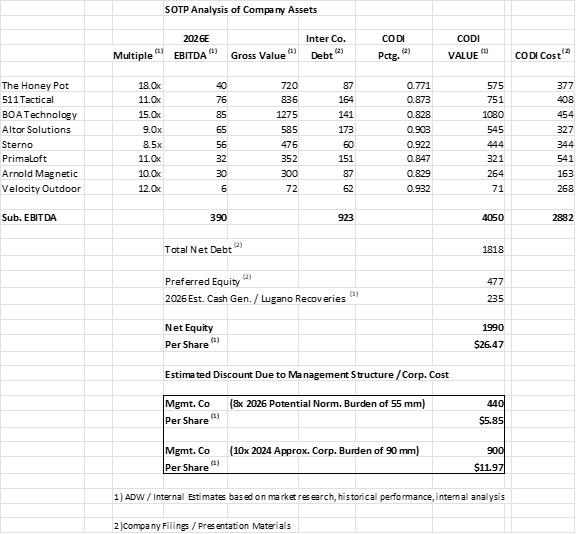
The Company / Management will argue that raising debt increases returns for equity and that the issuance of preferred stock is a low cost / low dilution way to fund great investments. This only holds true when the investments are successful or have a recovery. As you will be able to see in our analysis below, the Company only has $923 mm of inter-company debt at the subsidiary level and another $894 mm of additional net debt at the parent company. Why should the parent company have any additional debt if it is just a consolidator / manager of the subsidiaries?
Simply put, the debt differential largely shows the equity hole created by money lent / equity invested for Lugano with little recovery! To simplify, one catastrophic investment by the Company’s external manager likely cost the common shareholders approximately $10.00 of NAV!3
The same point can be made a different way. CODI’s total cost of its stakes is roughly $2,882 mm and our estimate of net equity value after all remaining debt and preferred and including some recovery for Lugano is $1,996 mm.
Furthermore, do we dare to try to calculate the sum-total of the management fees that were paid over ~20 years for this performance? The Company claims corporate expense is roughly $13 mm, but with ongoing one-off expenses it appears to be closer to $20 mm. When you layer on management fees that were $74.8 mm in 2024, the true cost of the Company’s structure has approximated almost $90 - $95 mm in a single year when you include management fees being deducted at the subsidiary level!4
While the Company has intimated that this burden could normalize around $55 mm, we cannot really see a path there without asset sales. If the market is capitalizing the corporate cost of running the business at a reasonable 10x $90 mm of corporate, management’s share of NAV is meaningfully higher than the value of shareholders -- $7.79 vs $11.97!5
Sum-of-the-Parts Asset Valuation and Estimated Discount Analyses
Our calculations indicate a potential valuation via liquidation in excess of $26.00 per share, and show that the market is applying a massive discount to Company shares based on its external management structure
So, what we have now is a $15.00 dollar IPO share that is now worth ~$7.79? Management will point to the $25.876 of dividends that were paid over the ~20 years, but what has that manifested in IRR for a day one shareholder? By our calculations, that is roughly an annualized IRR of about 4 percent!7 Compare this to the S&P 500 with dividends re-invested which was in the ~9.5 percent range8.
What happened? The same thing that we see happen at many other similarly structured companies. The external manager made a lot of poor investments, issued stock-based compensation and a variety of equity, debt, and preferred to fund new investments, and collected fees while shareholders suffered!
Trying to reconcile the maze of private placements, ATMs, and offerings since the Company’s inception is likely a fool’s errand. But we would like to draw your attention to one simple fact. When the Company went public it had ~19.5 mm shares outstanding post-IPO and today it has roughly 75.2 mm9. So, the Company has issued 55.7 mm shares over its life as a public company while its share price has collapsed from $15.00 a share to $7.79 a share
The Discount to NAV is Unlikely to Meaningfully Narrow Under the Current Structure
The Board must confront the reality that the Company’s discount to NAV is based on structural and reputational issues, and unlikely to meaningfully narrow under the current structure. Investors do not assign a persistent discount without reason. The market’s message is clear: investors appear convinced that management will continue to prioritize actions / capital allocation decisions that increase and perpetuate their fee stream at the expense of common shareholders.
Absent complete elimination of the external management structure, we believe this discount will remain and perhaps get worse. Without closing the gap, shareholders cannot realize the Company’s intrinsic value. In our view, continuing to operate under the existing structure will continue to destroy shareholder value, and we are concerned that management will issue additional equity at the expense of common shareholders.
Fiduciary Duties Require Value Realization
The Board’s fiduciary obligation is to maximize value for shareholders — not preserve the Company’s existing structure for the benefit of the external manager. When structural misalignment prevents value realization and cannot be credibly remedied, the only rational course is for shareholders to push for orderly liquidation. The risk of another Lugano or additional capital raises that impair common equity is too great!
Orderly Liquidation Maximizes Shareholder Value
An orderly liquidation would involve marketing portfolio companies to strategic and financial buyers, repaying subsidiary and holding company obligations, distributing net proceeds directly to shareholders, and terminating the management services agreement.
We believe private market valuation of the Company’s portfolio greatly exceeds the valuation implied by the Company’s discounted public holding company structure, based on our sum-of-the parts analysis above. Liquidation would enable the Company to release that trapped shareholder value / capital.
The issue facing CODI is structural. The misalignment between the best interests of common equity and management cannot be fixed / repaired. The Board cannot stand by and let this destruction of shareholder value continue!
In Summary:
It is indefensible for the external manager to extract premium private equity fees for “oversight” when it missed a multi-year fraud at Lugano that decimated shareholder value.
With millions in management fees flowing from the Company to its external manager regardless of share price performance, we believe Elias Sabo (the Company’s CEO) has little incentive to disrupt a status quo that benefits him. Why wouldn’t he just keep enjoying the ride in a Flying Lizard Motorsports BMW M4 GT3 during his high-speed weekends in the SRO America series?
We demand the Board to fulfill its fiduciary duties promptly and decisively. We are prepared to pursue all available actions to ensure shareholder interests are protected.
Respectfully,
Adam Wyden
Managing Member of ADW Capital Partners, L.P.
About ADW Capital Management, LLC
ADW Capital Management, LLC is a concentrated, long-biased investment partnership founded by Adam Wyden in 2010.
Contact
Adam Wyden
ADW Capital Management, LLC
(646) 684-4086
adam@adwcapital.com
1 Valuation based on ADW estimates and analysis
2 Company filings
3 Based on ADW estimates and analysis
4 Company filings / Based on ADW estimates and analysis
5 Based on ADW estimates and analysis
6 Company filings
7 Based on ADW estimates and analysis
8 Based on ADW estimates and analysis
9 Company filings
A photo accompanying this announcement is available at https://www.globenewswire.com/NewsRoom/AttachmentNg/708b0b09-b74d-4f57-b7eb-16721369fbe7