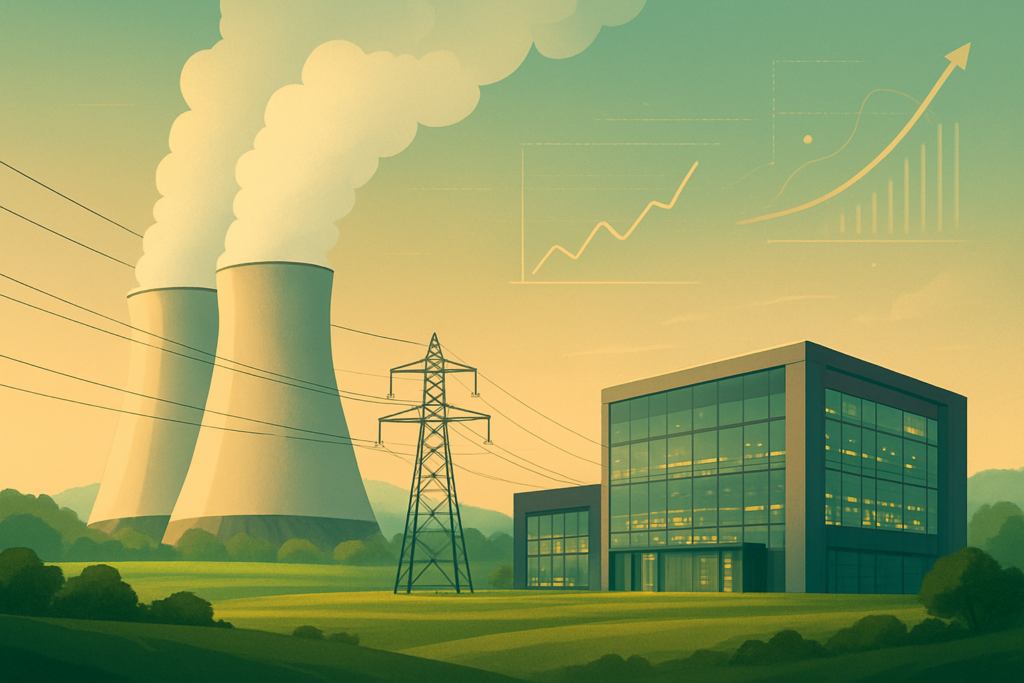
As of February 26, 2026, the intersection of heavy industry and high technology has created a new class of "market darlings" that few investors would have predicted five years ago. At the center of this transformation is Vistra Corp (NYSE: VST). Once viewed as a legacy utility provider tethered to the cyclical nature of Texas electricity prices, Vistra has reinvented itself as a cornerstone of the global Artificial Intelligence (AI) infrastructure. By leveraging a massive nuclear energy portfolio and a sophisticated retail engine, the Irving, Texas-based company has become a primary beneficiary of the "AI power crunch"—the massive surge in electricity demand required to fuel the next generation of data centers. Today, Vistra is no longer just a power company; it is an essential partner to the world’s largest hyperscalers.
Historical Background
Vistra’s journey is one of the most dramatic corporate "phoenix" stories in American finance. Its roots trace back to TXU Corp, which in 2007 was the subject of the largest leveraged buyout in history—a $45 billion acquisition by KKR, TPG, and Goldman Sachs. Rebranded as Energy Future Holdings (EFH), the company made a disastrous multi-billion dollar bet that natural gas prices would rise. Instead, the shale revolution sent gas prices plummeting, making EFH’s coal-heavy fleet uncompetitive and leading to a massive $33 billion bankruptcy filing in 2014.
In October 2016, Vistra Energy emerged from the wreckage as a standalone, publicly traded entity. Unlike its predecessor, the new Vistra was leaner, focused on competitive markets, and led by a management team determined to avoid the leverage traps of the past. Over the last decade, key transformations—including the 2018 merger with Dynegy and the pivotal 2024 acquisition of Energy Harbor—have shifted the company's focus from fossil fuels to a diversified, nuclear-forward energy giant.
Business Model
Vistra operates a unique, integrated business model that balances the volatility of wholesale power markets with the stability of retail sales. The company is organized into two primary strategic pillars:
- Vistra Vision: This segment comprises the company’s zero-carbon assets, including its massive nuclear fleet, solar installations, and the world’s largest battery energy storage facility at Moss Landing. This is the growth engine of the company, attracting ESG-conscious investors and technology firms seeking carbon-free power.
- Vistra Tradition: This segment includes its high-efficiency natural gas plants and remaining coal assets. These plants provide essential "dispatchable" power—energy that can be turned on quickly when the sun isn't shining or the wind isn't blowing—ensuring grid reliability.
Supporting these generation assets is a Retail Segment (including brands like TXU Energy and Ambit) that serves over 5 million customers. This integrated approach allows Vistra to "hedge" its own production: when wholesale prices are low, the retail arm profits; when wholesale prices are high, the generation arm wins.
Stock Performance Overview
Over the past two years, Vistra’s stock has transitioned from a steady dividend payer to a high-octane growth play.
- 1-Year Performance: Throughout 2025, VST shares saw a meteoric rise, significantly outperforming the S&P 500 as investors piled into the "AI Power" trade.
- 5-Year Performance: Since 2021, Vistra has outpaced almost every other utility in the sector, driven by aggressive share buybacks and the strategic re-rating of its nuclear assets.
- 10-Year Performance: From its 2016 emergence, Vistra has delivered massive total returns, overcoming the "utility" stigma to trade more like a technology infrastructure firm.
The stock’s "Beta"—a measure of volatility—has increased as it became a proxy for AI demand, often moving in tandem with data center REITs and semiconductor companies rather than traditional regulated utilities.
Financial Performance
In its most recent earnings report (February 2026), Vistra demonstrated the full scale of its earning power.
- Latest Earnings: The company reported a full-year 2025 Adjusted EBITDA of $5.912 billion, beating analyst expectations.
- Guidance: Management issued 2026 EBITDA guidance in the range of $6.8 billion to $7.6 billion, reflecting the first full year of integrated operations with Energy Harbor and new high-margin contracts.
- Cash Flow & Debt: Vistra continues to be a cash-flow machine, reporting $3.592 billion in Adjusted Free Cash Flow for 2025. The company has used this cash to retire debt and execute a relentless share repurchase program, buying back nearly 30% of its outstanding shares since late 2021.
- Valuation: Despite the price surge, Vistra’s forward P/E ratio remains attractive compared to pure-play tech stocks, leading many analysts to argue the stock still has room to run as it "catches up" to the valuations of its peers.
Leadership and Management
CEO Jim Burke, who took the helm in 2022, is widely credited with the company’s current strategic discipline. Burke, a veteran of the TXU/EFH era, has steered the company away from the reckless expansionism of the past. His focus on "Capital Allocation" is a mantra for the firm—balancing the return of cash to shareholders with strategic investments in nuclear "uprates" (capacity expansions). The board is seen as shareholder-friendly, with a clear focus on per-share metrics rather than just top-line growth.
Products, Services, and Innovations
Vistra’s "crown jewels" are its nuclear plants: Comanche Peak in Texas, and the Beaver Valley, Davis-Besse, and Perry plants acquired from Energy Harbor.
- Nuclear Uprates: Vistra is currently executing a plan to add 433 MW of new nuclear capacity through technical upgrades to existing reactors. This is "new" carbon-free power created without the decades-long lead time of building a new plant from scratch.
- Battery Storage: The Moss Landing facility in California remains a global benchmark for battery storage, proving Vistra's ability to manage the transition to a more renewable-heavy grid.
- 24/7 Green Power: Vistra’s ability to bundle nuclear energy with gas-backed reliability is a unique product offering that hyperscalers like Meta and Amazon are willing to pay a premium for.
Competitive Landscape
Vistra’s primary rival in the "nuclear-for-AI" space is Constellation Energy (NASDAQ: CEG).
- CEG vs. VST: While Constellation is the nation’s largest nuclear operator and often commands a higher valuation premium, Vistra is viewed as the "diversified alternative." Vistra’s presence in the ERCOT (Texas) market gives it a unique advantage, as Texas remains the preferred destination for new data center construction due to its business-friendly climate and independent power grid.
- Retail Edge: Unlike some of its generation-only competitors, Vistra’s retail business provides a built-in cushion against volatile commodity prices.
Industry and Market Trends
The "electrification of everything" is the dominant macro trend.
- AI Data Centers: Modern AI chips require significantly more power than traditional servers. Data centers that once required 20 MW now demand 500 MW or more.
- Baseload Scarcity: As older coal plants retire, the "baseload" (constant, reliable power) provided by nuclear has become a scarce and valuable commodity.
- Onshoring Industry: A resurgence in U.S. manufacturing, particularly in semiconductors and batteries, is further straining the domestic power grid.
Risks and Challenges
Vistra’s ascent is not without hurdles:
- Regulatory Scrutiny: In late 2025, the Federal Energy Regulatory Commission (FERC) began investigating "co-location" deals—where data centers connect directly to power plants. Critics argue this could "shift costs" to ordinary residential consumers, potentially leading to new fees or restrictions on such deals.
- Operational Risk: Nuclear power requires flawless execution. Any safety incident or unplanned outage at a major plant like Comanche Peak could have a material impact on earnings.
- Grid Stability: In Texas, the ERCOT grid remains a political lightning rod. Extreme weather events continue to pose a risk to all operators in the state.
Opportunities and Catalysts
- Hyperscaler Contracts: In early 2026, rumors of a massive, long-term PPA (Power Purchase Agreement) with Meta Platforms and Amazon Web Services (AWS) have provided a strong catalyst for the stock.
- SMR Potential: While still in the early stages, Vistra is exploring the deployment of Small Modular Reactors (SMRs) at its existing sites, which already have the necessary transmission infrastructure.
- Index Inclusion: As Vistra’s market cap has swelled, its increased weighting in major indices has forced institutional buying.
Investor Sentiment and Analyst Coverage
Wall Street is overwhelmingly bullish. As of February 2026, over 80% of analysts covering VST maintain a "Buy" or "Strong Buy" rating. The consensus view is that Vistra is a "bridge" between the old economy and the new. Hedge fund ownership remains high, with many managers viewing Vistra as a "smarter way" to play the AI boom than buying expensive semiconductor stocks. Retail sentiment is also high, often trending on financial social media as the "NVIDIA of the utility sector."
Regulatory, Policy, and Geopolitical Factors
The Inflation Reduction Act (IRA) has been a massive tailwind for Vistra, providing production tax credits for existing nuclear plants. Furthermore, the Nuclear Regulatory Commission (NRC) has been increasingly supportive of license extensions, recently granting Vistra the right to operate its key plants into the 2040s and 2050s. Geopolitically, the push for energy independence and "onshoring" tech supply chains makes Vistra’s domestic energy production a matter of national security interest.
Conclusion
Vistra Corp has successfully navigated a decade of transformation to emerge as an indispensable pillar of the modern economy. By marrying the reliability of traditional power generation with the high-growth potential of carbon-free nuclear energy, the company has positioned itself at the vanguard of the AI revolution.
For investors, Vistra offers a compelling narrative: a highly profitable, cash-generative business that is also a direct play on the most significant technological shift of the 21st century. However, as the stock moves toward new highs, the primary watch-items will be the evolving regulatory landscape regarding data center co-location and the company’s ability to maintain its rigorous capital allocation strategy. As of February 26, 2026, Vistra remains a "power player" in every sense of the word.
This content is intended for informational purposes only and is not financial advice.