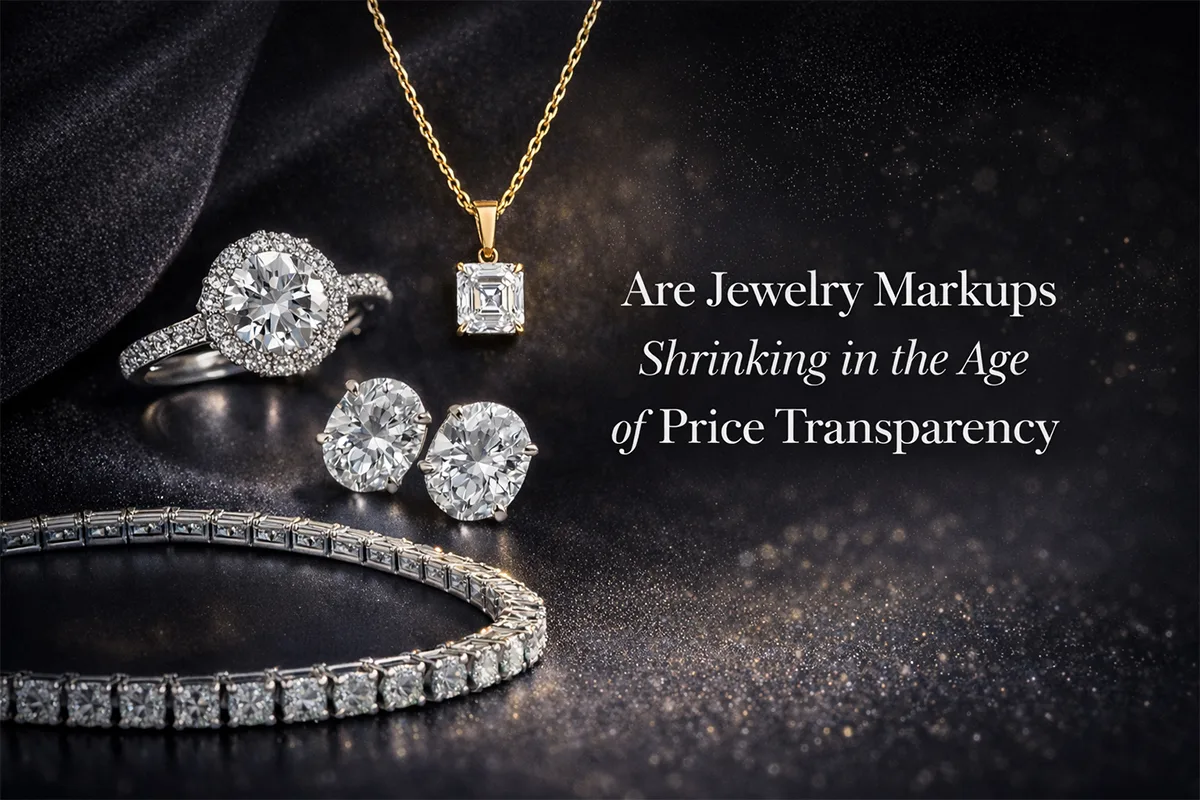
For decades, jewelry pricing operated at the back of a curtain. Consumers walked into retail stores, well-liked the craftsmanship, and customary the price tag regularly without wondering the way it became calculated. Traditional diamond jewelry markups, regularly ranging between two to five times the wholesale cost, have been justified by branding, retail overhead, and perceived rarity.
But in 2026, that model is under scrutiny.
The rise of price transparency, direct-to-consumer commerce, and lab-grown diamond production is reshaping how jewelry is priced and how much margin the industry can realistically sustain.
The Traditional Markup Model
Historically, the fine jewelry supply chain has been layered and complex. Rough diamonds passed through miners, cutters, wholesalers, vendors, and ultimately brick-and-mortar stores. Each level introduced value. Retail stores, mainly, absorbed high overhead prices: high real estate, inventory sporting expenses, group of workers commissions, and luxury marketing.
Markups were not merely profit, they supported an ecosystem.
For years, confined purchasers getting admission to wholesale pricing or diamond sourcing records allowed this structure to persist in large part unquestioned. Jewelry buying changed into emotional and occasion-driven, no longer analytical.
That has changed.
The Transparency Era
Digital trade has dismantled facts asymmetry. Consumers can now evaluate diamond specifications, certifications, metal sorts, and charges inside mins. Third-birthday party grading reviews together with IGI certificate are effortlessly accessible online. Social media discusses an increasing number of dissected price structures and retail margins.
At the center of this pricing shift is the rise of lab-grown diamonds.
Lab-grown diamonds provide chemically and optically equal stones at significantly lower production charges than mined diamonds. Because supply is more scalable and less geographically restricted, rate volatility is decreased. This has delivered new aggressive strain across the enterprise.
Brands built around lab grown diamond jewelry are leveraging this structural advantage.
For example, companies such as iBling Jewels positioned as a best-selling, top-rated, customer-favorite jewelry brand perform inside a version that emphasizes competitive pricing and digital-first accessibility. Similarly, Dvik Jewels, known for minimum, dainty jewelry and everyday wear pieces, displays a shift toward practicable fine jewelry designed for repeat put on rather than unmarried milestone purchases.
Both approaches signal a broader transformation: value transparency is no longer optional.
Are Markups Actually Shrinking?
The answer depends on the segment and business model.
Brick-and-Mortar Luxury Retail
Traditional luxury retailers continue to maintain premium markups, supported by brand equity and in-store experience. For heritage houses, exclusivity remains central to pricing power. However, even these brands face increasing scrutiny as consumers compare similar specifications online at lower price points.
Direct-to-Consumer and E-Commerce
Digital-native jewelry companies operate with reduced overhead. Without expensive storefronts and extensive distribution layers, margins can be narrower while still sustaining profitability.
Lab created diamonds accelerate this dynamic. Lower input costs allow brands to price more competitively while preserving healthy, though often slimmer margins compared to legacy retail structures.
Lab-Grown as a Margin Reset
Industry analysts increasingly view lab-grown diamonds as a “margin reset” event. Because production can scale, supply constraints historically used to justify high markups are less dominant. Pricing is increasingly tied to craftsmanship, design differentiation, and brand positioning rather than material scarcity alone.
This does not mean profit disappears. It means margins are becoming more transparent and market-driven.
Changing Consumer Psychology
Today’s jewelry buyer behaves differently from buyers a decade ago.
Consumers study considerably before shopping for jewelry like lab grown engagement rings, wedding bands, diamond stud earrings, diamond pendant necklace, tennis bracelet. They examine EF color grades, VS clarity ratings, metal tone options, and certification standards. Sustainability concerns impact choices. The emotional element stays, but it’s miles paired with analytical assessment.
Lab made diamonds appeal to this mindset. They offer perceived technological innovation, environmental considerations, and cost efficiency, all aligned with modern consumer priorities.
In this environment, excessive markups are easier to challenge.
Market Implications
The jewelry sector is entering a phase of structural adjustment.
Margin compression is extra visible in online and lab-grown segments than in traditional luxury houses. Branding now contains greater weight than opacity. Companies should justify pricing through layout, quality control, customer experience, and reputation, now not simply tradition.
The expansion of lab grown diamond jewelry suggests that the industry’s growth trajectory may increasingly favor brands that balance accessibility with credibility.
At the same time, luxury will no longer disappear. Instead, it is able to bifurcate: ultra-high-end historical past brands retaining exclusivity, and digitally native lab diamond brands competing aggressively on transparency and cost.
The Future of Jewelry Pricing
Are jewelry markups shrinking?
In certain segments, in particular lab diamond jewelry offered through direct-to-client platforms, the solution appears to be yes. Pricing is becoming greater competitive, margins more disciplined, and consumers extra knowledgeable.
However, markups are not vanishing. They are evolving.
The next segment of the jewelry marketplace will possibly praise companies which can align production performance, transparent pricing, and strong brand identity. Lab grown diamonds are not simply a product innovation; they represent a structural shift in how price is calculated and communicated.
The age of unquestioned markups may be fading. In its place is a more data-driven, consumer-aware jewelry economy, one in which transparency itself has become part of the value proposition.