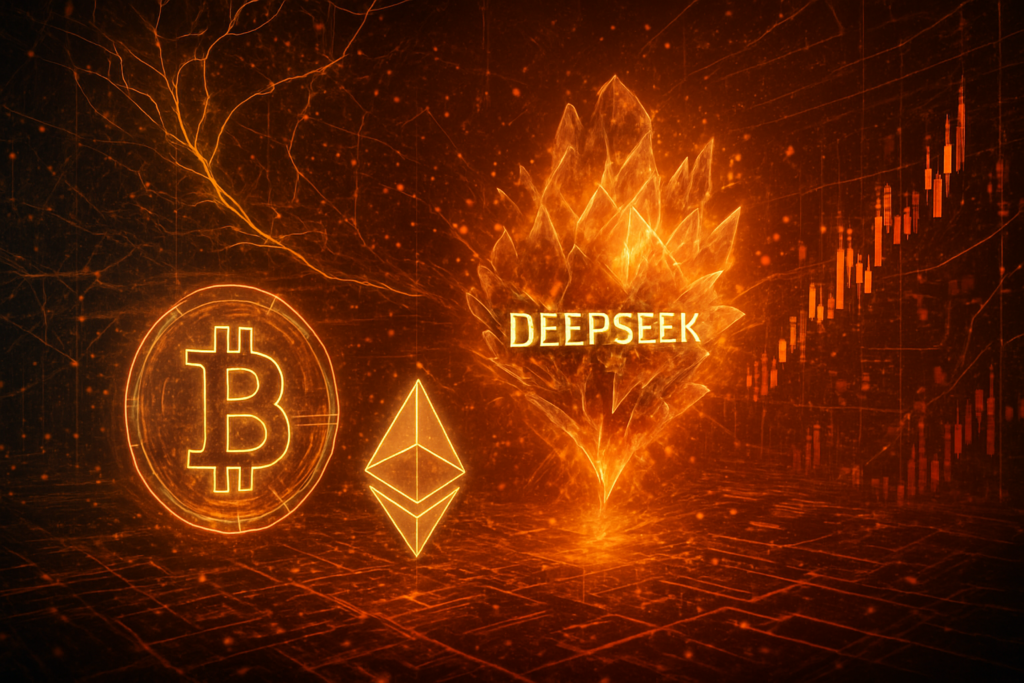
The cryptocurrency market is no stranger to volatility, but the "DeepSeek Effect" of January 2025 stands as a watershed moment that fundamentally decoupled "hype" from "utility" in the AI-crypto sector. On Monday, January 27, 2025, a massive sell-off in risk assets—triggered by a breakthrough in AI efficiency from the Chinese startup DeepSeek—erased over $300 billion from the total crypto market capitalization in a single day. The event, often described as AI’s "Sputnik moment," proved that the multi-billion dollar "moats" built by Western tech giants were more fragile than previously believed, sending shockwaves through both Wall Street and the digital asset ecosystem.
The immediate reaction was a "risk-off" cascade as investors realized that the high valuations of AI-integrated crypto projects were predicated on an "expensive compute" thesis that had just been dismantled. As DeepSeek’s R1 model demonstrated it could match the performance of industry leaders for a fraction of the training cost, the premium on decentralized GPU networks and AI-centric protocols evaporated almost overnight, leading to one of the most significant corrections in the current market cycle.
Market Impact and Price Action
The price action on "Black Monday," January 27, 2025, was nothing short of historic. Bitcoin (BTC) fell approximately 6.5% during intraday trading, slipping below the crucial $100,000 psychological threshold to hit lows of $97,900. This move was particularly jarring for the community, as it marked the first major breach of the $100k support level since the late 2024 rally. Ethereum (ETH) fared even worse, plunging 7% to test the $3,000 support level, a decline that analysts attributed to a broader exit from "platform" plays as investors fled to the safety of stablecoins.
The AI-token sector, the darling of the 2024 bull run, bore the brunt of the "DeepSeek Effect." Tokens that had traded as proxies for AI growth saw double-digit losses. Render (RENDER) dropped 12.6%, while Fetch.ai (FET)—part of the Artificial Superintelligence Alliance—fell 10%. Projects focused on GPU resource sharing, such as Nodes.AI, plummeted by as much as 20%. The narrative that "more compute equals more value" was directly challenged by DeepSeek’s ability to run high-performance models on older, less expensive hardware like the NVIDIA (NASDAQ: NVDA) H800 chips.
The sell-off was mirrored in traditional markets, providing a rare moment of total correlation between crypto and big tech. NVIDIA (NASDAQ: NVDA) experienced the largest single-day loss in market history, shedding 17% of its value—approximately $589 billion. Other giants like Microsoft (NASDAQ: MSFT), Broadcom (NASDAQ: AVGO), and Marvell (NASDAQ: MRVL) also saw significant declines as investors questioned the necessity of their massive capital expenditures on AI infrastructure. This systemic "repricing of risk" forced crypto liquidations across the board, with nearly $800 million in long positions wiped out in 24 hours.
Community and Ecosystem Response
Social media sentiment shifted from euphoria to existential dread within hours. On "Crypto Twitter" (now X), discussions moved from price targets to the technical architecture of "Mixture of Experts" (MoE), the methodology DeepSeek used to achieve its efficiency. Marc Andreessen of a16z (NASDAQ: N/A) called the breakthrough a "profound gift to the world," though his optimism was not immediately shared by retail investors watching their portfolios bleed. Ben Goertzel of the ASI Alliance argued that the crash was "irrational," suggesting that cheaper AI models would actually accelerate the adoption of decentralized AI (DeAI) in the long run.
Interestingly, while established AI tokens struggled, the market saw a bizarre surge in "DeepSeek" themed memecoins and "AI Agent" tokens. This highlighted a growing trend in early 2025: the retail market’s pivot toward "agentic" narratives. During the Agentic Ethereum 2025 Summit in February, Ethereum co-founder Vitalik Buterin noted that AI had moved from being a "player" (a bot) to an "interface" (an agent), reinforcing the shift toward using crypto as the economic rails for AI transactions rather than just a way to fund chip purchases.
What's Next for Crypto
As we look back from January 2026, the DeepSeek shock did not kill the AI-crypto sector; it matured it. The market moved away from "Compute" tokens—those focusing on mining or hardware training—and toward Inference and Application tokens. The realization of the "Jevons Paradox"—whereby more efficient technology leads to increased total demand—eventually restored confidence in decentralized GPU networks like Render and Aethir. By late 2025, these projects recovered to near all-time highs as they pivoted to support millions of smaller, specialized AI agents rather than a few massive LLMs.
In the short term, the industry is closely watching the "Agentic GDP" metric—the total economic value generated by autonomous AI agents transacting on-chain. Projects like Virtuals Protocol and AI16Z are now processing millions in monthly revenue, signaling a definitive move from speculation to utility. Furthermore, the ASI Alliance (FET) is expected to launch its "ASI-Mini 1" model later this year, a Web3-native LLM designed specifically for the resource-constrained environments that DeepSeek proved were viable.
Bottom Line
The "DeepSeek Effect" of 2025 served as a brutal but necessary correction for the crypto-AI ecosystem. It purged projects that were "AI in name only" and forced the sector to focus on "Intelligence per Joule" rather than raw parameter counts. For investors, the takeaway was clear: the value of a crypto-AI project no longer lies in how many GPUs it can aggregate, but in how effectively it can facilitate the "Agentic Economy."
As of January 12, 2026, the AI-crypto market cap has stabilized above $50 billion, making it the top-performing segment of the digital asset space over the past year. The shock taught the market that in the age of exponential AI growth, efficiency is the only true moat. For those who survived the January 2025 crash, the rewards have been substantial, but the lesson remains: in the intersection of AI and Web3, the technology moves faster than the markets can often price.
This article is for informational purposes only and does not constitute financial or investment advice. Cryptocurrency investments carry significant risk.