Food grade exopolysaccharides market is growing as clean-label demand rises, driving shift to fermentation-based texturants for stable, high-performance food formulations.
NEWARK, DE / ACCESS Newswire / March 17, 2026 / According to analysis by Future Market Insights (FMI), the global food grade exopolysaccharides market is entering a phase of structured expansion as food and beverage manufacturers accelerate the shift toward biologically derived texturants to meet evolving clean-label mandates and regulatory scrutiny.
In 2025, the food grade exopolysaccharides market was valued at USD 1.2 billion. Based on FMI's latest analysis, demand is projected to surpass USD 1.3 billion in 2026 and reach USD 2.4 billion by 2036, registering a compound annual growth rate (CAGR) of 6.3% during the forecast period.
This growth reflects a fundamental transformation in formulation strategies, where manufacturers are prioritizing rheological stability alongside consumer transparency. As synthetic hydrocolloids fall out of favor, fermentation-derived polymers are emerging as essential functional ingredients across multiple food applications.
Get Access of Report Sample: https://www.futuremarketinsights.com/reports/sample/rep-gb-32318
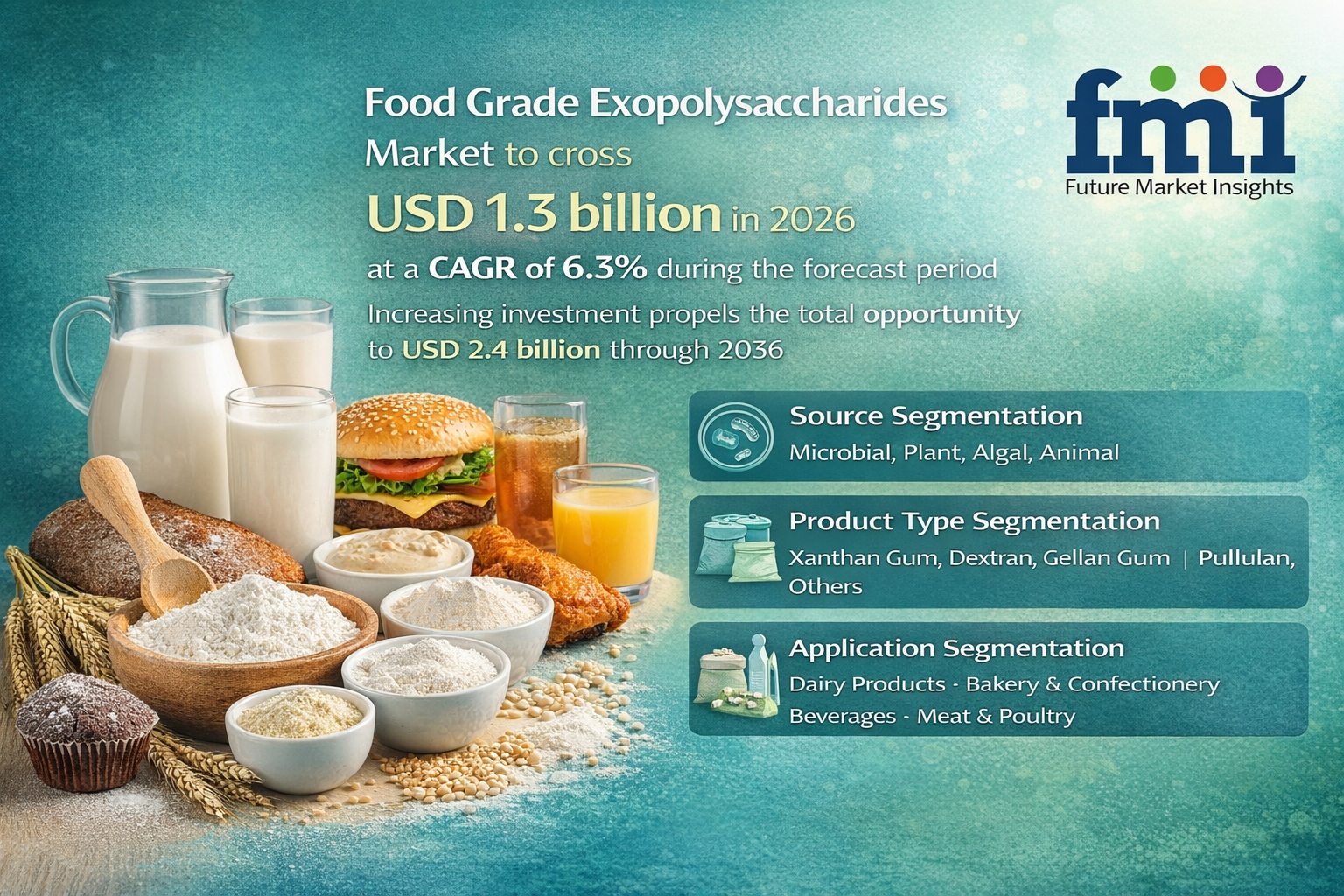
Food Grade Exopolysaccharides Market Snapshot
Market Value (2025): USD 1.2 Billion
Forecast Value (2036): USD 2.4 Billion
Forecast CAGR (2026-2036): 6.3%
Leading Source Segment: Microbial (55.4%)
Top Product Type: Xanthan Gum (42.1%)
Leading Application: Dairy Products (34.8%)
Fastest Growing Market: India
Clean-Label Mandates Driving Market Transformation
One of the primary forces shaping the food grade exopolysaccharides market is the intensifying pressure from retail chains and regulatory bodies to eliminate synthetic additives from ingredient declarations.
Formulation engineers are no longer optimizing solely for viscosity but are now required to deliver full-spectrum rheological stability under extreme processing conditions. This shift is compelling manufacturers to adopt biologically synthesized polymers that maintain structural integrity without triggering consumer skepticism.
As a result, procurement teams are actively replacing chemically modified starches and synthetic emulsifiers with microbial exopolysaccharides capable of delivering consistent performance across diverse food matrices.
Fermentation Scaling Unlocking Cost Parity
A critical inflection point in market expansion lies in achieving cost parity with traditional hydrocolloids.
Exopolysaccharides derived from controlled bacterial fermentation provide superior stability, but their widespread adoption has historically been limited by higher production costs. However, the rapid scaling of precision fermentation technologies is significantly reducing unit economics.
As primary ingredient suppliers expand continuous-feed bioreactor capacity, the cost-in-use barrier is diminishing. Once parity is achieved, mass-market manufacturers will be able to integrate these advanced texturants without compromising profitability, triggering large-scale adoption.
Functional Superiority Over Conventional Hydrocolloids
Exopolysaccharides offer distinct functional advantages over legacy plant-based and chemically modified alternatives.
These high-molecular-weight polymers demonstrate exceptional stability under high shear, thermal processing, and low pH conditions-environments where traditional starches often fail. Their predictable molecular structure, particularly in microbial variants, eliminates batch-to-batch variability, providing formulation engineers with greater control over final product characteristics.
This reliability is increasingly critical as manufacturers develop complex formulations such as plant-based dairy alternatives, fortified beverages, and ambient-stable products.
Microbial Segment Leads Market Expansion
By source, the microbial segment is expected to account for approximately 55.4% of total market share in 2026.
The dominance of microbial exopolysaccharides is driven by their consistency and scalability. Unlike agricultural sources, bacterial fermentation is not subject to climate variability, enabling uniform production quality across batches.
This precision allows manufacturers to design highly stable formulations without incorporating excessive safety margins, improving both efficiency and cost management.
Xanthan Gum Maintains Product Leadership
By product type, xanthan gum is projected to hold around 42.1% of the market in 2026.
Its dominance stems from its unique synergistic interactions with other hydrocolloids, enabling manufacturers to achieve high viscosity at extremely low inclusion rates. This significantly reduces overall formulation costs while maintaining desirable texture and mouthfeel.
Consequently, procurement teams are increasingly leveraging xanthan gum as a foundational component in multi-gum systems to optimize both performance and margins.
Dairy Applications Driving Demand
By application, dairy and dairy-alternative products are expected to account for approximately 34.8% of total demand in 2026.
Manufacturers in this segment face the complex challenge of replicating the mouthfeel and stability of natural milk fat, particularly in low-fat and plant-based formulations. Exopolysaccharides play a critical role in achieving this, preventing phase separation and ensuring consistent texture throughout shelf life.
Failure to integrate these advanced polymers often results in product instability, leading to quality issues and potential delisting from retail shelves.
Asia-Pacific Emerging as High-Growth Region
Geographically, the market is witnessing strong growth across emerging economies, with Asia-Pacific leading expansion.
Food Grade Exopolysaccharides Market Growth by Country (2026-2036)
Country |
CAGR |
India |
9.1% |
China |
8.2% |
Brazil |
6.8% |
Germany |
6.1% |
United Kingdom |
5.8% |
United States |
5.4% |
Japan |
4.9% |
India is emerging as the fastest-growing market, driven by rapid modernization of dairy processing infrastructure and increasing demand for ambient-stable food products. Meanwhile, China's strong investments in fermentation technology are accelerating domestic production and adoption of advanced microbial polymers.
Processing Challenges and Operational Shifts
Despite strong growth potential, the transition to exopolysaccharides introduces operational complexities.
Unlike traditional starches, these polymers require precise hydration and shear conditions to activate fully. This necessitates recalibration of mixing processes and, in some cases, investment in specialized equipment such as high-shear induction systems.
While pre-hydrated liquid formulations offer a workaround, they introduce logistical inefficiencies that may offset cost advantages, particularly in long-distance supply chains.
Innovation Creating New Market Opportunities
Technological advancements in fermentation and bioprocessing are unlocking new growth avenues.
Continuous-feed bioreactors are reducing energy consumption and improving production efficiency
Synergistic blending of microbial polymers is enabling ultra-low inclusion stabilization systems
Advanced exopolysaccharides are supporting next-generation applications in plant-based meat and fortified beverages
These innovations are positioning exopolysaccharides as critical enablers of modern food design.
Key Players in the Food Grade Exopolysaccharides Market
Leading companies operating in the global market include:
CP Kelco
IFF (DuPont)
Cargill
Ingredion
ADM
Kerry Group
Jungbunzlauer
Tate & Lyle
These players are leveraging advanced fermentation capabilities, proprietary microbial strains, and large-scale bioprocessing infrastructure to maintain competitive advantage in a highly capital-intensive market.
Market Outlook: Fermented Polymers to Define Future Food Systems
The long-term outlook for the food grade exopolysaccharides market remains highly promising as the global food industry continues transitioning toward clean-label, high-performance ingredients.
Rising demand for stable, transparent, and functionally superior formulations across dairy, beverage, and plant-based applications will sustain investment in fermentation technologies. As cost barriers decline and processing capabilities improve, exopolysaccharides are set to become foundational components in next-generation food systems.
For a comprehensive strategic outlook and deeper insights into formulation trends shaping the Food Grade Exopolysaccharides Market through 2036, request the full report.
For an in-depth analysis of evolving formulation trends and to access the complete strategic outlook for the Food Grade Exopolysaccharides Market through 2036, Full Report Request - https://www.futuremarketinsights.com/reports/food-grade-exopolysaccharides-market
Related Reports:
Food Grade Ammonium Carbonate Market: https://www.futuremarketinsights.com/reports/food-grade-ammonium-carbonate-market
Food Grade Phosphate Market: https://www.futuremarketinsights.com/reports/food-grade-phosphates-market
Food Grade Industrial Gases Market: https://www.futuremarketinsights.com/reports/food-grade-industrial-gases-market
Food Grade Lubricant Market: https://www.futuremarketinsights.com/reports/global-food-grade-lubricants-market
Food Grade Sodium Hypochlorite Market: https://www.futuremarketinsights.com/reports/food-grade-sodium-hypochlorite-market
About Future Market Insights (FMI)
Future Market Insights (FMI) is a leading provider of market intelligence and consulting services, serving clients in over 150 countries. Headquartered in Delaware, USA, with a global delivery center in India and offices in the UK and UAE, FMI delivers actionable insights to businesses across industries including automotive, technology, consumer products, manufacturing, energy, and chemicals.
An ESOMAR-certified research organization, FMI provides custom and syndicated market reports and consulting services, supporting both Fortune 1,000 companies and SMEs. Its team of 300+ experienced analysts ensures credible, data-driven insights to help clients navigate global markets and identify growth opportunities.
For Press & Corporate Inquiries
Rahul Singh
AVP - Marketing and Growth Strategy
Future Market Insights, Inc.
+91 8600020075
For Sales - sales@futuremarketinsights.com
For Media - Rahul.singh@futuremarketinsights.com
For web - https://www.futuremarketinsights.com/
SOURCE: Future Market Insights, Inc.
View the original press release on ACCESS Newswire