Mono-PE medical pouches enable recyclable sterile packaging, helping healthcare reduce waste, meet global regulations, and support circular economy goals.
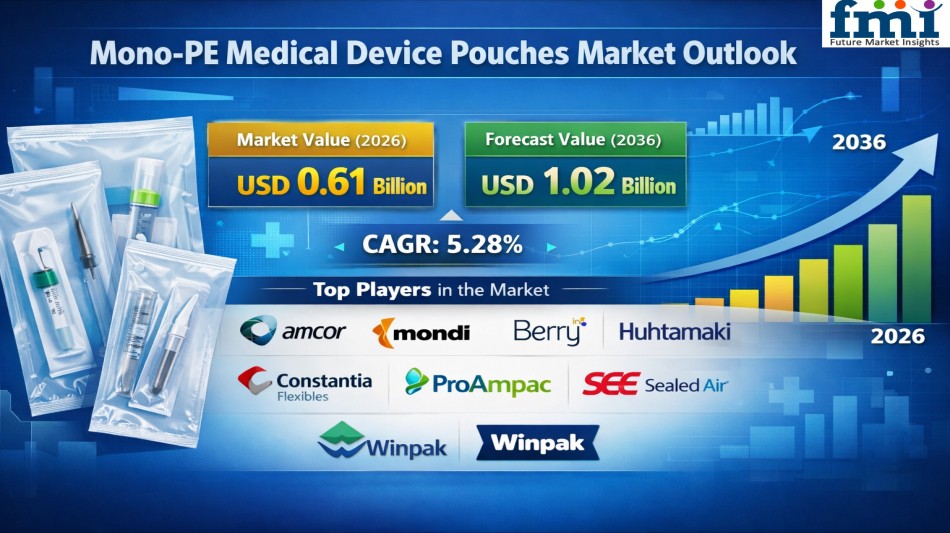
NEWARK, DE / ACCESS Newswire / March 16, 2026 / The global Mono-PE Medical Device Pouches Market is entering a pivotal decade of transformation as healthcare supply chains accelerate the shift toward recyclable sterile barrier systems. Valued at USD 0.61 billion in 2026, the market is projected to reach USD 1.02 billion by 2036, expanding at a CAGR of 5.28% during the forecast period.
This expansion reflects a structural change across global healthcare packaging ecosystems. Hospitals, medical device manufacturers, and procurement networks are increasingly replacing multi-material laminates with mono-polyethylene sterile packaging formats to meet circular economy goals and comply with stricter global waste regulations.
According to a strategic industry assessment by Future Market Insights (FMI), the growth trajectory of mono-PE pouches is strongly linked to "Design for Recycling" mandates, rising healthcare waste disposal costs, and new regulatory frameworks such as the EU Packaging and Packaging Waste Regulation (PPWR). These policies are pushing healthcare organizations to transition away from mixed-polymer sterile barrier systems that are difficult to recycle and often incinerated as clinical waste.
Mono-PE Medical Device Pouches Market Metric Overview (2026-2036)
Metric |
Value |
|---|---|
Current Market Value (2026) |
USD 0.61 Billion |
Projected Market Value (2036) |
USD 1.02 Billion |
Global CAGR (2026-2036) |
5.28% |
Top Growth Market |
India (6.8% CAGR) |
Leading Material Segment |
High-Density Polyethylene (44.5% Share) |
Experience Exponential Growth: Secure Your Sample Report and Dominate the Market
https://www.futuremarketinsights.com/reports/sample/rep-gb-32300
The Circularity Imperative: Healthcare Packaging Re-Engineered
The medical device sector is witnessing a fundamental mindset shift-from "protection at any cost" to "protection within circularity." Historically, sterile barrier systems relied heavily on complex laminates combining PET, nylon, paper, and polyethylene layers to guarantee durability and microbial protection. However, these materials complicate recycling and significantly increase waste management costs.
Mono-PE pouches are emerging as the industry's answer to this challenge. Constructed entirely from polyethylene-based polymers, these pouches maintain sterile integrity while allowing the entire structure to be recycled within a single polymer stream.
Healthcare systems across Europe and North America are increasingly penalizing mixed-material medical packaging due to rising Extended Producer Responsibility (EPR) costs and national taxes on non-recyclable plastics.
As a result, procurement teams are actively prioritizing suppliers capable of delivering fully recyclable sterile barrier solutions without compromising regulatory compliance or product performance.
Material Innovation: Engineering Strength Without Complexity
One of the most critical developments supporting the growth of mono-PE packaging is the rapid advancement of oriented polyethylene technologies, particularly Machine Direction Oriented (MDO-PE) films.
These advanced structures enable packaging engineers to achieve:
High puncture resistance for heavy surgical tools
Improved clarity for visual device inspection
Enhanced tensile strength for transport durability
Such innovations allow polyethylene films to replicate the mechanical properties traditionally provided by complex laminates.
Another major benefit lies in material efficiency. Modern medical-grade polyethylene resins offer increased stiffness, enabling downgauging-the ability to use thinner films without sacrificing structural performance. This reduces material consumption and shipping weight while maintaining sterile barrier reliability.
Segment Spotlight: Material and Pouch Type Leadership
High-Density Polyethylene (HDPE): HDPE is expected to hold 44.5% market share in 2026, making it the dominant material segment. Its superior rigidity and puncture resistance make it ideal for packaging heavier medical devices such as orthopedic implants and surgical kits.
Flat Pouches: Flat pouches remain the leading pouch format, capturing approximately 52% of the global market. Their compatibility with automated packaging lines and established sterile barrier validation protocols makes them the preferred solution for high-volume surgical instrument sets.
This format also reduces stress on seals during sterilization and transport, which is particularly important when working with mono-material polyethylene structures that have narrower sealing tolerances.
Surgical Instruments: Among application segments, surgical instruments dominate demand due to their high turnover rates in hospitals and surgical centers. Each surgical procedure generates sterile packaging waste, making this segment a prime target for recycling initiatives.
Infrastructure as a Catalyst: Hospitals Drive Adoption
While packaging innovation is critical, the true tipping point for mono-PE adoption lies within hospital waste management infrastructure.
Healthcare facilities must establish dedicated polyethylene waste segregation systems before the economic benefits of recyclable sterile packaging become fully realized.
Once hospitals implement PE-only recycling streams in surgical suites and sterile processing departments, the operational advantages of mono-material pouches become clear:
Lower clinical waste disposal costs
Reduced incineration volumes
Higher recycling recovery rates
As this infrastructure expands, adoption is expected to accelerate rapidly.
Regional Powerhouses: Asia Leads Manufacturing Expansion
Although North America and Europe remain major consumers of sterile barrier packaging, the fastest growth is occurring across Asia-Pacific manufacturing hubs, where medical device production is expanding rapidly.
India (6.8% CAGR): India is projected to be one of the fastest-growing markets for mono-PE medical pouches. Government-supported manufacturing programs and export-oriented medical device plants are driving demand for globally compliant sustainable packaging solutions.
China (6.5% CAGR): China continues to play a central role as both a manufacturing powerhouse and innovation hub. Local device manufacturers are upgrading packaging lines to support high-clarity oriented polyethylene films suitable for global export markets.
Germany (5.1% CAGR): Germany's strict environmental regulations and extended producer responsibility frameworks are accelerating the shift toward recyclable sterile packaging formats.
United States (4.8% CAGR): In the U.S., the rise of Group Purchasing Organizations (GPOs) is influencing procurement decisions. Sustainability metrics are increasingly being integrated into supplier evaluations, encouraging medical device manufacturers to adopt recyclable packaging.
Dynamics of the Decade: Sustainability Meets Sterile Performance
Looking toward 2036, several transformative trends are expected to reshape the mono-PE medical packaging landscape.
Circular Economy Compliance: Global healthcare systems are rapidly aligning with circular economy targets. Hospitals are demanding packaging formats that can be recycled rather than incinerated.
Advanced Resin Technologies: New polyethylene blends capable of maintaining seal strength through Gamma, E-beam, and Ethylene Oxide sterilization cycles are expanding the technical viability of mono-material solutions.
Closed-Loop Recycling Models: Forward-thinking packaging suppliers are forming partnerships with hospital networks to establish closed-loop recycling programs, reclaiming used polyethylene pouches for high-grade recycling.
Standardization and Global Validation: Medical device manufacturers are increasingly seeking single global packaging validations, enabling the same mono-PE pouch to be used across multiple regulatory jurisdictions.
Competitive Landscape: Expertise Over Volume
The Mono-PE Medical Device Pouches Market remains highly concentrated due to the technical complexity involved in producing medical-grade polyethylene films and maintaining sterile barrier compliance.
Tier-1 converters are investing heavily in specialized MDO-PE film production lines, cleanroom extrusion facilities, and precision seal testing systems to meet stringent medical packaging standards.
Leading companies are strengthening their market positions by offering integrated packaging solutions, combining high-performance films with technical validation support for medical device manufacturers navigating regulatory approvals.
Major players operating in the market include:
Amcor plc
Mondi Group
Berry Global Inc.
Huhtamaki Oyj
Constantia Flexibles
ProAmpac
SEE (formerly Sealed Air Corporation)
Winpak Ltd.
Oliver Healthcare Packaging
SteriPack Group
These companies maintain competitive advantage through deep relationships with medical device OEMs and extensive expertise in ISO 11607 sterile barrier validation.
Outlook: Packaging as a Strategic Healthcare Asset
The transition toward recyclable sterile barrier systems signals a broader shift in the healthcare packaging industry. Packaging is no longer viewed solely as a protective layer-it is becoming a strategic component of sustainable healthcare supply chains.
As hospitals tighten sustainability mandates and governments enforce stricter packaging waste regulations, mono-PE medical pouches are expected to become the new standard for sterile device packaging.
By combining regulatory compliance, recyclability, and performance parity with traditional laminates, mono-PE technology is positioning itself at the center of the healthcare sector's move toward circular packaging ecosystems.
For an in-depth analysis of evolving formulation trends and to access the complete strategic outlook for the Mono-PE Medical Device Pouches Market through 2036, visit the official report page at: https://www.futuremarketinsights.com/reports/mono-pe-medical-device-pouches-market
Explore More Research Reports by FMI
White-Label Computer Peripheral Packaging Market - https://www.futuremarketinsights.com/reports/white-label-computer-peripheral-packaging-market
Modular Packaging Architecture for Recyclability Market - https://www.futuremarketinsights.com/reports/modular-packaging-architecture-for-recyclability-market
Wooden Toddler Toy Packaging Market - https://www.futuremarketinsights.com/reports/wooden-toddler-toy-packaging-market
Serialized Packaging for Confidential Products Market - https://www.futuremarketinsights.com/reports/serialized-packaging-for-confidential-products-market
Secure Document Packaging Market - https://www.futuremarketinsights.com/reports/secure-document-packaging-market
About Future Market Insights (FMI)
Future Market Insights (FMI) is a leading provider of market intelligence and consulting services, serving clients in over 150 countries. Headquartered in Delaware, USA, with a global delivery center in India and offices in the UK and UAE, FMI delivers actionable insights to businesses across industries including automotive, technology, consumer products, manufacturing, energy, and chemicals.
An ESOMAR-certified research organization, FMI provides custom and syndicated market reports and consulting services, supporting both Fortune 1,000 companies and SMEs. Its team of 300+ experienced analysts ensures credible, data-driven insights to help clients navigate global markets and identify growth opportunities.
For Press & Corporate Inquiries
Rahul Singh
AVP - Marketing and Growth Strategy
Future Market Insights, Inc.
+91 8600020075
For Sales - sales@futuremarketinsights.com
For Media - Rahul.singh@futuremarketinsights.com
For web - https://www.futuremarketinsights.com/
SOURCE: Future Market Insights, Inc.
View the original press release on ACCESS Newswire