Metal packaging remains resilient, driven by essential demand in food, beverage, and industrial sectors, supported by recyclability and circular economy trends.
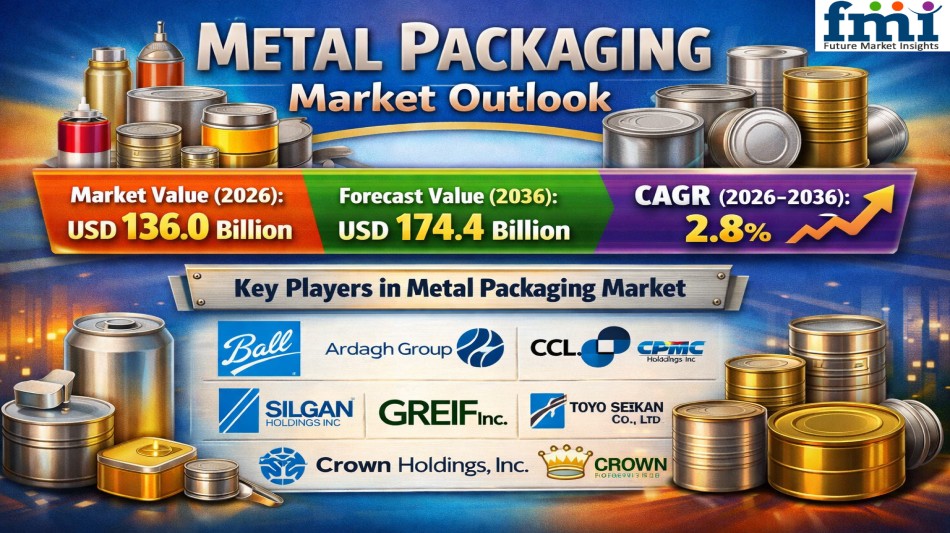
NEWARK, DELAWARE / ACCESS Newswire / February 26, 2026 / The global metal packaging market is entering a phase of steady, performance-driven expansion, reflecting its entrenched role across food, beverage, and industrial supply chains. Valued at USD 136.0 billion in 2026, the market is projected to reach USD 174.4 billion by 2036, expanding at a compound annual growth rate (CAGR) of 2.8%.
According to a comprehensive analysis by Future Market Insights (FMI), the market is expected to generate an absolute dollar opportunity of USD 42.1 billion between 2026 and 2036. This growth trajectory highlights the sector's maturity characterized by stable demand, incremental innovation, and structural resilience rather than rapid acceleration. Metal packaging remains deeply integrated into global consumption patterns, particularly in canned beverages, processed foods, and industrial chemical storage.
Metal Packaging Market Metrics Overview (2026-2036)
Metric |
Value |
Market Value (2026) |
USD 136.0 Billion |
Market Value (2036) |
USD 174.4 Billion |
CAGR (2026-2036) |
2.8% |
Absolute Dollar Opportunity |
USD 42.1 Billion |
Top Growth Market |
India (4.5% CAGR) |
Explore Opportunities - Get Your Sample of Our Industry Overview Now!
https://www.futuremarketinsights.com/reports/sample/rep-gb-14868
The Stability Factor: A Market Built on Essential Demand
Unlike emerging packaging formats, metal packaging operates within a highly penetrated ecosystem where growth is driven by consumption fundamentals rather than disruptive expansion. Demand remains anchored in high-volume applications such as carbonated beverages, canned food, aerosol products, and industrial packaging.
The market's resilience is supported by three core pillars:
Food and Beverage Dependency: Metal packaging provides unmatched barrier protection against oxygen, moisture, and light, ensuring extended shelf life and product safety.
Industrial Utility: Steel drums, pails, and intermediate bulk containers remain critical for transporting chemicals, lubricants, and bulk liquids.
Recyclability Advantage: Aluminum and steel are infinitely recyclable, reinforcing their role in circular economy frameworks.
However, the industry also faces structural constraints. Competition from flexible plastics and PET packaging, combined with the energy-intensive nature of metal production and raw material price volatility, continues to moderate growth potential.
The Sustainability Imperative: Circular Economy as a Growth Anchor
One of the most defining forces shaping the metal packaging market is the global shift toward sustainability. Regulatory mandates and corporate ESG commitments are accelerating the adoption of recyclable packaging formats, positioning metal as a preferred material.
Industry leaders emphasize that metal packaging aligns closely with circular economy principles due to its ability to be recycled repeatedly without degradation. This characteristic is particularly valuable as governments worldwide implement Extended Producer Responsibility (EPR) regulations and stricter packaging waste directives.
A leading industry voice noted, "Metal packaging is uniquely positioned to meet the requirements of a circular economy. Aluminum and steel are permanent materials that remain available for future generations, making them ideal for long-term sustainability strategies."
Material Evolution: Steel Dominance Meets Aluminum Innovation
The competitive dynamics within the metal packaging market are increasingly defined by the interplay between steel and aluminum.
Steel (50.9% share in 2026): Continues to dominate due to its strength, durability, and superior barrier properties. It is widely used in food cans, industrial drums, and bulk containers where structural integrity is critical.
Aluminum: Gains traction in beverage and aerosol packaging due to its lightweight nature, corrosion resistance, and high recyclability.
The transition toward lightweight aluminum formats is particularly evident in beverage packaging, where premiumization and portability are key consumer drivers. Slim cans, specialty designs, and enhanced branding capabilities are enabling higher per-unit value realization.
Segment Spotlight: Food & Beverage Leads Consumption
The food and beverage segment remains the largest end-use category, accounting for 51.3% of total demand in 2026. This dominance reflects the critical role of metal packaging in preserving product quality and extending shelf life.
Key demand drivers include:
Shelf-Life Extension: Complete barrier protection ensures product stability without refrigeration.
Convenience Consumption: Rising demand for ready-to-drink beverages and portable food formats.
Sustainability Pressure: Beverage brands are increasingly adopting recyclable aluminum cans to meet carbon reduction targets.
The rapid growth of energy drinks, craft beverages, and premium canned products is further accelerating demand for specialized metal packaging formats.
Industrial Applications: The Backbone of Bulk Packaging
Beyond consumer goods, metal packaging remains indispensable in industrial sectors. Steel drums, intermediate bulk containers (IBCs), and pails provide the durability and safety required for transporting hazardous and high-value materials.
Industries such as chemicals, paints, lubricants, and automotive rely heavily on metal packaging for its:
High load-bearing capacity
Resistance to environmental stress
Compliance with safety and regulatory standards
This industrial backbone ensures consistent demand even during economic fluctuations, reinforcing the market's stability.
Regional Dynamics: Asia Pacific Leads Growth Momentum
While mature markets in North America and Western Europe continue to generate stable demand, growth opportunities are increasingly concentrated in emerging economies.
Metal Packaging Market CAGR Analysis by Country (2026-2036)
Country |
CAGR (%) |
India |
4.5% |
China |
3.9% |
Brazil |
3.6% |
Indonesia |
3.4% |
Mexico |
3.2% |
India (4.5% CAGR):
India is projected to be the fastest-growing market, driven by rising consumption of packaged beverages and expansion in food processing industries. Regulatory initiatives promoting recyclable materials and strengthening packaging compliance are accelerating adoption.
China (3.9% CAGR):
China remains a global production and consumption hub, supported by urbanization, premium beverage demand, and national circular economy policies encouraging aluminum can usage.
Brazil and Mexico:
Growth is supported by strong beverage industries, export-oriented manufacturing, and well-established recycling infrastructure.
Indonesia (3.4% CAGR):
Emerging as a key consumption base, driven by urbanization, middle-class expansion, and increasing packaged food demand.
Manufacturing and Supply Chain: Scale as a Competitive Advantage
The metal packaging market exhibits a moderately concentrated competitive landscape, with a handful of global players dominating high-volume segments such as beverage and food cans.
Key competitive factors include:
Scale-driven manufacturing efficiency
Long-term supply contracts with major brands
Sustainability positioning and recycling infrastructure
Geographic proximity to filling and production facilities
Companies with vertically integrated operations-spanning metal forming, coating, and recycling-are better positioned to manage cost volatility and meet sustainability targets.
Large beverage can manufacturers leverage high-speed production lines and global networks to secure multi-year agreements with leading beverage brands, ensuring stable revenue streams.
Strategic Imperatives: Navigating Cost and Sustainability Pressures
FMI analysis highlights several strategic priorities for industry participants:
Lightweighting and Material Optimization: Reducing material usage without compromising structural integrity to manage costs.
Recycling Partnerships: Strengthening closed-loop systems to align with regulatory and sustainability goals.
Capacity Expansion: Investing in high-speed can manufacturing to capture growth in ready-to-drink beverages.
These strategies are critical as companies navigate raw material price volatility and increasing environmental regulations.
Competitive Landscape: A Balance of Scale and Specialization
The market features a mix of global giants and specialized players. Leading companies such as Ball Corporation, Crown Holdings, Ardagh Group, Silgan Holdings, Greif Inc., and Toyo Seikan dominate large-scale production, particularly in beverage and food cans.
Meanwhile, niche and industrial-focused companies compete in specialized segments such as aerosol packaging, decorative cans, and bulk containers.
Buyer behavior is increasingly influenced by consolidation among global food, beverage, and industrial manufacturers. Long-term contracts tied to metal price indices are common, reducing short-term volatility but limiting supplier flexibility.
For an in-depth analysis of evolving formulation trends and to access the complete strategic outlook for the Metal Packaging Market through 2036, visit the official report page at: https://www.futuremarketinsights.com/reports/metal-packaging-market
Explore More Research Reports by FMI
Heat Sealable Packaging Market - https://www.futuremarketinsights.com/reports/heat-sealable-packaging-market
Automotive Label Market - https://www.futuremarketinsights.com/reports/automotive-labels-market
Cosmetic Plastic Packaging Market - https://www.futuremarketinsights.com/reports/cosmetic-plastic-packaging-market
Reusable Grocery Tote Market - https://www.futuremarketinsights.com/reports/reusable-grocery-tote-market
Automated Labeling Machines Market - https://www.futuremarketinsights.com/reports/automated-labeling-machines-market
About Future Market Insights (FMI)
Future Market Insights (FMI) is a leading provider of market intelligence and consulting services, serving clients in over 150 countries. Headquartered in Delaware, USA, with a global delivery center in India and offices in the UK and UAE, FMI delivers actionable insights to businesses across industries including automotive, technology, consumer products, manufacturing, energy, and chemicals.
An ESOMAR-certified research organization, FMI provides custom and syndicated market reports and consulting services, supporting both Fortune 1,000 companies and SMEs. Its team of 300+ experienced analysts ensures credible, data-driven insights to help clients navigate global markets and identify growth opportunities.
For Press & Corporate Inquiries
Rahul Singh
AVP - Marketing and Growth Strategy
Future Market Insights, Inc.
+91 8600020075
For Sales - sales@futuremarketinsights.com
For Media - Rahul.singh@futuremarketinsights.com
For web - https://www.futuremarketinsights.com/
SOURCE: Future Market Insights, Inc.
View the original press release on ACCESS Newswire