Infrastructure Renewal, Energy Corridors, and Utility Modernization Anchor Long-Term Value Creation in the Global Pipe Industry
NEWARK, DE / ACCESS Newswire / February 26, 2026 / The global pipe market is entering a decade of sustained infrastructure-led expansion, with total market value estimated at USD 161.4 billion in 2026 and forecast to reach USD 262.9 billion by 2036, advancing at a CAGR of 5.0%. Growth reflects long-term capital allocation toward essential transport systems supporting water, energy, and industrial operations worldwide.
According to the latest industry assessment by Future Market Insights, value formation across the sector remains anchored in regulated infrastructure upgrades, rehabilitation of aging assets, and energy corridor expansion rather than cyclical construction volatility.
Get Access of Report Sample: https://www.futuremarketinsights.com/reports/sample/rep-gb-14917
Infrastructure Modernization Drives Structural Demand
Pipe systems form the backbone of water distribution, wastewater treatment, oil and gas transmission, and industrial processing networks. As municipalities and utilities prioritize system resilience and leakage reduction, procurement cycles are increasingly tied to lifecycle performance rather than upfront cost alone.
Large-diameter and high-specification pipes account for a disproportionate share of market value due to material intensity, certification complexity, and installation engineering requirements. Public infrastructure funding frameworks across North America, Europe, and Asia are reinforcing predictable, staged demand realization over multi-year project timelines.
Urbanization, population growth, and climate adaptation measures further amplify replacement and expansion programs, particularly in water-stressed and industrializing regions.
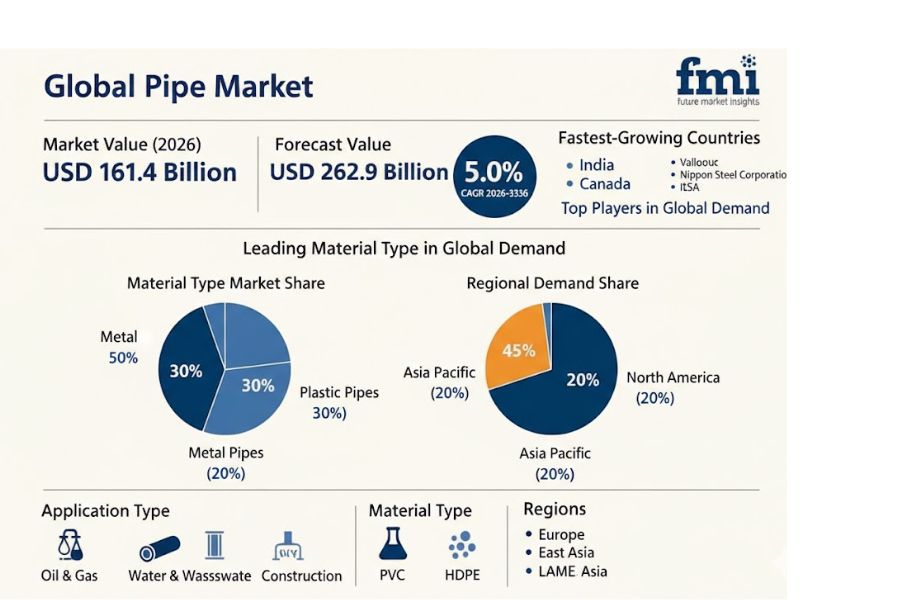
Quick Stats: Global Pipe Market Outlook (2026-2036)
Metric |
Value |
|---|---|
Market Value (2026) |
USD 161.4 Billion |
Forecast Value (2036) |
USD 262.9 Billion |
Projected CAGR |
5.0% |
Leading Material Type |
Metal Pipes |
Largest End-Use Industry |
Oil & Gas (38.0% Share) |
Material Analysis: Metal Pipes Maintain Dominance
By material type, metal pipes command 67.7% of global demand, supported by their superior structural strength, pressure tolerance, and thermal resistance. Steel and alloy variants remain indispensable in:
High-temperature industrial systems
Long-distance oil and gas transmission
High-pressure municipal and energy networks
While plastic and composite alternatives address corrosion resistance and weight reduction in selected applications, metal pipes continue to dominate where safety compliance and mechanical integrity remain critical.
Material selection decisions increasingly factor in lifecycle durability, corrosion protection coatings, and compatibility with regulatory standards governing potable water and hazardous fluid transport.
End-Use Segmentation: Oil & Gas Leads Consumption
The oil and gas sector accounts for 38.0% of total pipe demand, reflecting extensive upstream gathering systems, midstream transport corridors, and downstream refining operations.
Key demand drivers include:
High-integrity pipeline infrastructure
Strict safety and inspection standards
Long-distance transmission requirements
Pressure and temperature-intensive environments
Water and wastewater systems represent the second-largest application, supported by municipal rehabilitation programs and urban expansion. Construction, chemical processing, and manufacturing industries further diversify consumption across application categories.
Regional Demand Momentum: Emerging Markets Accelerate
Global expansion patterns reveal strong momentum in emerging and developed economies alike:
Global Growth Outlook by Country (2026-2036)
The market demonstrates differentiated growth patterns across major economies between 2026 and 2036, with Asia-Pacific countries leading the expansion trajectory. Emerging industrialization, infrastructure development, and manufacturing investments are key growth drivers in high-performing regions, while mature economies are witnessing steady yet comparatively moderate expansion supported by technological upgrades and replacement demand.
High-Growth Emerging Economies
India - 8.3% CAGR
India is projected to register the highest growth rate, driven by rapid industrial expansion, government-led infrastructure projects, and increasing foreign direct investment in manufacturing and energy sectors.China - 7.8% CAGR
China continues to demonstrate strong momentum, supported by large-scale production capacity, export strength, and continuous advancements in industrial automation and technology adoption.
Stable Growth in Developed Markets
Canada - 6.6% CAGR
Canada's market growth is fueled by investments in energy, natural resources, and modernization of industrial facilities, alongside supportive regulatory frameworks.Italy - 6.4% CAGR
Italy shows moderate expansion, supported by advancements in manufacturing technology, export-oriented industries, and sustainable infrastructure development initiatives.United States - 5.9% CAGR
The United States reflects steady growth, primarily driven by technological innovation, industrial automation upgrades, and replacement demand across established sectors.
Overall, emerging Asian economies are set to outperform mature Western markets in terms of CAGR, highlighting a clear shift in global growth dynamics toward high-investment and rapidly industrializing regions.
India: Infrastructure Buildout at Scale (8.3% CAGR)
India leads global growth, supported by:
Urban water supply and sanitation programs
Agricultural irrigation expansion
City gas distribution network rollout
Industrial corridor and real estate development
Large-scale public investment and cost-efficient material procurement strategies underpin sustained volume expansion.
China: Industrial & Municipal Strength (7.8% CAGR)
China's demand remains anchored in:
Municipal wastewater and water treatment upgrades
Industrial utility infrastructure within manufacturing clusters
Replacement of aging urban pipeline systems
High-volume domestic manufacturing capacity
Leakage reduction and system efficiency initiatives continue to support stable baseline demand.
USA & Canada: Rehabilitation-Focused Growth
In North America, expansion is driven primarily by aging infrastructure replacement, energy sector transmission projects, and regulatory compliance upgrades. Growth remains steady rather than explosive due to phased project execution and mature asset bases.
Market Dynamics: Scalability Challenges & Cost Pressures
While long-term demand fundamentals remain robust, scalability is influenced by structural constraints:
Raw material price volatility in steel, alloys, and polymers
Regulatory divergence across jurisdictions
Skilled labor shortages in complex installations
Environmental compliance costs in coating and manufacturing processes
Logistics sensitivity for oversized components
Installation economics in dense urban corridors further complicate project timelines, particularly where underground utility congestion limits access.
Nevertheless, infrastructure maintenance cycles and long-term utility planning frameworks continue to provide demand visibility extending well beyond short-term construction fluctuations.
Competitive Landscape: Performance & Certification as Differentiators
Global competition is concentrated among established manufacturers with broad product portfolios and international certification capabilities.
Key players shaping demand include:
Tenaris
Vallourec
Nippon Steel & Sumitomo Metal
TMK Group
These companies compete on:
Material performance and pressure ratings
Compliance with international safety standards
Global manufacturing footprints
Supply chain reliability
Technical engineering support
As infrastructure owners prioritize lifecycle cost optimization, suppliers capable of delivering corrosion-resistant coatings, advanced alloys, and standardized certification frameworks are strengthening their competitive positioning.
Outlook to 2036: Infrastructure Resilience as a Long-Term Anchor
By 2036, the pipe market is expected to reflect deeper integration with sustainable infrastructure mandates, energy transition investments, and climate-resilient urban planning. Replacement of aging water networks, expansion of hydrogen and gas transmission corridors, and modernization of industrial systems will sustain long-duration capital flows into pipe procurement.
Unlike discretionary construction markets, pipe demand remains structurally embedded in regulated infrastructure systems, ensuring steady value realization even amid macroeconomic volatility.
With governments prioritizing water security, energy reliability, and industrial efficiency, the global pipe market is positioned not merely for growth-but for long-term structural indispensability across the world's essential transport networks.
For an in-depth analysis of evolving formulation trends and to access the complete strategic outlook for the Pipe Market through 2036, Full Report Request: https://www.futuremarketinsights.com/reports/pipes-market
Related Reports:
Pipe Wrenches Market- https://www.futuremarketinsights.com/reports/pipe-wrenches-market
Pipe Screw Extruder Market- https://www.futuremarketinsights.com/reports/pipe-screw-extruder-market
Pipe Inspection Robot Market- https://www.futuremarketinsights.com/reports/pipe-inspection-robots-market
About Future Market Insights (FMI)
Future Market Insights (FMI) is a leading provider of market intelligence and consulting services, serving clients in over 150 countries. Headquartered in Delaware, USA, with a global delivery center in India and offices in the UK and UAE, FMI delivers actionable insights to businesses across industries including automotive, technology, consumer products, manufacturing, energy, and chemicals.
An ESOMAR-certified research organization, FMI provides custom and syndicated market reports and consulting services, supporting both Fortune 1,000 companies and SMEs. Its team of 300+ experienced analysts ensures credible, data-driven insights to help clients navigate global markets and identify growth opportunities.
For Press & Corporate Inquiries
Rahul Singh
AVP - Marketing and Growth Strategy
Future Market Insights, Inc.
+91 8600020075
For Sales - sales@futuremarketinsights.com
For Media - Rahul.singh@futuremarketinsights.com
For web - https://www.futuremarketinsights.com/
SOURCE: Future Market Insights, Inc.
View the original press release on ACCESS Newswire