Steady FIBC growth is driven by global trade, safety compliance, and circular packaging, transforming bulk bags into high-performance, sustainable logistics solutions.
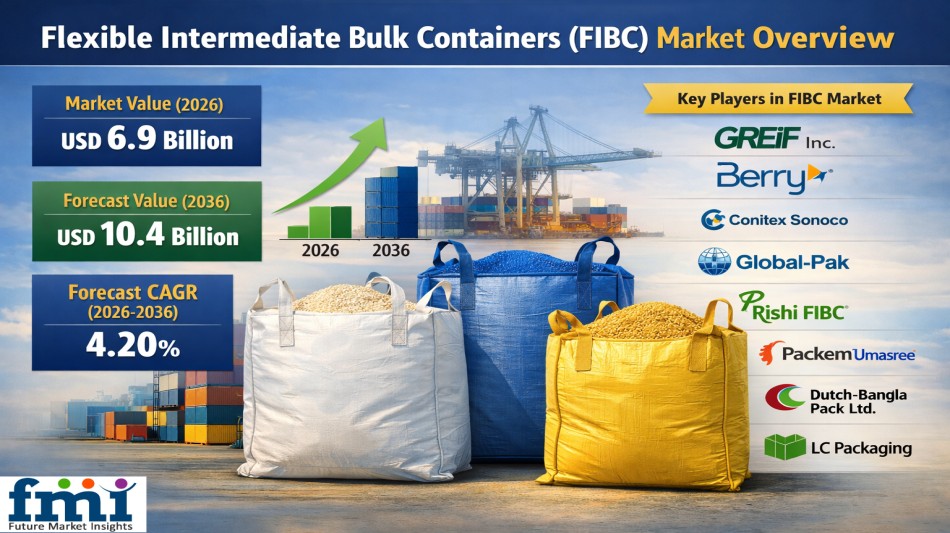
NEWARK, DELAWARE / ACCESS Newswire / February 25, 2026 / The global Flexible Intermediate Bulk Containers (FIBC) market is entering a new phase of performance-driven expansion as industrial supply chains increasingly prioritize safety, sustainability, and cost optimization in bulk packaging. Valued at USD 6.6 billion in 2025, the market is estimated to reach USD 6.9 billion in 2026 and is projected to climb to USD 10.4 billion by 2036, expanding at a compound annual growth rate (CAGR) of 4.20%.
This steady growth reflects the intensification of global trade in hazardous, food-grade, and high-volume commodities, where standardized containment solutions are critical for ensuring operational efficiency, regulatory compliance, and risk mitigation. As global logistics networks become more complex, FIBCs commonly known as bulk bags or jumbo bags are evolving from simple transport tools into highly engineered packaging systems designed for performance, safety, and lifecycle optimization.
Flexible Intermediate Bulk Containers (FIBC) Market Size, Market Metrics at a Glance
Metric |
Value |
|---|---|
Market Value (2026) |
USD 6.9 Billion |
Projected Value (2036) |
USD 10.4 Billion |
CAGR (2026-2036) |
4.20% |
Leading Region |
Asia Pacific |
Top Growth Market |
India (5.8% CAGR) |
Discover Growth Opportunities in the Market - Get Your Sample Report Now: https://www.futuremarketinsights.com/reports/sample/rep-gb-14500
The Materiality Shift: From Commodity Packaging to Circular Value Chains
The FIBC industry is undergoing a structural transformation as manufacturers pivot from conventional polypropylene-based products toward high-performance, sustainable materials and lifecycle services. While polypropylene continues to dominate, accounting for nearly 78% of volume share, the integration of recycled polypropylene (rPP) and recycled polyethylene terephthalate (rPET) is reshaping production strategies.
The Materiality Shift: From Commodity Packaging to Circular Value Chains
The FIBC industry is undergoing a structural transformation as manufacturers pivot from conventional polypropylene-based products toward high-performance, sustainable materials and lifecycle services. While polypropylene continues to dominate, accounting for nearly 78% of volume share, the integration of recycled polypropylene (rPP) and recycled polyethylene terephthalate (rPET) is reshaping production strategies.
A key driver of this shift is the volatility of virgin polymer pricing and the growing regulatory push toward recycled content. Manufacturers are increasingly investing in closed-loop recycling systems, converting post-consumer and industrial waste into high-performance bulk packaging. This transition is enabling producers to stabilize input costs while meeting sustainability targets set by governments and multinational corporations.
The rise of "bottle-to-bag" recycling technologies exemplifies this transformation. By converting PET waste into durable woven fabrics, manufacturers are unlocking new premium segments while reducing reliance on virgin plastics. This shift is not only regulatory-driven but also increasingly demanded by global buyers seeking to reduce Scope 3 emissions and improve supply chain transparency.
Safety and Compliance: The New Competitive Benchmark
Regulatory pressure is emerging as a defining force in the FIBC market. The transportation of hazardous and combustible materials requires strict adherence to safety standards, particularly concerning electrostatic discharge and contamination control.
Improper bulk stowage can have catastrophic consequences. Industry experts highlight that mixing incompatible chemicals during transport can lead to chemical reactions, fires, and total cargo loss, underscoring the importance of certified packaging solutions. As a result, demand for Type C and Type D FIBCs designed to dissipate static electricity is accelerating, particularly in chemical, petrochemical, and pharmaceutical applications.
Manufacturers are responding by investing in advanced antistatic materials, rigorous testing infrastructure, and UN certification, which are increasingly becoming prerequisites for participation in high-value supply chains. Compliance is no longer optional it is a key differentiator that determines access to premium contracts and long-term partnerships.
Lifecycle Services: From Product Sales to Value-Based Models
The FIBC market is shifting beyond traditional product-centric models toward service-based ecosystems. Leading players are integrating lifecycle services such as collection, cleaning, reconditioning, and reuse, creating new revenue streams while enhancing sustainability credentials.
For example, in September 2025, a leading industrial packaging company reported the reconditioning or recycling of over 4.5 million containers, signaling a significant shift in buyer preference toward circular packaging solutions. These services allow customers to reduce waste, lower procurement costs, and ensure compliance with environmental regulations.
Digital tools are further enhancing lifecycle management. The integration of RFID tags and QR codes into bulk bags enables real-time tracking, improving inventory visibility and facilitating efficient reverse logistics. This digital transformation is strengthening customer relationships and creating barriers to entry for non-integrated competitors.
Segment Spotlight: Safety, Materials, and End-Use Expansion
Product Type: Safety-Driven Innovation
Type A FIBCs dominate the market, accounting for 44% of total share in 2026, primarily used for non-hazardous materials. However, the market is witnessing a rapid shift toward Type B, Type C, and Type D bags, driven by stricter safety regulations.
Type B bags are gaining traction for applications requiring protection against brush discharges.
Type C bags are essential for grounded operations in flammable environments.
Type D bags represent the fastest-growing segment, offering static dissipation without grounding, reducing operational risks.
Material: Circularity Takes Center Stage
While polypropylene remains the dominant material, the adoption of recycled-content fabrics is accelerating. The use of polyethylene liners is also expanding, providing enhanced barrier properties for moisture-sensitive goods.
Metallic laminates are gaining traction in high-value chemical applications, offering superior protection against light and oxygen exposure. These innovations are enabling FIBCs to compete with rigid containers in performance-sensitive applications.
End Use: Chemicals Lead, Agriculture Accelerates
The chemicals segment accounts for 30% of market share, driven by the global movement of polymers, fertilizers, and specialty chemicals. This segment serves as the primary testing ground for high-integrity packaging solutions.
Food & Pharmaceuticals demand is rising due to stringent hygiene standards and cleanroom manufacturing requirements.
Agriculture is witnessing increased adoption of FIBCs due to cost advantages and improved logistics efficiency.
Construction continues to drive volume growth, particularly in emerging economies with expanding infrastructure projects.
Regional Powerhouses: Asia Pacific Leads Global Expansion
While the FIBC market is global in nature, growth trajectories vary significantly by region, reflecting differences in industrial output, regulatory frameworks, and export intensity.
Market Growth by Country (2026-2036)
Country |
CAGR (%) |
|---|---|
India |
5.8% |
China |
5.2% |
Canada |
4.8% |
Turkey |
4.5% |
Japan |
4.3% |
United States |
3.8% |
Germany |
3.5% |
Dynamics of the Decade: Circularity, Digitalization, and Specialization
Looking ahead to 2036, several transformative trends are expected to redefine the FIBC market:
Circular Economy Integration: Increasing adoption of recycled materials and closed-loop systems.
Digital Tracking Solutions: Smart FIBCs with embedded tracking technologies to enhance supply chain visibility.
Specialized Hazardous Packaging: Rising demand for UN-certified bags for chemical and waste transport.
Regulatory Intensification: Stricter safety and environmental standards shaping product design and procurement.
These trends are collectively driving a shift toward high-value, performance-oriented packaging solutions, where differentiation is based on safety, sustainability, and service integration.
Competitive Landscape: From Commodity Suppliers to Strategic Partners
The FIBC market is witnessing a clear bifurcation between volume-driven commodity manufacturers and value-driven sustainability partners. Leading companies are focusing on vertical integration, securing access to recycled feedstock, and developing advanced materials to maintain competitive advantage.
Service-based models are becoming a key differentiator. Companies that offer end-to-end lifecycle management, including collection, reconditioning, and recycling, are gaining a competitive edge by delivering measurable value beyond the product itself.
Regulatory compliance continues to act as a barrier to entry, favoring companies with certification capabilities, advanced testing infrastructure, and global logistics networks. As safety and sustainability requirements intensify, the market is expected to consolidate around players capable of meeting these complex demands.
Key Players in the Flexible Intermediate Bulk Containers (FIBC) Market
Prominent players operating in the global FIBC market include:
Greif Inc.
Berry Global
Conitex Sonoco
Global-Pak
Rishi FIBC
Packem Umasree
Dutch-Bangla Pack Ltd
LC Packaging
Flexible Packaging Solutions (FPS)
Ameriglobe LLC
For an in-depth analysis of evolving formulation trends and to access the complete strategic outlook for the Flexible Intermediate Bulk Containers (FIBC) Market through 2036, visit the official report page at: https://www.futuremarketinsights.com/reports/fibc-market
Related Reports:
Flexible Plastic Packaging Market - https://www.futuremarketinsights.com/reports/flexible-plastic-packaging-market
Flexible Containers Market - https://www.futuremarketinsights.com/reports/flexible-containers-market
Bulk Bag Market - https://www.futuremarketinsights.com/reports/bulk-bags-market
Intermediate Bulk Container (IBC) Market - https://www.futuremarketinsights.com/reports/intermediate-bulk-container-market
Intermediate Bulk Container Industry Analysis in Japan - https://www.futuremarketinsights.com/reports/intermediate-bulk-container-industry-analysis-in-japan
About Future Market Insights (FMI)
Future Market Insights (FMI) is a leading provider of market intelligence and consulting services, serving clients in over 150 countries. Headquartered in Delaware, USA, with a global delivery center in India and offices in the UK and UAE, FMI delivers actionable insights to businesses across industries including automotive, technology, consumer products, manufacturing, energy, and chemicals.
An ESOMAR-certified research organization, FMI provides custom and syndicated market reports and consulting services, supporting both Fortune 1,000 companies and SMEs. Its team of 300+ experienced analysts ensures credible, data-driven insights to help clients navigate global markets and identify growth opportunities.
For Press & Corporate Inquiries
Rahul Singh
AVP - Marketing and Growth Strategy
Future Market Insights, Inc.
+91 8600020075
For Sales - sales@futuremarketinsights.com
For Media - Rahul.singh@futuremarketinsights.com
For web - https://www.futuremarketinsights.com/
SOURCE: Future Market Insights, Inc.
View the original press release on ACCESS Newswire